Life can be viewed as a spontaneous scene in a film because everything that happens in it is not premeditated and certainly does not happen by choice.
By Kennedy Nyavaya

It is characterised by unanswered questions like who decides one’s gender from the womb, why people do not have the choice to select their parents or even the time they are born.
Uncertainty is the general order of existence etched to linger right through to the demise of humanity.
An emotionally-charged play titled Finding Temeraire which was written by New Zealand-based playwright Stanley Makuwe and directed by award-winning filmmaker Agnieszka Piotrowska invokes the questions which only the celestial can respond to.
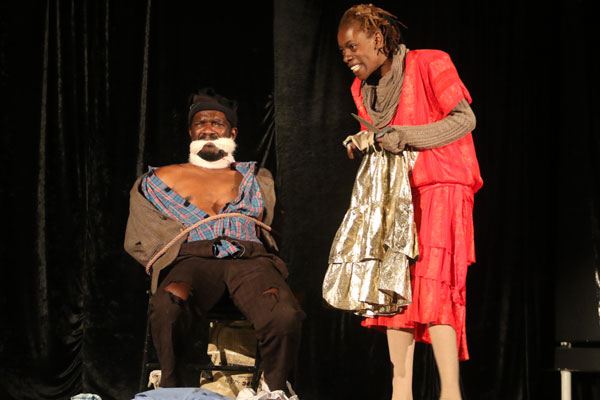
The hour-long visual story showcased at Harare’s Theatre in the Park last week presented by a two-piece cast of veteran actress Charmaine Mujeri and Eddie Sandifolo is a succinct depiction of how society gives women fewer choices.
When Temeraire, played by Sandifolo, meets his long-forgotten jilted lover Primrose (Mujeri) who has just been released from prison for murdering the child that resulted from the pair’s relationship, a mixed bag of love-hate memories is rekindled.
Although the two reunite in the end, promiscuous Temeraire who has lost his posh lifestyle is taken down memory lane the hard way as Primrose seeks to inflict the same pain she felt through the pregnancy, birth and subsequent murder of the child that led to her 25-year stay in prison.
- Chamisa under fire over US$120K donation
- Mavhunga puts DeMbare into Chibuku quarterfinals
- Pension funds bet on Cabora Bassa oilfields
- Councils defy govt fire tender directive
Keep Reading
Faced with an uninspiring reality, the female character questions the existence and ability of God to twist the fortunes of the feminine species, which she feels is exposed to unfair realities in life.
Zimbabwean society is largely Christian and believes it impossible to question the Creator but according to Eunice Tava, the play’s co-director, the script is crafted in a way that seeks to paint the real grave picture.
“This is a very serious topical issue that we are dealing with, murder, emotion and all these other issues, so the director was happy with the outcome,” Tava said.
In the story, not only does the female protagonist wade into the supernatural, she also puts male chauvinism on the spotlight as reckless men who ditch responsibility, such as Temeraire, are hardly punished.
Meanwhile, the play set in both the pre and post-colonial era, has subtle racial connotations as it seeks to decry white supremacy.
“It clearly speaks strongly against white rule and the racial divide and whites kicking blacks down mining shafts? It’s all there in the script,” said Makuwe from his foreign base.