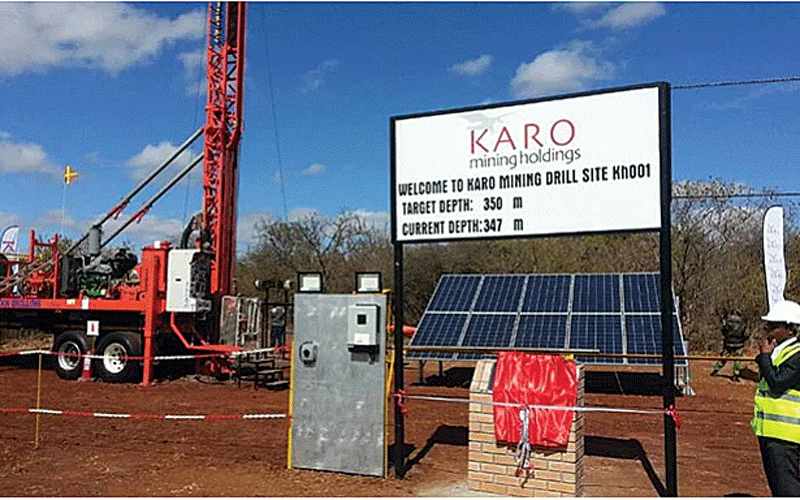
PLATINUM group of metals (PGM) miner, Karo Mining Holdings expects to mill its first ore in June 2027 at its Karo Platinum Project (KPP) in Selous, with total capex to that point budgeted at US$499 million.
The KPP covers an area of 23 903 hectares within the Great Dyke in Mashonaland West, approximately 80 kilometres southwest of Harare and 35km southeast of Chegutu.
The Great Dyke is a PGM-bearing geological feature that runs north to south, which is approximately 550km in length and up to 11km wide, and is second to the Bushveld Complex of South Africa in terms of its PGM resource base.
The project is in the southern portion of the middle chamber of the Great Dyke and is supported by good infrastructure, including road and power access in the project area.
“Karo Platinum is entitled to mine PGMs situated within the licence area as per the Mining lease terms, Karo Platinum is responsible for the mine development and mining operations and will build, own and operate the concentrators and smelters, as well as base metal and PGM refinery,” Karo said in a statement attached to its financial statement for its financial year ended September 30, 2025.
“The Karo Platinum project construction commenced on 7 December 2022, which has steadily progressed and still on going as at reporting date.
“First ore in the mill (FOIM) is planned for approximately 15 months after financial close, which is currently estimated to occur in June 2027 and the capital and working capital cost to FOIM is budgeted at US$499 million.”
The group continued to be funded during the year under review by its parent company, the Cyprus-based integrated resources group, Tharisa Plc (Tharisa), by preference shares, which, due to the nature and terms of the instruments, are classified as debt.
- News in depth: Chinese scramble for Zim’s chrome leaves communal lands scarred
- Pushback over Chinese lithium push
- News in depth: Chinese scramble for Zim’s chrome leaves communal lands scarred
- Pushback over Chinese lithium push
Keep Reading
“As at 30 September 2025 the construction process, that commenced in December 2022, was still ongoing with a total project funding requirement of US$499 million,” Karo said.
“Prices, which declined in 2024 and in turn slowed construction, improved by 45% in 2025 to a spot basket price of US$1 882,74/6Eoz (2024:US$1 302,54/6Eoz).
“This has improved the estimated fundability and debt capacity of the project. During the year, Karo Platinum was utilising the US$150 million facility availed by KMH, of which USD$133 million had been utilised and US$17 million is to flow in FY2026 which will enable the company to meet its obligations as they fall due over the next 12 months.”
Karo said Tharisa would provide additional funding of US$20 million through a commodity-linked notes debt facility from Arxo Finance, available as of December 2025.
“The terms of the facility are expected to be ratified and extended. In addition, work on securing debt funding amounting to US$175,8 million is ongoing, with financial close targeted for 2026,” the company said.
“Tharisa Plc has committed to continue to fund the company and to provide parent company guarantees for Karo Platinum's debt.
“The parent is in discussions with strategic equity investor that is expected to be concluded in 2026.
“The directors have and will continue to review the spending, investment and commitments in the project; and have prepared scenarios to match the project commitments and funding availability should it be required to maintain available funds for the foreseeable future.”
Karo said the group had been able to settle its obligations as they fell due without significant challenges, with the board satisfied that the firm will continue to operate for the foreseeable future.
Tharisa is a significant player in the global chrome industry, supplying some 10% of China and Indonesia's annual demand.
The company is also prominent in the specialty chrome market, with roughly 15% of the average annual chrome output delivered into these markets.
In its results released in a month ago, Tharisa, which is based in South Africa, revealed that it paid a 33% lower dividend to 3 US cents (4.5 US cents) in the year to September 30, after production fell, but headline earnings improved marginally.
Reef mined increased 17.4% to 5.4Mt from 4.6Mt. PGM production fell by 4.7% to 138.3koz (thousand ounces) from 145.1koz in the previous year. Chrome concentrate production fell 8.2% to 1.56Mt compared with 1.7Mt in the previous year.
The share price nudged up 0.7% to R21.65 on the JSE Monday afternoon - a year before the share price traded at R16.40.
Revenue declined by 16.4% to $602.9 million. Operating profit was up 5% to $125.6m from $119.6m in the previous year.
Earnings before interest tax depreciation and amortisation was up 5.5% to $187.3m. Headline earnings a share fell 2.1% to 27.5 US cents from 28.1 US cents.