
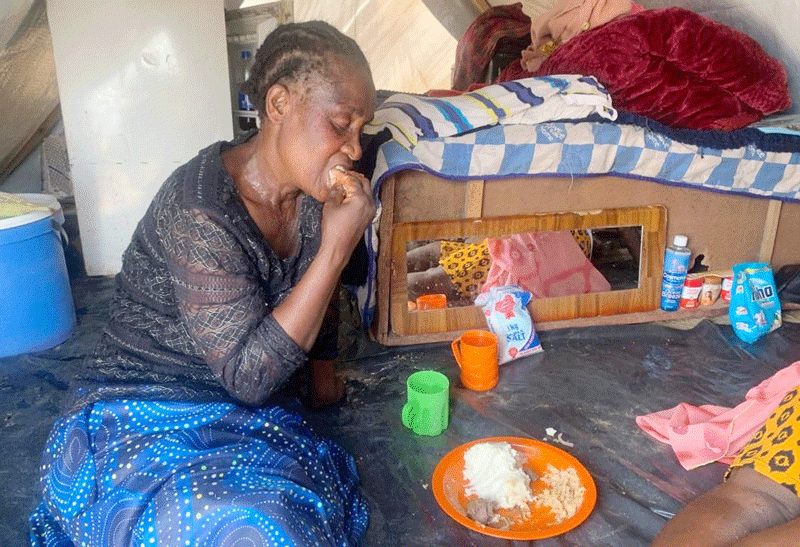
Children from families evicted at Willdale farm in Zvimba, Mashonaland West and are staring at an uncertain future, with many at risk of dropping out of school after failing to secure places at nearby learning institutions.
The families were removed from the Mt Hampden farm they called home in November last year, and initially dumped the open along the Harare–Chirundu highway in the middle of the rainy season without food, water or any form of shelter.
They were later relocated to a makeshift camp Nyabira.
Now cramped into tents measuring about four by six metres, parents are forced to share the small space with their teenage and adult children, a living arrangement that has disrupted family life in deeply personal ways
As the new school term approaches, the disruption has left hundreds of pupils idle and vulnerable, raising fears that prolonged exclusion from education could expose them to drugs, substance abuse and other social ills, further deepening the cycle of poverty and marginalisation facing the displaced families.
The Standard crew visited the Nyabira site now guarded by Zanu PF youths and spoke to parents who outlined a range of challenges, painting a gloomy picture of the future facing their children.
A mother of four, Maudi Mutyambizi, said Zanu PF local leadership has remained silent on where their children will attend school.
“Since the Zanu PF local leadership has become the gatekeeper of who comes in and out of the site, supposedly to manage the flow of information, they are not saying anything about the assistance we will receive for our schoolchildren,” said Mutyambizi.
- Brito bristles at Baobab swamp
- Kamambo’s board is the best: Sibanda
- Corruption Watch: Get scared, 2023 is coming
- Mugabe burial saga in bizarre twist
Keep Reading
She added that most families cannot afford the fees being charged by government schools in the area.
“We cannot afford the fees being demanded by Nyabira Government Primary School and the additional requirements,” she complained.
Another victim of the evictions, Munashe Chitambo, said authorities who have visited the site since their relocation last month have failed to address the issue of schooling.
“The minister of State for Provincial Affairs and Devolution, Amai Mnangagwa, Unicef officials and representatives from various government departments came here, but not even one of them spoke about how our children will be accommodated at local government schools,” Chitambo said.
A young mother, Tendayi Murape, whose child is supposed to start Grade One, said education was critical, but her child lacks a birth certificate after important documents were lost during the evictions at Willdale Farm.
“We need help for our Grade One children to start school,” lamented Murape, appealing to the Registrar-General’s office to conduct mobile registrations at the site.
“Most of us lost our documents when we were forcibly evicted.
“Court messengers threw our belongings around and it was raining.
“We lost birth certificates and identity documents.”
A bursar at Nyabira Primary School, who declined to be named, disclosed that admission requirements included US$50 in school fees and levies, two bags of cement, US$10 for sports attire, a transfer letter from the previous school, US$5 for a report book payable upfront, and a rim of bond paper.
Nyabira has only one government primary school and one secondary school, alongside several private institutions that are beyond the reach of most evicted families.
Private schools in the area include New Dawn, Aunt Bee and Best Junior Schools, Northwest College and Destiny Learning Centre.
The Zanu PF councillor for the area, Clive Phiri, who was uncomfortable speaking to the media, said the issue of schooling has not yet been discussed at leadership level and that families are currently making individual arrangements.
“So far, nothing concrete has been agreed upon. People are making individual arrangements for their children at nearby schools,” Phiri said.
Mashonaland West provincial education director Edson Chauke confirmed that the Ministry of Primary and Secondary Education has not yet intervened beyond compiling a list of affected children.
“We compiled a list of children in need through our Zvimba district school inspector, but we are yet to brief the permanent secretary on the way forward,” Chauke said.
“We just received a letter from social welfare indicating that they are going to help some few children with schooling at their Kadoma children’s home but they are still to come with a figure.”
Pressed further, Chauke said he could not immediately disclose the number of affected learners.
“I do not have the total number at the moment. I will check with the district schools inspector,” he said.
However, Primary and Secondary Education spokesperson Taungana Ndoro said children at the Nyabira site can be absorbed by nearby schools, noting that the main challenge related to teachers from the Mt Hampden schools where the children were previously enrolled.
“The children will be accommodated at nearby schools around Nyabira. “The issue is that of surplus teachers from the schools where the learners came from,” said Ndoro.
Under Zimbabwean law, the right to education is protected by Section 75 of the constitution, which obliges the State to take reasonable measures to ensure that every child has access to basic education.
The constitution further provides that a child’s best interests are paramount in every matter concerning the child.
Zimbabwe is also a signatory to regional and international instruments, including the African Charter on the Rights and Welfare of the Child and the UN Convention on the Rights of the Child, both of which place an obligation on governments to ensure continuity of education for children affected by displacement, evictions or emergencies.
In previous court rulings, Zimbabwean courts have emphasised that lawful evictions must be carried out humanely, with due regard to the welfare of affected families, particularly children, and that alternative arrangements should be made to prevent violations of basic rights.
Government policy under the Education Act empowers the Ministry of Primary and Secondary Education to facilitate the placement of learners who are displaced by circumstances beyond their control, while the Registrar-General’s office is mandated to provide late birth registration and replacement of lost civil documents, especially for school-going children.
Advocacy groups argue that without a coordinated policy response, displaced children risk falling through institutional gaps, undermining government commitments to inclusive education and social protection.
The education crisis is expected to persist, as government officials have indicated that families at the Nyabira site will have to relocate again after three months while authorities search for a permanent settlement for more than 4 000 displaced people currently housed at the temporary camp.
The eviction of settlers from Willdale Farm is reportedly meant to pave the way for the development of the Zim Cyber City project, a multi-million-dollar initiative.
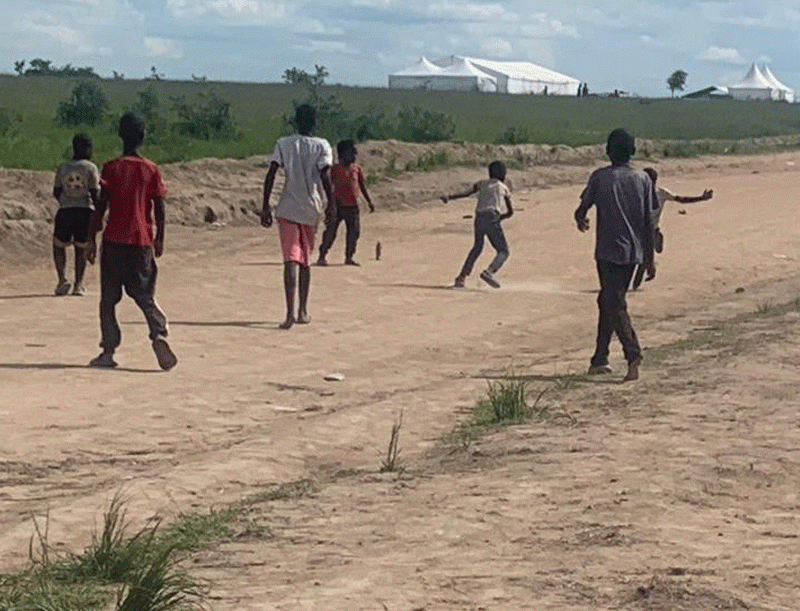
However, the lack of clear communication from authorities has left many families anxious about their future.
The Nyabira evictions added to a growing list of forced displacements across the country, a trend that has drawn sharp criticism from human rights organisations who argue that arbitrary evictions continue to undermine the dignity and livelihoods of vulnerable communities.


