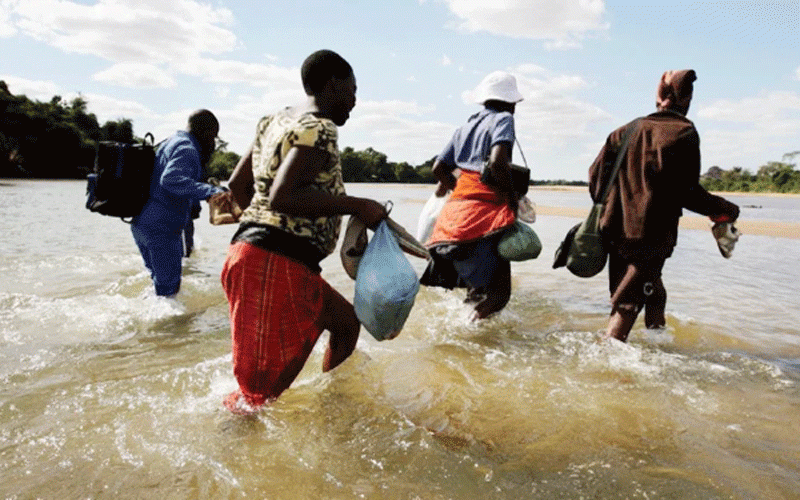
Admire Chideme (42) sits on the banks of flooding Limpopo River constantly peeping to the other side where the South African soldiers are patrolling using two speed boats.
Chideme, who stays in South Africa illegally and had come for holidays, equates his journey to Zimbabwe to the annual wildebeest pilgrimage in Serengeti National Park in Tanzania.
The annual migration of over 1,2 million wildebeest across the Serengeti-Mara ecosystem, remains one of planet Earth’s most spectacular natural events.
The crossings of the Grumeti and Mara Rivers, typically occurring between May and August, represent the migration’s most dramatic and lethal chapter.
Here, danger converges from all sides.
Massive Nile crocodiles, some weighing over a tonne, lie in ambush.
Swift currents and treacherous, steep banks lead to mass drownings and fatal injuries.
On land, predators stalk the banks, targeting exhausted survivors.
- Zim headed for a political dead heat in 2023
- Record breaker Mpofu revisits difficult upbringing
- Tendo Electronics eyes Africa after TelOne deal
- Record breaker Mpofu revisits difficult upbringing
Keep Reading
“We are like the wildebeest of Serengeti, we don’t know what awaits on the other side, that is if we manage to cross Limpopo successfully,” Chideme said.
The waters of the Limpopo River, a murky natural border between Zimbabwe and South Africa, conceal both deadly crocodiles and the desperate hopes of hundreds crossing illegally.
Like Chideme, many are not first-time border jumpers, but individuals who live and work illegally in South Africa and are returning from risky holiday visits to their families back home, only to face a fortified and sometimes violent reception from South African security forces.
Away from official Beitbridge Border Post, one of Africa's busiest transit points, a different, more perilous migration unfolds daily.
The South African National Defence Force (SANDF), bolstered by a government mandate to secure porous borders, has intensified Operation Corona.
Recent operations have led to mass apprehensions.
During the December 2025 festive period alone, soldiers intercepted over 1 100 undocumented Zimbabweans in a single operation.
The newly established Border Management Authority (BMA) reports arresting approximately 8 000 people for illegal entry attempts in December.
The journey is notoriously dangerous.
Crossers, often guided by smugglers known as “goma-gomas”, must navigate the crocodile-infested river, evade armed patrols, and scramble through or over a compromised border fence.
“People don't bother us because we work here every day. The soldiers know who we are so when they see us passing, they let us go,” said Fadzai, a 43-year-old woman, who regularly crosses to work as a “runner”, carrying goods.
However, the military’s posture has grown more confrontational.
Authorities commend their soldiers for “restraint and professionalism”, but the pressure to deter migration has led to documented clashes.
In one incident in December, a soldier was stabbed in the forearm during an apprehension.
Members of SANDF were reportedly stoned by Zimbabweans who wanted to enter the country illegally on the Beitbridge border last week.
The soldiers were trying to retrieve a SANDF boat that had floated towards the Zimbabwean side of the Limpopo River, but they were stoned and insults were hurled at them.
It is alleged that those who attacked the soldiers accused them of disturbing their plans to enter South Africa illegally.
The soldiers reportedly did not retaliate.
Sipho Chauke, the chief border guard at Beitbridge, told a South African television channel that illegal crossing into South Africa was problematic for the BMA.
“If we can be given powers of arresting because normally with the Zimbabweans, we take them back to Zimbabwe and when they arrive in Zimbabwe it seems as if they are not being dealt with,” Chauke said.
“Sometimes we find ourselves deporting one person four of five times a day.”
South African President Cyril Ramaphosa's administration has made faster deportations a priority, reporting over 51 000 removals in the past financial year.
Yet the cycle persists.
Border commanders acknowledge the frustration of apprehending and deporting the same individuals multiple times in a
With Zimbabwe’s economy continuing to struggle, the relative opportunity in South Africa remains a powerful lure, compelling people to repeatedly risk the dangerous river crossing.
The Limpopo River, in its seasonal flow, thus tells a cyclical story of desperation and enforcement.
While the South African state deploys more boats, drones, and soldiers to hold the line, the pull of family and livelihood ensures a steady flow of people back across the river.