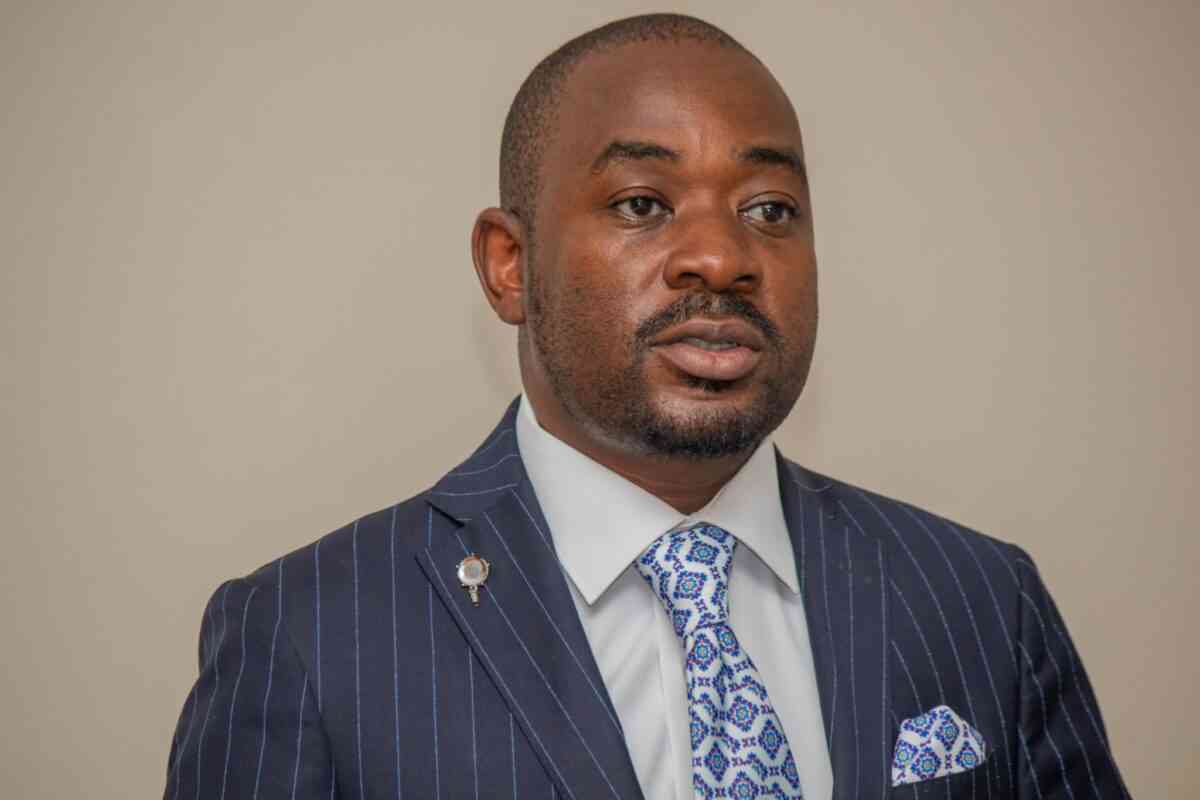
Opposition leader Nelson Chamisa's announcement that he is making a political comeback has caused some excitement in a country where opposition politics is considered to be on its deathbed.
In January 2024, Chamisa abruptly left the Citizens Coalition for Change (CCC) party that he and others had formed in 2022.
His main gripe was what he called “infiltration” by the ruling Zanu PF.
This followed the emergence of a suspected Zanu PF proxy, Sengezo Tshabangu, who proclaimed himself the secretary-general of the party and started recalling the opposition’s elected representatives hardly months after the 2023 elections.
The opposition leader said he would not “swim in a river with hungry crocodiles,” referring to CCC members he accused of being sell-outs working for the ruling party.
On Friday, Chamisa unveiled his “Agenda 2026” political plan, which he described as a movement to unseat President Emmerson Mnangagwa’s government.
He said the new movement will focus on building a new national consensus, reclaiming citizen agency and leadership, preparing for a future citizens’ government, driving a “moral revolution,” and re-engaging the international community.
He said grassroots mobilisation activities will be activated soon, adding that the new movement is not a political party.
- Young vocalist making southern Africa dance
- Business opinion: Branding in the age of entrepreneurship and industrialisation (Part 6)
- Business opinion: Branding in the age of entrepreneurship and industrialisation (Part 6)
- Plot to block Chamisa thickens
Keep Reading
Pashor Raphael Sibanda, who defeated Finance minister Mthuli Ncube in the race for the Cowdray Park seat in the 2023 elections only to be recalled by Tshabangu, said politicians had failed to fill the vacuum left by Chamisa during his sabbatical.
"For nearly two years, president Chamisa was not on the political stage. In that time, no one managed to command the people’s confidence,” Sibanda said.
“The so-called alternatives proved hollow and directionless. His return, with clarity and mass support, settles the matter:
“President Chamisa remains the political centre of Zimbabwe’s democratic alternative. His absence exposed a vacuum, his return restores real opposition power and legitimacy.”
Chamisa's followers on various media platforms reacted to the unexpected political development with excitement.
Some followers said he offered hope to millions of ordinary Zimbabweans exasperated by Mnangagwa’s rule.
"This is very beautiful and touching. The words in themselves provide healing to the land before we even lift a finger to act," one user, Noah Mpofu, commented on Chamisa's X account.
Another X user, Mthandazo Ndlovu, commented: "The main task is to convince the majority of the opposition citizens that this is an inclusive, people-driven movement that is here to address our biggest problem, Zanu PF, not just another dictatorship stokvel.
“The people are tired of the political games which affect them."
Another use said: "Interesting ideologies. Zimbabweans needed this boldness."
Other X users said they were ready to rally behind Chamisa if he provided clarity on the future and direction of his movement.
"We are ready to participate and contribute to meaningful efforts to bring about change in our country, Sir, but we must agree on key fundamentals, especially where internal organisational democracy is concerned," one user, M-Jay, commented.
"Hopefully the culture of ‘form your own party’ is behind us."
Other supporters offered cautious support while demanding accountability.
"I think first we must be accountable and accept where you messed up before we talk about anything," said one user, Gutsa Ruzhinji.
Another X user said: "This is my problem with you, and you have not changed. Why are you always avoiding mentioning Mnangagwa by name? If you ever do, you call him 'my brother.'
"Even saying 'Zanu PF' seems difficult for you, yet they are the source of our problem. See why people say you are one of them."
X user Eke-a-Rebel added: "Sorry, young man, but you're not what Africa needs right now. Africa needs soldiers who are willing to die for the things they say.
"You have never been persecuted by Zanu PF for some strange reason, but everyone around you has had their lives ruined for being around you. No thanks."
This is not the first time Chamisa has led a new movement. In 2018, longtime opposition leader Morgan Tsvangirai, founding president of the Movement for Democratic Change (MDC), died.
Chamisa then claimed Tsvangirai had appointed him acting leader before passing away.
He proclaimed himself party leader at Tsvangirai’s burial, ran under the MDC banner in the 2018 presidential election, and came second to Mnangagwa.
However, the leadership battle spilled into court, which ruled that Chamisa’s leadership of the MDC was unconstitutional and that Thokozani Khupe, Tsvangirai’s deputy, was the rightful successor.
That led to Chamisa forming the CCC in 2022, with some of those who had broken away from the MDC joining him.
Mnangagwa has been accused of silencing the opposition by using a combination of coercion and financial muscle.
The dismantling of the opposition has been linked to Zanu PF plans to extend the 83 year-old ruler’s term by two years despite the constitution limiting presidents to two five year terms.
Mnangagwa’s loyalists want to use the weakened Parliament to circumvent the referendum required for any changes to the term limits. Reuben Mbofana, a political analyst, said Chamisa’s return would breathe new life into Zimbabwe’s politics.
“Nelson Chamisa’s return to active politics is, in principle, welcome. Zimbabwe desperately needs a strong, credible, and coherent opposition, especially after witnessing how an unaccountable ruling party can so easily run amok when there are no effective checks on its power,” Mbofana said.
“Any development that potentially strengthens democratic contestation should not be dismissed lightly.
“However, that welcome must be tempered with serious and unavoidable questions. Chamisa’s re-entry risks being merely cosmetic — or even ineffective — if it is not accompanied by a clearly defined, radically different strategy from the past.
“Zimbabweans still vividly remember his dramatic decision two years ago to step aside from opposition politics, citing infiltration and the hijacking of opposition structures. The key question now is: what has fundamentally changed since then?