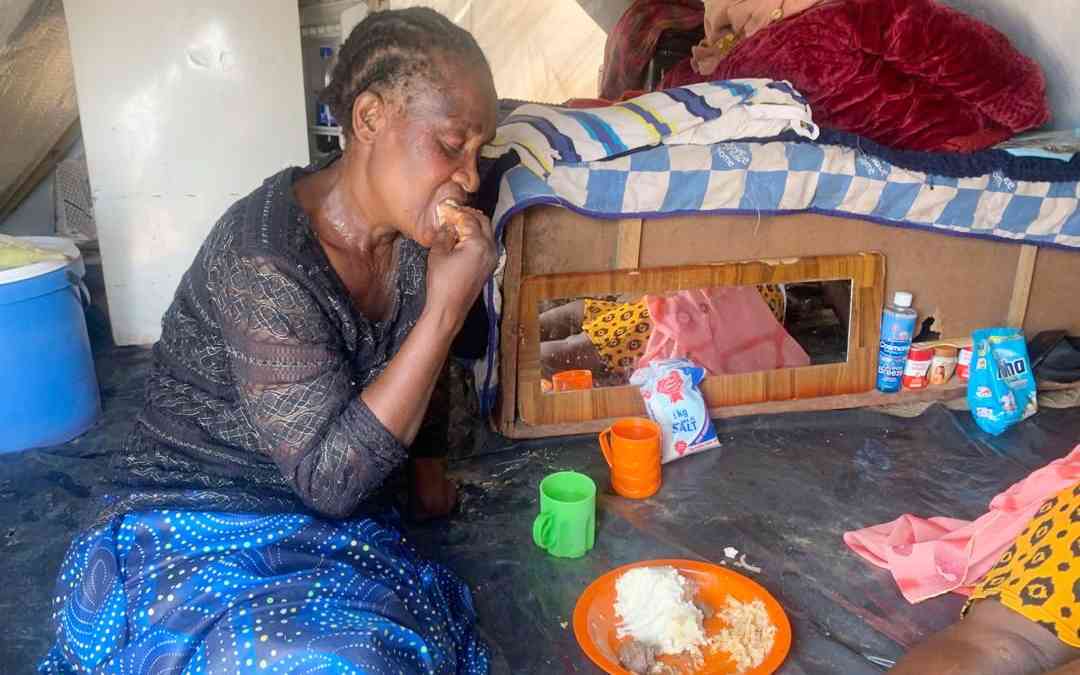
What was meant to be a temporary refuge has become a daily test of dignity for more than a thousand families evicted from Willdale Farm in Mt Hampden three months ago and relocated to a camp in Nyabira.
Cramped into tents measuring roughly four by six metres, parents are forced to share the limited space with their teenage and adult children, a living arrangement that has disrupted family life in deeply personal ways.
For many couples, the lack of privacy has effectively stripped them of their conjugal rights.
With no separate rooms or secure partitions, husbands and wives say they are unable to relate as couples without the constant presence of their children.
A married woman who asked to be identified only as Amandla described the situation as “unbearable.”
“We no longer enjoy a normal married life because our children are always there,” she said.
“There is simply no privacy. We are all sleeping in one small tent,” she added.
Other residents echoed her concerns, saying the conditions have forced couples to seek privacy at inappropriate and sometimes unsafe times or places.
- Free media environment key developmental reportage says PemSec Mangwana
- CAPS United rob Wha Wha
- CAPS Utd salvage point in four-goal thriller
- MAKEPEKEPE WIN AT LAST
Keep Reading
Some said they wait until children are outside playing during the day, while others reluctantly leave the camp at night in search of seclusion a practice they say exposes families to danger and undermines parental responsibility.
Jonathan Gwerume, another evictee, said the setup has turned family life upside down.
“We now do things at odd times and places, not because we want to, but because the living set-up leaves us with no choice,” he said.
“Sharing a tent with grown-up children makes it impossible to live as a normal family.”
Beyond the personal strain, residents worry about the broader social impact, particularly on children growing up in an environment with no clear boundaries between adult and child spaces.
Parents say the situation risks exposing young people to matters they are not emotionally prepared to process.
Human rights advocates argue that adequate shelter is not just about protection from the elements, but also about preserving dignity, privacy and family life.
Women Coalition of Zimbabwe lawyer Seppy Ndlovu said such living arrangements risk exposing children to adult activities that may negatively affect their development.
“Lack of privacy at such camps can expose children, especially the girl child, to early sexual debut that can ruin their adult life,” she said.
“Married couples need their space.”
Respina Machokoto, a sociologist, said prolonged congestion in camps can also strain relationships.
“Such living arrangements can give rise to infidelity due to lack of privacy and the proximity of living structures,” Machokoto said.
Families are calling on authorities to urgently provide proper and humane accommodation that allows parents and children to live with dignity and restores a sense of normal family life lost in the aftermath of their displacement.
Child welfare experts warned that growing up in overcrowded shelters without clear physical and emotional boundaries can have lasting consequences, particularly for the girl child, who may face heightened vulnerability to exploitation, peer pressure and early relationships.
They say the absence of safe, private spaces undermines parental guidance and weakens the protective environment children need during formative years.
At the same time, social analysts caution that sustained lack of privacy can erode trust and stability within marriages, increasing the risk of infidelity and family breakdown.
Without urgent intervention to improve living conditions, they warn, the camp’s congestion could deepen social fractures already created by displacement.