TTransitioning from the structural rigidity of civil engineering to the fluid world of visual storytelling, Tinashe Gakaka’s journey is a masterclass in creative pivots.
Trained at CSUST in China, Gakaka initially sought solace from grueling blueprints through a camera lens—a hobby that transformed into a career following a serendipitous beauty pageant gig and just 15 minutes of YouTube tutorials.
Today, as the founder of kREATE Business, he merges technical precision with artistic soul.
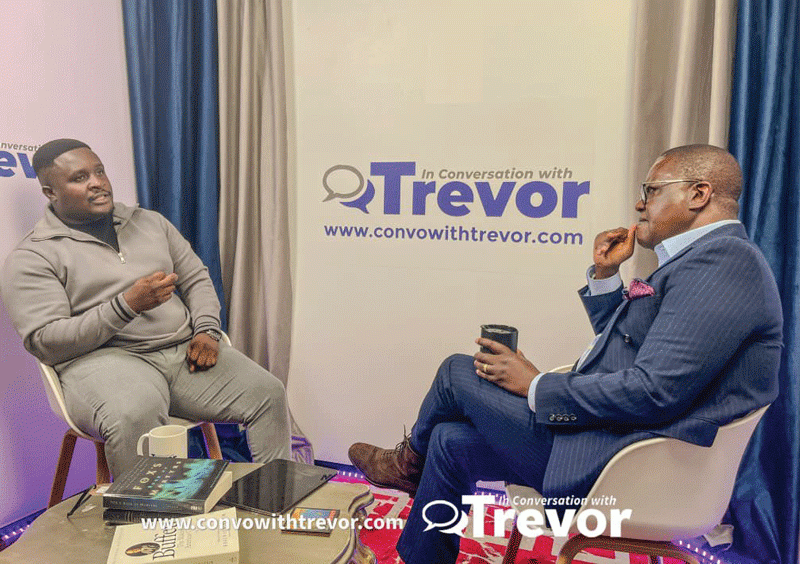
In this latest episode of In Conversation with Trevor hosted by Alpha Media Holdings chairman Trevor Ncube (TN) , Gakaka (TG) discusses "firing" micromanaging clients, treating brands like family, and choosing creative uncertainty over a stable engineering salary.
Below are excerpts from the interview.
TN: Greetings, and welcome to In Conversation with Trevor, brought to you by Heart and Soul Broadcasting Services.
Today, I’m in conversation with Tinashe Gakaka, photographer and founder of kREATE Business.
Now, you were trained as a civil and survey engineer, but you decided to walk away from that and pursue photography — something you were never formally trained to do.
- Masunda lands global sugar industry position
- In Conversation with Trevor: Chisamba: Let’s be proud of ourselves
- In Conversation with Trevor: ‘I tried to change Zanu PF from within’ – Margaret Dongo
- In Conversation with Trevor : How car crash changed my life
Keep Reading
I love these stories because they take courage. Why did you make that choice? Why did you leave engineering for photography?
TG: To be honest, the full story is a testimony in itself — that’s why I always bring it up. I started photography during university. I was at CSUST in China, studying civil engineering.
At some point, the math and the workload became overwhelming, so I needed a hobby to relax and breathe.
My girlfriend at the time, now my wife, encouraged me. I told her I was thinking about buying a camera, and she said, “I think that’s a great idea.”
So, I bought one, thinking I’d just take pictures of flowers and rocks — general hobby stuff.
Then, a friend of mine was running a beauty pageant for the university, kind of a modeling show.
The photographer they’d hired didn’t show up. My friend called me and said, “I know you bought a camera, come through.”
I told her, “I haven’t even unboxed it.” She said, “Just come and pretend like you know what you’re doing. We have 12 models, and they need pictures.”
I thought, What do I have to lose? So I went to my wife and said, “I’m doing this.” She said, “Just go for it.”
On my way there, I watched about 15 minutes of YouTube to figure out how to turn the camera on and which buttons did what. I got there, shot the 12 models, transferred the photos to my phone, and everyone was impressed.
From there, clients started coming in. We looked at each other and thought, this might actually be something.
TN: Trevor: You call that a testimony. Why? Did God speak to you? Did you have a revelation or is it just because of how it all unfolded?
TG: It’s more about how I threw myself into the deep end and how it worked out.
TN: You finished your engineering degree and even practiced for three to four years. Then you decided to walk away fully. That’s a big decision. Do you believe you can have two careers?
TG: Absolutely. I think we’re in a season where you can pursue two things at once as long as you don’t mix them up.
TN: Which one do you enjoy more?
TG: I enjoy photography more. But they both relate to the same thing: seeing something tangible that you’ve created.
In engineering, it’s seeing a building or structure go up. In photography, it’s seeing billboards or magazine covers. For me, it’s about creating things that are real and visible.
TN: So, you’ve been doing photography full-time for about three years, though you first picked up a camera 10 years ago next May. What have you put into this craft to reach the level where big brands trust you?
TG: Our focus is on telling the brand’s story and not just having the brand explain who they are. We look at brands from the outside and figure out how best to work with them.
TN: What’s your modus operandi?
TG: We believe quality and speed don’t usually go together. We also treat brands like family, not clients. When you treat someone as a client, you’re just taking from them. But when they’re family, you feed off each other.
TN: Suppose I come to you and say, “Here’s my brand. I want you to reimagine it.” How do you start?
TG: We’d sit you down and assess who Trevor is. Then we’d look at your relationship with your audience and who you’re trying to reach. From there, we’d examine your brand image and visuals. It all has to work as an ecosystem.
TN: No one taught you this?
TG: I had to learn. I’m still learning.
TN: Do clients ever push back on your creative direction? How much resistance can you take before you get fired?
TG: We ask for creative freedom to a certain extent.
If a client tells us exactly what to do, we’re just reflecting their ideas, not doing our job. With creative freedom, we can explore their brand from a fresh perspective. Most people fight for familiarity.
They’re comfortable in their bubble. But we have to dissolve everything and rebuild from the ground up with their signature still intact.
TN: Have you ever been fired by a brand?
TG: Actually, I’ve fired brands myself.
TN: Really? Why?
TG: Too many people calling shots, too many cooks. When there are too many micromanagers, we don’t feel creative. We’re just being directed. So, I said, “It’s best you work with people who suit your needs.” We walked away.
TN: What’s your creative process with such big clients?
TG: We place a personality on each brand. We don’t use the same approach for every client as each brand tells a different story.
We brainstorm, break things down, pitch our direction, and then find common ground with the client.
TN: Have you ever approached a brand you wanted to work with, rather than waiting for them to come to you?
TG: Not yet. All our work so far has come through referrals and from working with agencies like 10 Media. We do have two brands we’d like to approach.
TN: It’s clear you’ve always had a creative passion even during engineering. When did you first realize that?
TG: In high school. I was more of an art and design student. I actually dropped a subject in my final year to pick up art.
I’m grateful for my family : they’ve always been supportive. As long as I’m passionate, they back me.
Of course, it’s not always easy explaining to parents that you’re dropping math or engineering.
But once they see tangible results, they understand: “Oh, he’s not just a cameraman — he’s a photographer.”
TN: You left stable income and walked into uncertainty. What was that like?
TG: It was very challenging. You go from a steady salary to making personal decisions that affect your daily life. Building a brand and name for yourself takes time. You have to put yourself in uncomfortable situations and learn things on the spot.
TN: Why put yourself through that? Why not stay in engineering?
TG: I come from a family of entrepreneurs. Seeing them go through the process and eventually succeed pushed me. I knew I could do it too — even if it meant dropping the monthly salary.
TN: That couldn’t have been easy.
TG: It wasn’t. I remember my last day at the office — I was doubting myself. But I realised I have a gift, backed by God. It’s a calling. The way I feel when I create — the reaction from clients, brands, and people — that feeds me.
TN: Break that down for me.
TG: It’s about evoking feelings and emotions — raising self-esteem, making brands stand out. We help people experience more of themselves. They feel free. That’s what drives us.
TN: Have you ever had moments where you thought, “I should’ve stuck to engineering”?
TG: Yes. The industry has ups and downs, dry seasons, busy seasons. When you’re figuring things out, you shoot everything: birthdays, conferences, events. You ask yourself, “Is this sustainable?” You’re trying to fit pieces together without knowing what the picture looks like.
TN: Tell me about kCREATE Business and Gax Photography. What’s the difference?
TGtg: Gax Photography focuses on concept photography — high fashion, models. kCREATE Business is a creative warehouse — a full-turnkey experience. We offer photography, videography, cinematography, graphic design, copywriting, and social media management. You give us your brand, we place all our services on it, and we give it back — changed and better.