Tafadzwa Meki is redefining nation-building by focusing on the womb.
As a perinatal psychologist and founder of Salt Africa, Meki is breaking the silence surrounding maternal mental health in Zimbabwe — a field often dismissed or misunderstood.
Her advocacy is deeply personal, rooted in her own journey through the stigma of PCOS and the societal pressures placed on women.
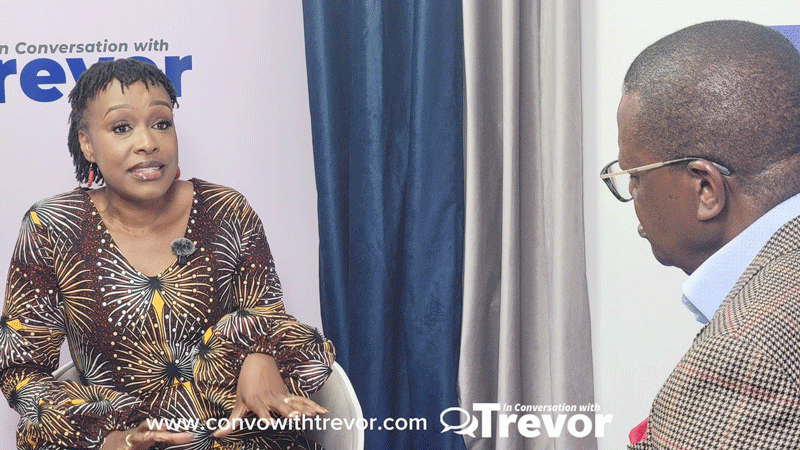
In this episode of In Conversation with Trevor hosted by Alpha Media Holdings chairman Trevor Ncube (TN), Meki (TM) discusses the "badges of honour" she carries from her struggles and her mission to provide "homegrown solutions" at public hospitals.
For Meki, helping women heal is not just work, it is a vital calling. Below are excerpts from the interview.
TN: Welcome to In Conversation with Trevor, brought to you by Heart and Soul Broadcasting Services.
I go beyond the headlines and beyond the sensation. Today, I'm in conversation with Tafadzwa Meki, a mental health expert and perinatal psychologist.
Your work touches on very rich threads - purpose, motherhood, loss at a very critical moment of life, mental health advocacy that allows you to influence policy formulation and systems change.
- Psychometric testing: Everything you need to know
- Power of language in nation building
- ‘Let’s toughen children living with disability’
- Mental colonisation is the biggest obstacle for african development
Keep Reading
But let's start where you say this is a calling for you, not work. Take me to the beginning, where you first hit this sense that this is what you want to do, and where that came from.
TM: I'll start off by first of all saying humble beginnings. I'm a farm girl from Zimbabwe, from the sugarcane fields- grew up in Triangle, very humble beginnings, small community. I guess that nurtures who you become.
So that feeling of family, regardless of colour, religion, background, or belief system, grows within you.
TN: When did you start getting the sense that helping women heal was a calling?
TM:Through the Young Christian Students movement, we'd go into communities, build walls, help women—there was a cyclone and we helped rebuild a woman's roof.
Fast-track to motherhood. I got married, and certain realisations came - like how we take for granted how to become a mother.
TN: They say every healer has their own wounds. What wounds are you dealing with? It appears to me there's a painful place there. Shall we go there?
TM: In touching the lives of the women I work with today, I heal myself because I know through my amazing team we are giving them the help that I got — that I know they have not been getting. Back to Tafadzwa: happily married, two years in, no baby.
The questions start coming — "When's the baby coming?" In our culture, you're called lazy, and it's always the woman.
Snide remarks like, "You don't need to come to work—you should be at home making a baby."
I had a great gynaecologist, together with my husband, we went for tests and they said I have PCOS (polycystic ovary syndrome). It was foreign territory to me. I thought I was special because I didn't get painful periods like other girls.
Looking back, young girls miss their periods and don't know what it is. They don't have space to have these conversations. But there is help, there is information. It’s nothing to be ashamed of. I'm a mother of three now.
TN: What did that season do to you, the snide remarks, the comments?
TM: Scars, yes, but not so much in pain. They're like badges of honour. I get my nails done, but I never get this one done because it's a reminder of where I've come from and the conquering that is in it.
Those remarks would sometimes make me cower and hide in a shell but I'm a very difficult person to put in a shell.
TN: Do you think you're difficult because you've had to fight to get out of the shell? What came first?
TM: I don't see the shell. It could be a temporary setback, but I snap up quickly and think, "We can't stay in this hole—let's work ourselves out."
TN: You built something that didn't exist. You chose a field that a lot of people don't understand and still dismiss. What resistance have you faced in starting to talk about perinatal mental health?
TM: The lack of knowledge. People ask, "What's perinatal mental health? Women get pregnant—it's nothing special. Babies die—you can make another one. You lose one twin—at least you have one."
Also, the lack of clarity about what problem we're addressing. A woman tries to fall pregnant—the first assumption is she's the one with the problem.
She falls pregnant, she starts leaking, and she's called all sorts of names. She gets hypertension in pregnancy and can't do what she used to — she's called lazy.
A twin pregnancy threatening to open—she has to be on bed rest—society calls her lazy. A woman in her forties, her golden chance—people ask, "Where were you all these years? Why not leave this to younger girls?"
TN: That's so heavy. You went through it all. Let's take a break. My heart is almost in tears because of what you've been telling us. Nation-building starts in the womb, doesn't it?
TM: Yes.
TN: The woman is experiencing pain, bodily changes, difficulties like you falling pregnant after two years. There's a stigma you internalised. Talk to me about what that feels like.
TM: It feels like your body has failed you. I had so many dolls growing up. Most young girls imagine being a mother. I didn't think it would be a nightmare, but that's what it turned into.
Greatest support I owe that to my husband. But it's what happens behind closed doors, conversations people aren't privy to. You put your head down, you take everything in, you cry sleepless nights.
When you discover you're actually pregnant, you're tempted to shout it from the rooftops, but you keep it in because you're afraid. What if? This was not part of the plan—but you come here with this raw story.
TN: Why don't we normalise talking about this?
TM: Because of the culture, the stigma, the taboo. It's an existential crisis we'd like to keep under wraps.
I must thank my in-laws. If it were another family, after this show I would have missed calls and threats saying, "You've embarrassed us."
But it's not a family secret because for those two years, not having a bulging tummy was not a secret. I answer from a lived, educated, and passionate space—to give a voice to women.
We forget to begin before birth. We talk about the pregnancy and see the tummy, but what is that woman going through? There is a woman carrying the future of the nation being belted down.
There is a woman who can't go to the market because she's in hospital with a baby in the neonatal unit. We talk about policy, but what are we doing about maternal mental health? It all begins in the mind.
TN: Let's go to a beautiful place—you decide to form Salt Africa. Tell me about the thought process behind it.
TM: Salt Africa was born from realising there was a gap in mental health. Salt stands for "Someone Always Listens to You" in Africa—giving homegrown solutions to homegrown mental health situations. I didn't want to borrow from a Western problem.
I wanted to look at our mental health as a continent, country, and people. What do we view as mental health? I discovered we don't. There are great advocates now, but it's a drop in the ocean. What about the child who's not on Instagram or Google?
TN: What does Salt Africa do on a daily basis?
TM: We are primarily maternal mental health—that's our biggest pillar. Every day we go to one of the biggest public hospitals in the country.
We walked in with a proposal—they didn't know me—and they said, "Go for it."
We started at Mpilo Maternity Hospital three times a week, one hour a day. Now we're there Monday to Friday, 8am to around 4pm.
We are the first to introduce comprehensive maternal mental health education in this country, cutting across the continuum of maternity care—all pro bono.
My team is on a voluntary basis. We're looking for partners and funding, but we believe the work has greater impact than the funds we seek. Good work speaks for itself.