The soccer World Cup is upon us, big time! And the big question is this, obviously: who will win the coveted trophy?
Forty-eight teams have qualified for the finals but the simple truth and reality is that only one team will win while forty-seven will lose. So, who will prevail?
Along with the trophy comes all sorts of bizarre things, not least predictions of who will win – remember Paul the Octopus correctly predicting the outcome of a number of matches at the 2010 World Cup in South Africa?
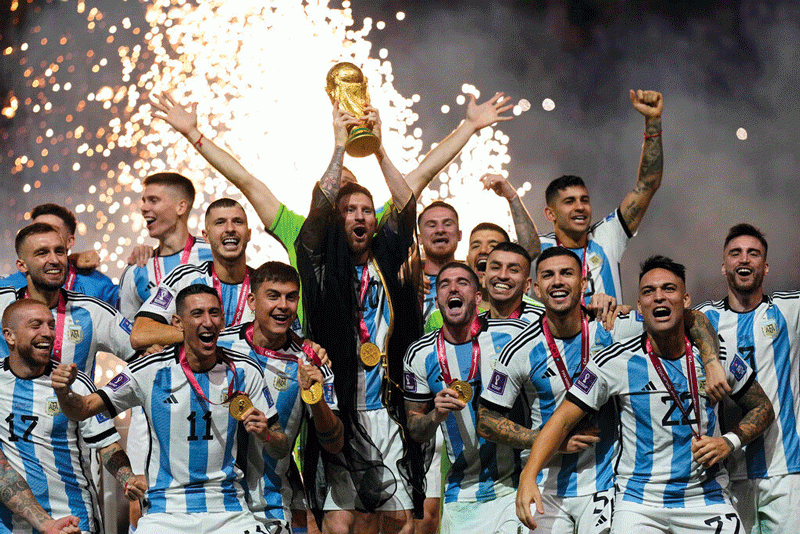
However, it is reported that a German mathematician and economist Joachim Klement has correctly predicted the last three Fifa World Cup winners, Germany (in 2014), France (in 2018) and Argentina (in 2022), using a scientific economic and statistical model, though it should be pointed out that he originally designed it as a satirical exercise to prove that predicting football tournaments was practically impossible.
He based his predictions, not on team tactics or current form but on four socioeconomic factors, namely population size (which determines the size of the talent pool to select from); climate (where football can be played year-round without severe weather disadvantages); the GDP per capita (that measures the wealth needed to provide the necessary infrastructure, schools, and training grounds to foster elite talent); and finally, their Current Fifa Rankings.
So, forty-eight teams have qualified but who will win?
Ask a supporter and he will say the most likely ones, the ones who expect and believe they will win, based no doubt on the above criteria, are the likes of Brazil, France, Argentina, Germany, Spain and England (all of them have won it before – of interest, Klement predicts the Netherlands will win this year).
But what about Scotland, South Africa, Jordan, Curacao, Cape Verde? If they and their supporters are honest, they do not expect to win nor are they likely to win.
- In Full: Nineteenth post-cabinet press briefing: July 05, 2022
- Muzarabani eager for Chevrons to qualify for Australia 2022
- R. Kelly sentenced to 30 years in sex trafficking case
- Cops Arrested For USD 10 Fraud
Keep Reading
That is no disgrace; that is no insult. It is reality. They have excelled in reaching that stage.
One or two teams might surprise others and even exceed expectation, but they are realistic and content.
They will go out hard and surprises can happen.
So, let us just underline that.
Some teams expect to win; most do not expect to win. But above all, let us just remember, forty-seven will not win.
All that is asked of each country, the important thing for all of them, is to do what they can with what they have.
Indeed, in one biblical account, Jesus praised one lady with the highest commendation: “she did what she could”.
It is a thought echoed in another instance where Jesus saw a poor woman give all she had (two coins) while the wealthy flashed their enormous wealth before handing over some of it, and He said that the woman gave more – she did what she could with the very limited resources she had.
The Parable of the Talents that Jesus told emphasised this point too. It was what each did with what talents they had that was important. It was much more a matter of “how” than “how much”.
That parable underlines a key point for children and schools to grasp, when it comes to sport.
The people received talents “each according to their ability”; children have different abilities and different levels of abilities.
Schools have different resources available to them, be they financial, human or structural. Just like those countries competing in the World Cup, some naturally will expect to win but others can proudly compete to the best of their ability, without disgrace or discrimination, even if they will not win.
Yet the sad thing is that society – stop! Shall we be more specific? The sad thing is that parents (many of whom will be supporting teams in the World Cup that will not win) expect, even demand that their child, their school, must be seen to win, to be the best.
Just remember forty-seven countries of the forty-eight at the World Cup Finals will not win.
The fact is that we cannot all win; we cannot all win all the time, in all areas, and that is perfectly acceptable and honourable.
However, we can all do what we can with the talents we have, the circumstances we face, the opportunities we experience, the factors we encounter.
Someone said that “The idea that an octopus, a turtle, or an otter might know the future is as absurd as it is entertaining”.
Equally, the idea that a child or a school might have their future determined by a sports result is as absurd as it is entertaining.
They did what they could. End of. High praise.