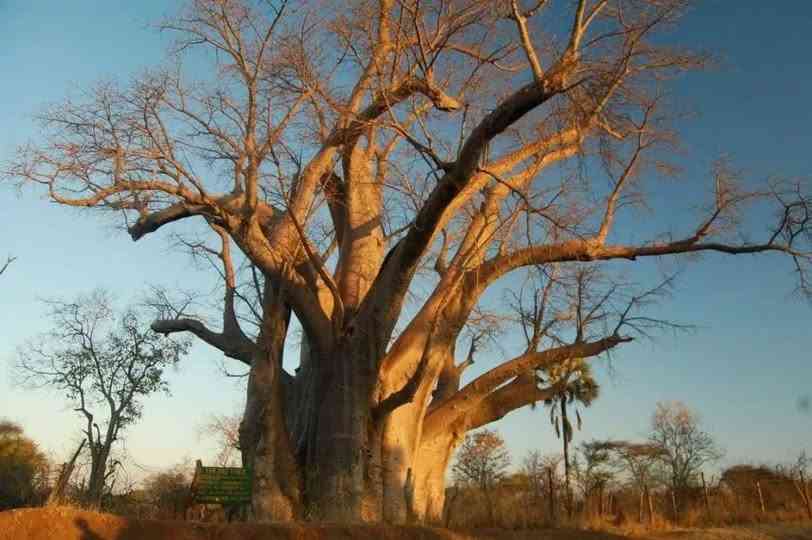
Zimbabwe is very proud of The Big Tree, the huge baobab tree close to Victoria Falls. While it may not exactly be the tallest tree in the world (‘only’ 24 metres), it is impressively wide in girth (22.40 metres – even if some argue that it is made up of three separate tree trunks). It is ‘beaten’ (if we are going to be competitive about it) by the General Sherman Tree in America which has the greatest volume of any living tree, and it is nothing in comparison to the Coast Redwood tree called Hyperion, also in the US, which stands at around 116 metres tall.
In contrast, the smallest tree may be the Dwarf Willow, a tiny, creeping willow that grows in arctic and alpine regions, typically reaching only 1 to 6 centimetres tall. We might think it is not exactly much of a tree, but a tree is a tree. Then there are Bonsai trees originating in Japan, which are grown and shaped in containers, mainly done as a hobby. They are all trees.
Here though is a question to consider: how can we measure if a tree is successful or not? Granted it might seem a somewhat odd question but bear with us. We should start by pointing out that there are obviously all sorts of different types, sizes, even purposes of tree, and so there is no Best Tree (as there is no Best Fruit – and consequently, logically, there is no Best School). They are all different. Some grow tall; some grow fruit; some grow wide; some provide shade; some produce flowers; some bloom for months, others for a short time. So is the successful tree the one that is the tallest, widest, shadiest, most colourful, most fruitful tree? Who says? No, each serves its own purposes (not ends).
We do not measure a tree by its height, its natural size – even redwood trees grow to different sizes. We do not measure a tree’s success by which fruit it produces nor by the amount of fruit it produces (some 30-fold, some 60-fold, some 100-fold) or even whether it produces fruit at all. We do not measure a tree by how much shade it provides. Some are taller; some are shadier. In short, we may simply consider if the tree is fulfilling its purpose, be it in providing fruit, shade, oxygen, beauty even.
“So what?” you may rightfully ask. We simply respond that we should use the same principles to apply to children when we consider education. As we concluded in a previous article, some children grow taller naturally, as we see here in this article some trees grow taller, so some children grow ‘taller’ (gaining higher grades) academically, naturally. All children, no matter their size, have great value even when their purpose is different – we cannot turn a pine tree into a baobab tree.
All children, no matter their ‘type’, are of great value. Some will grow ‘large’ academically but others will not – that does not take away from their value or significance. Some will produce little or even no fruit academically but they have other wonderful attributes and contributions, as a tree may not provide fruit but does give shade. Those other attributes are equally valuable in society.
Interestingly, as one example of the many types of personality tests, there is one entitled ‘Tall Trees Profile’ system which highlights four tree types (Palm, Pine, Oak, Willow) to “understand temperament, leadership, and family dynamics, aiming to foster better communication and reduce conflict by recognizing unique behavioural styles”. We have different personalities and leadership styles. It follows totally logically that we have different academic or let us just say learning styles and abilities. Furthermore, we can equally deduce that it is not simply temperament differences that people have but academic differences and sporting, cultural, social, individual differences and abilities.
It is simple really: is each tree growing in its own particular way, whether 30, 60 or 100-fold? For those of us who may think that we are redwoods looking down on all others who are clearly not as gifted academically, look more closely and carefully. In the past, many people often cruelly and inappropriately referred to people with a lower IQ as being “Thick as two short planks” – those who think that now cannot see the wood from the trees and are perhaps as guilty of such a status as those to whom they attribute it. First take the plank out of our own eye – and grow up. We do not grow strawberries on grapevines so do not expect all children to be academic. See each tree in its own right, purpose and value, and stop barking up the wrong tree.
- Tarakinyu, Mhandu triumph at Victoria Falls marathon
- Andrea The Vocalist, dreams big
- All set for the 2022 Econet Victoria Falls Marathon
- Econet Victoria Falls Marathon return a boon for tourism