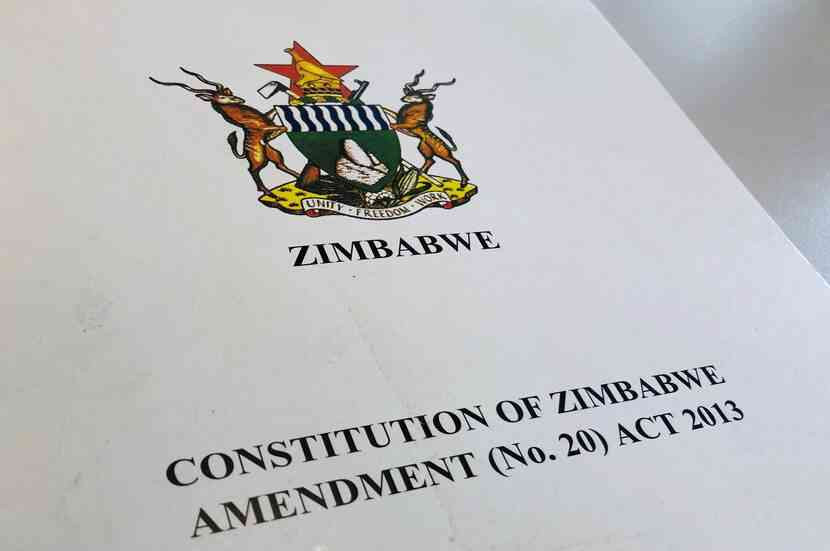
The constitution of Zimbabwe is the supreme law of the land. It outlines the structure of government, the separation of powers, the protection of fundamental human rights, the conduct of elections, and the limits of executive authority.
It is not merely a political document; it is a social contract between the state and its citizens.
It defines how power is acquired, exercised and relinquished.
Crucially, it sets presidential term limits and prescribes the procedures for constitutional amendments, including when a referendum is required.
At its core, the constitution exists to prevent the abuse of power and to ensure that no individual or institution stands above the law.
It protects citizens’ rights to political participation, freedom of expression, and freedom from torture or inhuman treatment.
Any attempt to amend it must therefore be approached with caution, transparency and broad-based consultation, because altering a constitution is not like amending ordinary legislation.
It reshapes the foundation of the nation.
- Unpacking environmental laws for real estate in Zimbabwe
- Village Rhapsody: Govt must ensure that devolution works
- Unpacking environmental laws for real estate in Zimbabwe
- Gukurahundi public hearings: A breakthrough or a political gimmick?
Keep Reading
It is against this backdrop that Zanu PF’s proposal to extend President Emmerson Mnangagwa’s term of office by two years, through a Constitutional Amendment Bill, must be examined.
Zanu PF spokesperson Chris Mutsvangwa has expressed confidence that resolution number one, adopted at the Zanu PF annual people’s conference, will “sail through” Parliament.
He argued that there is consensus in Parliament and that the president’s performance justifies the extension.
He cited the achievements of the second republic, including economic reforms such as the introduction of the Zimbabwe Gold (ZiG) currency.
Mnangagwa’s bid to extend his rule to 2030- effectively suspending 2028 elections may be the very catalyst Zimbabwe’s fractured opposition needed to end its long period of dormancy.
Mnangagwa, who rose to power after a coup against long time ruler Robert Mugabe nine years ago, has been ruling amid timid opposition after he crushed the Citizens Coalition for Change (CCC) and civil society.
Opposition against his government has only come from inside his ruling Zanu PF since the controversial 2023 elections, but the tabled on proposed changes to the constitution in cabinet last week seems to have dramatically changed the status quo.
Justice minister Ziyambi Ziyambi tabled far reaching proposals to amend the constitution, which include extending Mnangagwa’s term by two years when it expires in 2028.
The 2030 agenda was first adopted at the ruling Zanu PF conference held in Bulawayo two years ago.
On the surface, the argument from Zanu PF is one of stability and continuity.
Proponents say extending the presidential term from five to seven years would eliminate what the term “election mode toxicity” and allow sufficient time for project implementation.
They argue that this will promote stability and long-term planning.
However, constitutional democracy is not built solely on performance metrics or claims of economic reform. It is built on rules.
The rule of law demands that leaders submit themselves to constitutional limits, even if they believe they are delivering results.
The essence of constitutionalism is that power must be restrained, predictable and accountable.
NewsDay has reported that even individuals who have attempted to oppose the amendment have allegedly been abducted and tortured.
A member of the Constitution Defenders Forum (CDF), Baird Gore, was reportedly seized from his home and severely tortured before being dumped in police cells.
These allegations, represent not only a grave human rights violation but also a direct assault on the spirit of constitutional democracy.
The constitution guarantees freedom from torture and protects the right to political participation.
Suppressing dissent undermines the legitimacy of any constitutional amendment process.
The proposed changes go further than merely extending a term. They seek to alter the method of electing the president, transferring that responsibility from the electorate to Members of Parliament.
Critics argue that this effectively removes direct presidential elections, concentrating power within Parliament.
In a country with a history of disputed elections and political polarisation, such a move demands the highest levels of transparency and public consultation.
The Election Resource Centre (ERC) has criticised the amendments, stating that they lack a factual and democratic basis.
The watchdog has argued that the proposal ignores key reforms that could improve electoral credibility.
Furthermore, the ERC notes that amendments extending term limits should not apply retroactively to individuals who already occupied the office prior to the change.
This principle is not unique to Zimbabwe; it is a common safeguard in constitutional democracies worldwide.
It ensures that incumbents do not manipulate rules midstream for personal or partisan gain.
Another concerning aspect is the proposal to abolish the Zimbabwe Gender Commission and transfer its functions to the Zimbabwe Human Rights Commission.
Independent commissions are established to strengthen accountability and safeguard rights.
Weakening or restructuring them without extensive consultation risks eroding institutional checks and balances.
How are things supposed to be done?
First, constitutional amendments that affect the core structure of governance especially presidential term limits and electoral systems should ideally be subjected to a national referendum.
While Parliament has the authority to amend certain provisions, democratic legitimacy is strengthened when citizens are directly consulted on fundamental changes.
A referendum is not merely a procedural hurdle; it is an affirmation that sovereignty resides in the people.
Second, there must be genuine public consultation.
Civil society organisations, opposition parties, churches, traditional leaders and ordinary citizens must be given space to debate and contribute.
Public hearings should be transparent, inclusive and free from intimidation.
Third, the environment must be free from violence or coercion.
Allegations of abductions, torture and intimidation create fear and silence dissent.
Constitutional reform conducted under such conditions cannot claim to reflect the will of the people.
Fourth, adherence to constitutional safeguards is critical. If term limits are amended, they should not apply to current office holders.
This principle protects the integrity of the constitutional order and prevents perceptions of self-serving governance.
What then are the solutions?
Zimbabwe stands at a constitutional crossroads.
The way forward lies not in rushing amendments through Parliament but in strengthening democratic institutions.
The government should pause the Bill and initiate a broad national dialogue.
If there is genuine consensus, it will withstand the scrutiny of a referendum.
Electoral reforms recommended by stakeholders such as the ERC should be prioritised.
Improving the credibility of elections, enhancing the independence of the Zimbabwe Electoral Commission, and addressing political violence would go further toward reducing “election mode toxicity” than extending terms.
There must also be firm action against political violence. Independent investigations into allegations of torture and abduction should be conducted, and perpetrators held accountable. Without accountability, constitutional promises remain hollow.
Finally, leaders must remember that constitutional term limits are not obstacles to development; they are safeguards for democracy.
Stability is not achieved by concentrating power, but by building trust in institutions.
True progress is measured not only by economic indicators like currency reforms, but by the strength of democratic norms.
The constitution is more than a document. It is the people’s shield against arbitrary power.
Any amendment that touches its core must be handled with humility, inclusivity and respect for the will of the citizens.
Zimbabwe’s democratic future depends not on how swiftly a bill sails through Parliament, but on how faithfully the nation upholds the principles enshrined in its supreme law.
*Gary Gerald Mtombeni is a Harare based journalist. He writes here in his personal capacity. For feedback Email [email protected]/ call: +263778861608