Craft Properties Holdings chief executive officer Kudakwashe Taruberekera has called for an urgent shift in mindset and policy to accelerate the adoption of artificial intelligence (AI) in Zimbabwe, saying the technology is no longer optional, but foundational to future economic growth.
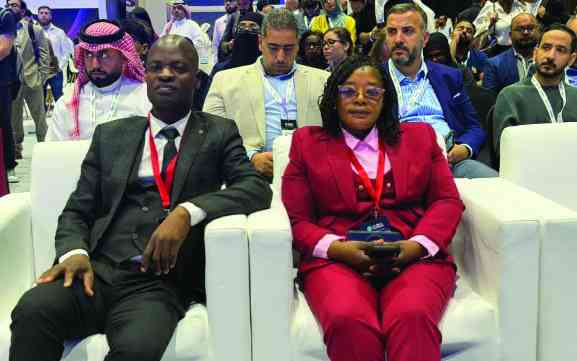
Taruberekera was speaking after attending the Global AI Show 2025 in Abu Dhabi, alongside engagements at other high-level platforms including the Dubai Future Forum, where he said he gained first-hand exposure to what he described as “the next industrial revolution.”
He was accompanied by his wife, Yeukai, who is a director at Craft Properties Holdings.
“It is my hope that reporting on my visit to the Global AI Show will not only change mindsets, but also trigger AI consciousness and uptake in both the public and private sector,” Taruberekera said.
Reflecting on insights from Abu Dhabi and previous global summits, Taruberekera said the most striking realisation was that AI has moved beyond being a support tool.
“AI is no longer an extra. It is now the foundation,” he said.
He described AI as a “digital teammate” — a proactive system capable of storing and analysing data at speed, supporting accurate decision-making across sectors such as property development, finance and engineering.
For Craft Properties, he noted, AI can analyse optimal land acquisition timing, recommend cost-effective building materials and eliminate guesswork that often characterises traditional development models.
- Time running out for SA-based Zimbos
- Sally Mugabe renal unit disappears
- Epworth eyes town status
- Commodity price boom buoys GB
Keep Reading
He also highlighted AI’s role in enabling a 24-hour economy, aligning with calls by Finance minister Mthuli Ncube for round-the-clock economic activity.
“AI does not tire. It serves clients across time zones 24/7, making a 24-hour economy not just possible, but practical,” Taruberekera said.
Taruberekera said Craft Properties is transitioning from conventional development methods to what he termed an “Intelligent Development Model.”
Through AI integration, the company aims to manage multiple projects simultaneously without expanding team size, improve efficiency, accuracy and safety in construction and compete globally with firms operating in markets such as Dubai and London.
“AI allows us to offer the same data-backed security and predictability expected in first-world markets,” he said.
Taruberekera said AI has the potential to revolutionise Zimbabwe’s real estate industry in several ways, including smart land use planning, using satellite imagery, soil analysis, demographics and urban growth data to predict future high-value suburbs, virtual site visits, enabling Zimbabweans in the diaspora to tour properties remotely using AI-driven virtual reality as well as early warning maintenance systems, where AI sensors detect faults such as water leaks or electrical risks before disasters occur
“These technologies build trust, improve safety and close deals faster,” he said.
Beyond property, Taruberekera said the biggest lesson from the UAE was its proactive approach to the future.
“Abu Dhabi and Dubai do not react to the future — they build it,” he said.
He stressed the need for AI literacy, urging Zimbabwe to move from policy to practice under the Education 5.0 framework.
“We don’t just need more builders; we need digital construction managers,” he said.
He also emphasised the importance of reliable electricity and internet infrastructure, noting that AI growth depends heavily on stable power and connectivity — an opportunity, he said, for Zimbabwe to scale up renewable energy such as solar.
Taruberekera pointed to the UAE’s ambition to establish an AI-powered government by 2027 as a model Zimbabwe could adapt.
Taruberekera said one of the most impressive aspects of the UAE model was how the private sector is treated as a development partner, not merely a source of tax revenue.
“They have a clear National AI Strategy that government and business follow together,” he said.
At Craft Properties, Taruberekera said the company plans to allocate a dedicated AI integration budget, form strategic partnerships with AI software providers and make smart home features — including AI security and energy-saving systems — a standard offering in future developments
He also revealed that the company was exploring partnerships with foreign firms, though details remain confidential for now.
Looking ahead, Taruberekera called for policy reforms to create tech-friendly zones, tax incentives for AI adoption, and duty exemptions on technology equipment.
He also emphasised youth empowerment, saying Zimbabwe’s young population could position the country as a regional AI hub for SADC and beyond if equipped with the right skills.
“The Global AI Show simplified AI and showed that competing with the so-called first world is possible,” he said.
“The future belongs to those who prepare for it — and AI is how we prepare.”