A distinctive, deep, syncopated rumble slices through the ordinary hum of commuter omnibuses and compact hatchbacks. It is a mechanical growl that demands immediate attention.
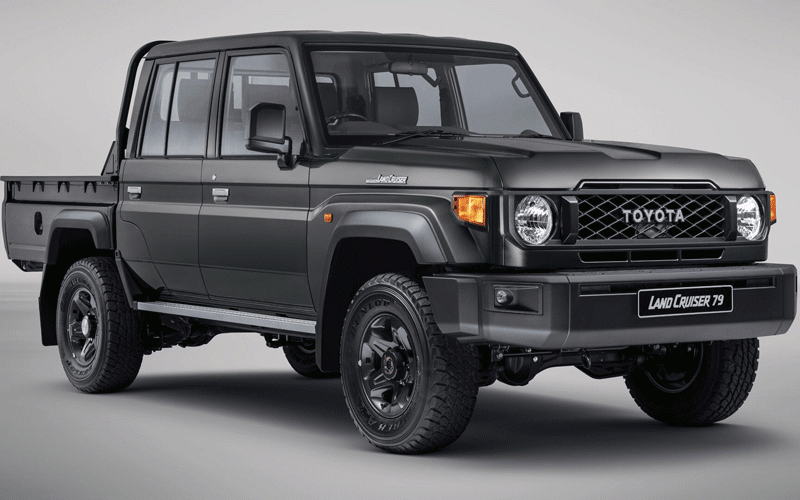
Within seconds, a glistening, lifted Toyota Land Cruiser 79 Double Cab glides past, its metallic paint reflecting the orange hues of the setting African sun.
From the pavement, a group of young men turn their heads in unison. One raises a hand, smiles broadly, and shouts a phrase that has rapidly transformed from a casual street compliment into a full-blown national automotive anthem, “Cruzer Mhanii!”
The driver offers a brief, acknowledging tap of the throttle. The response is instantaneous, a sharp, aggressive intake hiss followed by an intimidating exhaust note that echoes off the high-rise office blocks.
For more than four decades, the Toyota Land Cruiser 70 Series has been universally recognised as the unyielding backbone of humanitarian aid missions, heavy agricultural operations and remote mining ventures across the globe.
Built on an indestructible ladder-frame chassis with heavy-gauge steel body panels and rigid live axles, it was designed specifically to endure environments where mechanical failure equates to a life-threatening crisis.
Yet, in a fascinating cultural pivot, this unapologetic piece of agricultural machinery has migrated from the dusty, corrugated dirt roads of the Lowveld and the Eastern Highlands straight into the high-end social fabric of Zimbabwe’s urban elite.
No longer confined merely to cotton farms or wildlife conservancies, the 70 Series has established itself as the ultimate symbol of wealth, durability and raw, mechanical charisma on Zimbabwean tarmac.
- War over super car stuck in river
- Chombo’s trial date moved
- Kaukonde in car supply storm
- All set for Balance Up and Drive Campaign bash
Keep Reading
To understand the contemporary grip of the 70 Series on Zimbabwean popular culture, one must look beyond the specification sheets and delve into the local vernacular.
In Shona, appending the word “mhanii” serves as an emphatic, high-energy exclamation of deep admiration, awe and undisputed authority.
To label a vehicle as “Cruzer Mhanii” is to declare it the absolute king of the road, a machine that stands entirely above the ordinary.
This reverence spans the entire 70 Series lineup on Zimbabwean streets, where each model variant plays a distinct role.
The Land Cruiser 76 operates as a classic five-door SUV that serves as a high-end family cruiser and a corporate statement.
Meanwhile, the Land Cruiser 78, affectionately known as the troopy, stands as the ultimate overlander, favoured for rural touring and rugged utility.
Finally, the Land Cruiser 79 Single and Double Cab pickups command the tarmac as the prime canvas for extreme urban modifications.
The viral nature of this chant has fundamentally altered how the vehicle is perceived.
Once viewed strictly as a utilitarian workhorse reserved for rugged non-governmental organisations, government ministries, or commercial farmers, the 70 Series is now highly coveted by young corporate executives, prominent entrepreneurs and elite tastemakers.
On the bustling streets of Harare, Bulawayo and Mutare, driving a clean Land Cruiser 70 Series commands far more respect than piloting a European luxury sports car.
A European exotic may signal temporary affluence, but a 70 Series indicates a permanent understanding of power, foresight and unyielding status, serving as an assertive declaration that the owner values engineering longevity just as much as unvarnished prestige.
Zimbabwe’s automotive marketplace is highly diverse, filled with premium options ranging from luxury twin-cab pickups to high-tech SUVs. Yet, when wealthy buyers look to spend upward of US$100,000 on a lifetime vehicle, competitors like the Ford Ranger Raptor, the Volkswagen Amarok and even the Land Cruiser’s upscale sibling, the Hilux Legend, frequently take a backseat to the timeless 70 Series.
The reasons for this deliberate preference boil down to a few critical pillars, beginning with mechanical simplicity and unmatched longevity.
Modern premium utility trucks are increasingly reliant on intricate electrical architectures, complex sensor arrays and sensitive emissions-control systems.
While these features perform admirably on flawless highways, they can become significant vulnerabilities when subjected to fuel quality variations or the punishing vibrations of poorly maintained roads.
The 70 Series, by stark contrast, remains beautifully and intentionally analogue. Even with the introduction of modern updates, such as the 2.8-litre four-cylinder turbo-diesel mated to a 6-speed automatic transmission alongside the iconic 4.2-litre naturally aspirated inline-six and the massive 4.5-litre turbo-diesel V8, the underlying philosophy remains unchanged because it is a vehicle built to be fixed in the field with basic hand tools, completely avoiding overly complex air suspensions or delicate electronic modules that could leave a driver stranded.
Beyond its mechanical reliability, the vehicle offers profound financial defiance against depreciation.
Vehicles are notoriously depreciating assets, but the Land Cruiser 70 Series consistently defies standard economic gravity.
In Harare’s bustling car dealerships, a well-maintained, ten-year-old Land Cruiser 79 frequently commands a resale price that rivals or exceeds the cost of a brand-new, mid-tier alternative double-cab.
A prominent automotive importer based in Harare’s CBD notes that buying a 70 Series is not an expense but rather a capital investment, because an owner can drive it for 150,000 kilometres through the roughest mining terrain in Mashonaland West, bring it back to town, wash it and sell it for nearly what they originally paid for it.
This financial security is paired with an ultimate versatility that allows the vehicle to seamlessly transition across entirely different worlds.
It can spend Monday through Thursday navigating deep mud, carrying heavy equipment and traversing riverbeds at a mining site or agricultural estate and then, after a thorough detailing session on Friday evening, park confidently outside elite venues in Borrowdale or Chisipite while looking completely in its element.
While the legendary reliability of the Land Cruiser gets owners through the showroom doors, it is the growing customisation subculture that truly defines the “Cruzer Mhanii” phenomenon on contemporary Zimbabwean streets.
Urban owners are no longer content with leaving their cruisers stock, choosing instead to treat them as blank canvases for creating auditory masterpieces.
This acoustic modification scene focuses intensely on maximising the distinct character of the engines, shifting away from the quiet, restrictive factory piping and muted hum of the stock configuration toward an aggressive aftermarket street profile.
The most popular upgrade is a three-inch or four-inch straight-pipe stainless steel exhaust system, often exiting directly out the side of the vehicle just before the rear wheel arch.
For the V8 models, this unleashes a ferocious, low-frequency rumble that can literally be felt in the chest of pedestrians yards away, transitioning into an unrestricted mechanical wail under acceleration.
Equally important to this aesthetic is the intake sound, as almost every modified 70 Series in Zimbabwe features a prominent, high-mounted snorkel.
While originally designed to prevent water ingestion during deep river crossings, urban tuners have converted the snorkel into an acoustic megaphone by installing high-flow performance air filters and removing restrictive baffles from the inner intake tract.
Under acceleration, the snorkel emits an intensely loud, satisfying air induction hiss and when the driver lifts off the accelerator pedal, the sudden drop in pressure creates a dramatic, fluttering turbo wastegate hiss back through the snorkel tube.
This combination of a deep, roaring exhaust and a high-pitched, hissing intake creates a captivating dual-tone mechanical symphony that drives street-side spectators absolutely wild.
Purists often point out that the factory-spec 70 Series was never engineered for high-speed performance or luxurious ride comfort, as the top speed is electronically governed to a modest 150 km/h and the heavy-duty rear leaf-spring suspension can feel punishingly stiff when the vehicle’s bed is completely unladen.
However, Zimbabwean modification shops have completely rewritten the rulebook, engineering ingenious solutions to transform this utilitarian tractor into a fast, plush urban cruiser.
To make these heavy steel beasts move with sports-car agility, owners turn to advanced electronic engine management and performance tuning.
Specialised local tuning houses utilise custom Stage 1 and Stage 2 ECU remapping paired with larger, high-efficiency aftermarket intercoolers.
On the V8 diesel models, a professional software map unlocks dormant reserves of power, effortlessly bumping the stock output up to well over 280hp, while pushing torque figures to 650 Nm.
To safely manage this newfound power, the factory five-speed manual transmissions are often upgraded with heavy-duty clutches, or owners opt for the smooth-shifting 6-speed automatic transmissions found in recent models, resulting in a multi-ton, aerodynamically blocky vehicle that can accelerate away from traffic lights with shocking urgency.
Elevating comfort to executive standards requires a similarly complete overhaul of the chassis and cabin.
Overcoming the stiff, unforgiving ride of the agricultural-grade leaf springs involves replacing the standard factory shock absorbers with premium, long-travel adjustable bypass shocks and upgraded leaf packs from top-tier off-road brands, which provide a supple, cloud-like ride over harsh urban potholes while retaining payload capacities.
Inside the cabin, the transformation from a utilitarian workspace to a luxury oasis is achieved by stripping down the stark factory interior and replacing the original cloth or vinyl with plush, double-stitched quilted leather seats.
Furthermore, layers of advanced acoustic sound-deadening material are meticulously installed beneath the carpets and inside the door panels to effectively mute intrusive road noise, while high-definition touchscreen infotainment systems, premium multi-speaker sound setups, integrated subwoofers and reverse cameras are cleanly integrated into the classic, upright dashboard.
Ultimately, the Toyota Land Cruiser 70 Series has evolved far beyond its humble origins as an industrial tool to become an emotional touchstone, a cultural icon and a vibrant canvas for automotive self-expression in Zimbabwe.
It perfectly bridges the gap between the practical demands of a developing country’s infrastructure and the celebratory luxury of its successful elite.
As long as Zimbabwean drivers value unmatched durability, financial resilience and commanding road presence, the love affair with this boxy machine will only continue to intensify, proving that true automotive legends never die, they simply get louder, faster and infinitely more comfortable.
Therefore, the next time you hear that unmistakable, thunderous V8 rumble and powerful intake hiss echoing down a Zimbabwean street, look closely at the gleaming machine rolling past, join the crowd on the pavement, smile and salute the undisputed king of the tarmac, “Cruzer Mhanii!”