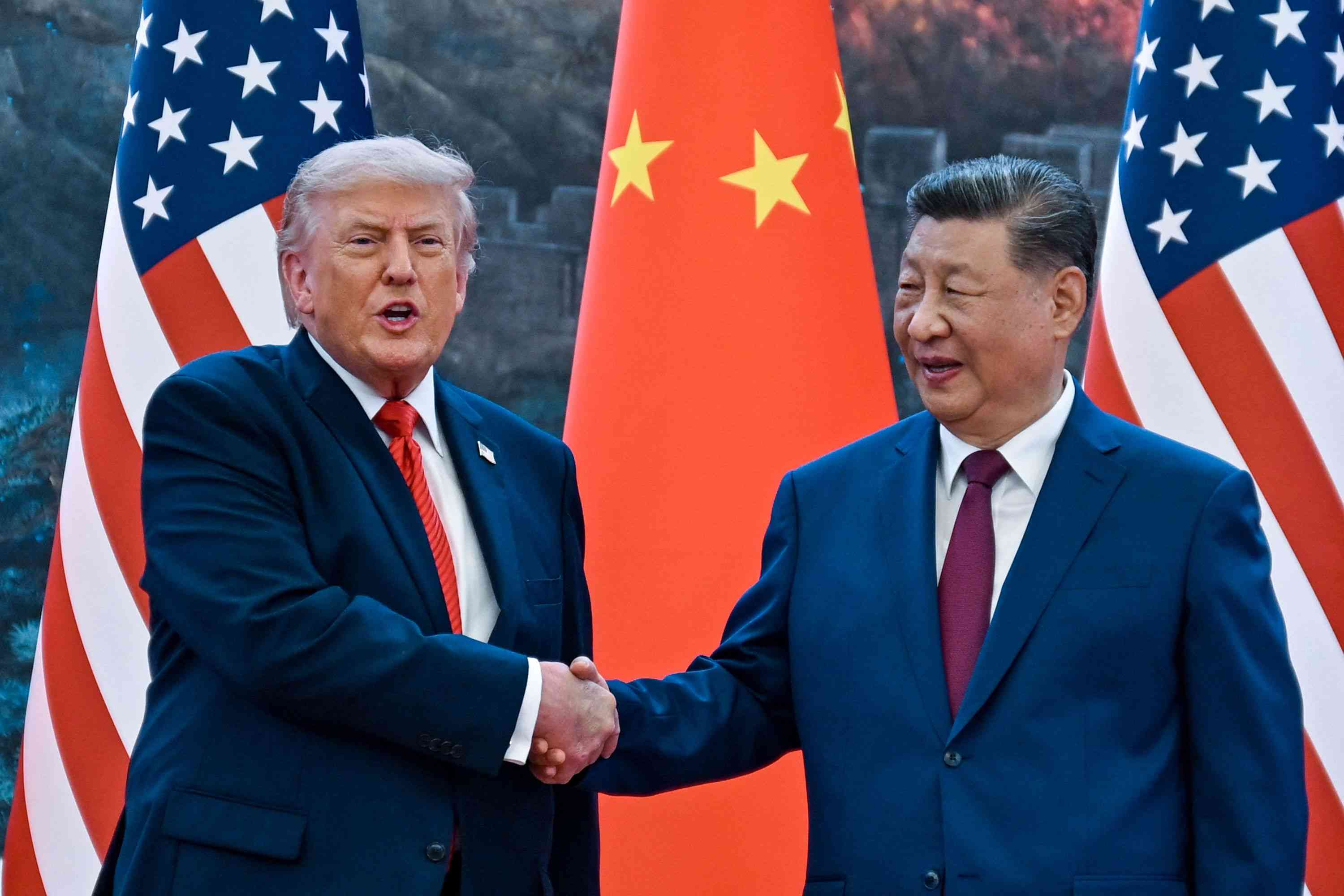
Donald Trump’s visit to China alongside a large delegation of top American business leaders has attracted close attention from investors and policymakers around the world.
Beyond the political symbolism, the trip carries important implications for US stock markets, global trade, and investor confidence.
For Zimbabwean readers, this is a story worth following closely. Developments between the United States and China often ripple through global financial markets, influencing everything from technology shares and commodity prices to currencies and business sentiment.
The size and profile of the delegation are especially significant. When major executives from leading companies travel with a president, it signals that the discussion is not only about diplomacy, but also about trade access, supply chains, and commercial opportunities.
That makes the visit relevant to investors who are trying to understand where the next major market move may come from.
If relations between the two largest economies improve, markets usually respond with optimism. Investors tend to welcome any sign of reduced trade tension, clearer policy direction, and stronger business cooperation. In practical terms, that can support share prices, particularly in sectors with deep exposure to China.
Technology companies are among the most sensitive to US–China developments. Semiconductor firms, smartphone makers, and companies involved in artificial intelligence or advanced manufacturing can benefit if trade restrictions ease or if new agreements improve access to the Chinese market. On the other hand, renewed friction can quickly pressure valuations and create uncertainty.
Industrial and consumer companies may also stand to gain. Many large US businesses depend on China either as a production hub or as a major customer base. Better relations can improve supply chain stability and support stronger earnings, which often encourages further investment in those stocks.
- The brains behind Matavire’s immortalisation
- Letter from America: Is former president Donald Trump a hero or villain?
- Red Cross work remembered
- All set for inaugural job fair
Keep Reading
That said, investors should remain cautious. A high-profile visit may lift market sentiment in the short term, but it does not guarantee lasting progress. US–China relations have often moved in cycles of cooperation and conflict, and markets can change direction quickly when expectations are disappointed.
There is also a wider global angle. Canada, as a major trading nation and resource economy, can be affected by shifts in US–China relations through trade flows, commodity demand, and broader market sentiment. This is why developments involving Washington and Beijing often matter well beyond the two countries directly involved.
For Zimbabwean investors, the main takeaway is the importance of viewing local investing within a global context. Many readers now follow US stocks, exchange-traded funds, and international market trends alongside local opportunities. Understanding major geopolitical events can help investors better judge risk, opportunity, and timing.
The business delegation itself also sends a clear message. Major companies are increasingly focused on access to global markets and on maintaining stable relationships with key trading partners. For investors, that is a reminder that corporate strategy and geopolitical strategy are often closely connected.
At Streetwise Economics, the goal is to make global markets easier to understand for everyday readers. This story is a good example of how politics, business, and investing intersect in ways that can affect markets far from Washington or Beijing.
In the end, Trump’s China visit is not just a diplomatic event. It is also a market signal, offering clues about trade, investor confidence, and the direction of global economic relations. For Zimbabwean readers trying to make sense of US and global markets, it is the kind of development that deserves close attention.
*Isaac Jonas is the founder and principal consultant of Streetwise Economics, an applied economics consulting practice based in Abbotsford, British Columbia, Canada. His work focuses on regional economic analysis, labour market intelligence, and capital market commentary, with clients across Canada and Zimbabwe. He holds a Master of Food and Resource Economics and an MA in Resource, Environment and Sustainability from the University of British Columbia, and a BSc Economics from the University of Zimbabwe, where he was a Mastercard Foundation Scholar.
Website: streetwiseeconomics.com · YouTube and Substack: Streetwise Economics
Follow Streetwise Economics on YouTube and Substack for more applied analysis. I am also available on social media — and always happy to discuss these ideas further or to take on commissioned research, applied economic analysis, labour market reports, and policy advisory work for institutional and corporate clients. Nothing in this article should be taken as investment advice. Always consult a licensed advisor and do your own due diligence before investing your money. Investing comes with risks