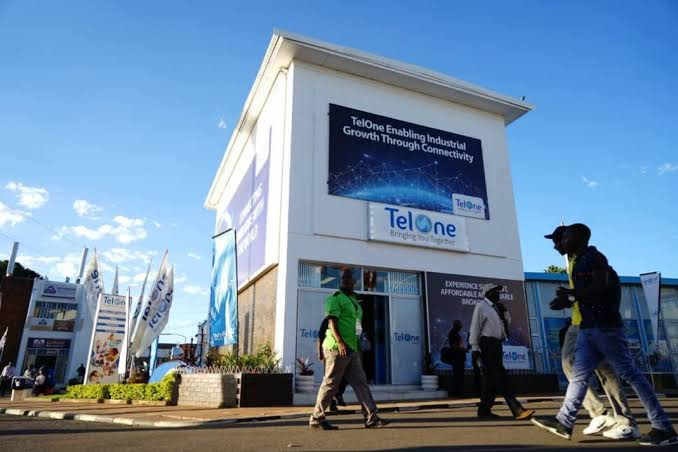
TELONE Private Limited (TelOne) is seeking US$343.17 million to finance three digital infrastructure projects, with a combined projected revenue of about US$3.8 billion, as the telecommunications company moves to expand broadband connectivity and strengthen Zimbabwe’s digital infrastructure.
The funding push comes as TelOne continues to face constraints from government arrears, which had risen to nearly US$42 million by June, more than double the US$19.2 million owed a year earlier.
The unpaid bills have limited the company’s ability to finance capital projects, maintain network infrastructure, and pursue expansion using internally generated resources.
At the time, chief executive officer Lawrence Nkala said TelOne needed equity funding alongside debt financing to support investment, as the company sought to modernise its infrastructure and respond to rising demand for data services.
These projects highlight the capital scale required to support that expansion; TelOne is seeking the US$343.17 million for fibre-to-the-home, wireless broadband, and data-centre developments.
Together, the projects are projected to generate about US$3.8 billion in revenue, potentially creating new revenue streams while expanding the company’s national digital infrastructure.
“TelOne fibre to the home (FTTH) deployment - The project involves the installation of fibre to the home (FTTH) broadband infrastructure to connect approximately 114 000 homes across various locations in Zimbabwe,” the Zimbabwe Investment and Development Agency (Zida) stated in its latest July 2026 Projects Prospectus.
According to the agency, this is a brownfield project aimed at expanding internet broadband services and extending last-mile connectivity to homes and individual subscribers.
- Calls for sanctions removal intensifies
- TelOne launches virtual insurance platform
- 15 Chikurubi inmates graduate as foresters
- PPPs essential to addressing infrastructural deficits
Keep Reading
“The proposed project requires a total investment of US$50 million, allocated as follows: US$30.5 million for Gigabit Passive Optical Network (GPON) infrastructure, plant, and equipment; US$14.8 million for services such as civil works and fibre termination; US$3.9 million for operating capital; and US$1 million for conducting an Environmental and Social Impact Assessment,” Zida said.
The investment structure is envisioned as a build, Lease, maintain & transfer (BLMT) public-private partnership (PPP), and will connect 114,000 homes to high-speed internet through FTTH infrastructure using GPON technology.
The US$50 million project is projected to generate US$719 million in revenue, with an 88% gross profit margin, 35% net profit margin, 47.1% return on investment (ROI), US$98 million net present value (NPV), and a 4.75-year payback period.
Regarding the TelOne wireless broadband deployment project, this initiative aims to improve internet connectivity in underserved regions of southern and eastern Zimbabwe, including Midlands, Matabeleland, Masvingo, and Manicaland.
“Promoted by TelOne Private Limited, this US$263.2 million initiative involves deploying approximately 1,600 wireless base stations under a build, lease, maintain, and transfer (BLMT) public-private partnership model,” Zida said.
“The project targets connecting 500 000 users in rural and peri-urban areas, addressing the digital divide and fostering digital inclusion. With feasibility studies completed, the viability of the project is proven with favourable returns in addition to its significant social impact.”
The project will deploy 1,600 wireless base stations to provide broadband connectivity to 500,000 users in rural and peri-urban areas.
The project is projected to generate US$2.9 billion in revenue, with a 95% gross profit margin, 53% net profit margin, 60% ROI, US$576.6 million NPV, and a five-year payback period.
Lastly, under the TelOne Data Centres Project, the company intends to roll out the Data Centre Facilities and Cloud Expansion Project in three cities in Zimbabwe, namely, Harare, Mazowe, and Bulawayo.
“The data centre facilities comprise physical facilities housing essential IT infrastructure, including servers, storage systems, and network equipment, to store, process, and distribute data and computer systems and applications,” Zida said.
“The project entails expanding the Harare data centre by 300m² of Tier III co-location space, deploying performance optimised data centres (PODs) in Harare and Mazowe, and upgrading Bulawayo data centre infrastructure for cloud services.”
The project, which is at the preparation stage with the feasibility study, business case, and environmental impact assessment already completed, aims to enhance co-location, cloud hosting, disaster recovery, and managed hosting services to meet growing government and private-sector demand.
According to Zida, this is a US$29.97 million project projected to generate US$181.61 million in revenue and US$113.80 million in profits over 13 years, with a 93% gross profit margin, 60% net profit margin, and a 29.23% ROI. It also has a US$8.4 million NPV, and an 11-year, eight-month payback period.
“PPP and debt structure required,” Zida said.