HARARE City Council clinics have been rocked by revelations of entrenched corruption, with nurses and support staff accused of siphoning money from desperate patients through unreceipted fees, drug sales and demands of “tokens” in exchange for preferential treatment.
A two-month-long investigation by Truth Diggers exposed how council health workers are allegedly exploiting the collapse of basic service delivery to enrich themselves at the expense of vulnerable patients.
A Truth Diggers journalist, posing as a patient, visited several municipal clinics, where she was directed to pay cash that was neither receipted nor officially accounted for, and observed several malpractices at the council-run clinics.
The investigation, which began after a tip-off from frustrated residents, uncovered instances of patients being forced to pay extra for medication, bribes for faster service and in some cases, patients demanding refunds after irregular transactions.
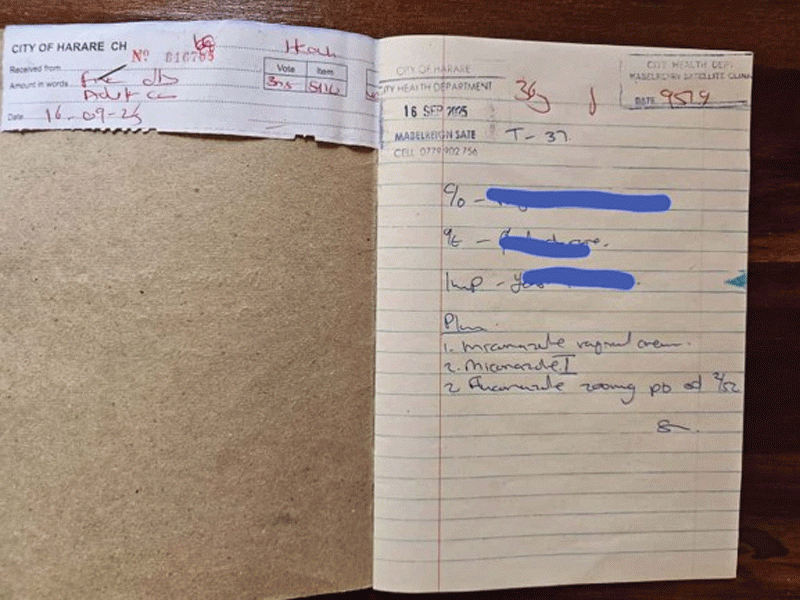
On July 2, 2025, at Mabelreign Satellite Clinic, this reporter, who had paid the standard consultation fee, was told by a nurse that drugs were available, but only at an additional cost of US$10, which was pocketed without documentation.
Barely three months later, on September 15, 2025, at the same clinic, another patient who declined to be named was asked to pay US$10 for drugs.
She complied, but was not given a receipt.
The following day, the patient returned to demand accountability.
- Harare cancels Pomona waste deal
- Devolution gains remain a mirage
- Harare cancels Pomona waste deal
- Pomona saga: Harare handed shock US$750k ‘garbage’ bill
Keep Reading
“You took my money for drugs, but did not issue a receipt,” she told the nurse in a recording in possession of Truth Diggers.
“I want the receipt so that I can claim a refund elsewhere.”
According to the recording, the nurse did not dispute the illicit transaction.
Instead, she offered an alternative.
She said: “Just bring your clinic card, and I will write something on it, which will enable you to claim your money.”
The Truth Diggers investigation also established that corruption at Harare City Council–run clinics is not a new phenomenon, but dates back to decades ago.
In Mabvuku, this reporter caught up with Febby Shoko, a woman who once confronted nurses after the health workers allegedly extorted money from her family members during childbirth.

Shoko said on July 23, 2021, her daughter-in-law was ordered to pay US$40 as a token --- commonly referred to as huku yambuya --- to the nurse on duty while delivering her son.
Traditionally, huku yambuya referred to a hen given as a token of appreciation to midwives in traditional culture, before the modernisation of maternal health services.
But in some health institutions, the practice is being monetised and weaponised against desperate pregnant women.
A fuming Shoko refused to leave the Mabvuku clinic without her money, demanding an immediate refund, Truth Diggers heard.
A colleague eventually reimbursed her after explaining that the nurse, who had taken the money had already gone home following her night shift.
Recounting her ordeal, Shoko said: “The money was paid to the nurse by my son, who was desperate for his wife’s safe delivery.
“But when they told me the following morning after my daughter-in-law had delivered, I felt it was not only unprofessional, but illegal too.
“I went back to the hospital and demanded the money back. They refunded me that very same morning. I refused to wait until the nurse returned in the evening when she resumed duty.”
A nurse at the clinic, who pleaded to remain anonymous, confirmed the incident to Truth Diggers, but refused to disclose further details, saying she was “not authorised to speak to the media”.
Shoko’s ordeal with paying a bribe for safe delivery was not her first encounter with malpractice at a council-run clinic.
She revealed that four years earlier, she had lost her grandson at the gates of Mabvuku Poly Clinic after a security guard allegedly denied her entry while the child was in urgent need of medical attention.
According to Shoko, the guard declined to call a council ambulance, insisting instead on a privately-owned one.
She believes this was motivated by kickbacks, as some guards allegedly receive commissions for directing patients to private ambulance operators.
The double tragedy, first losing her grandson due to negligence and later watching her daughter-in-law subjected to extortion during childbirth, pushed Shoko into advocacy for improved maternal health care.
She went on to found the Maternal Health Hub, an organisation that fights for the rights of pregnant women and campaigns against corruption targeting expectant mothers at health institutions.
The rot at council clinics is not confined to nurses alone.
Even ancillary staff are entangled in the web of corruption.
On September 16, 2025, at Mabelreign Satellite Clinic, this Truth Diggers journalist posing as a patient uncovered how clerks were also exploiting desperate patients.
The reporter was in the middle of a queue of patients waiting to pay for consultation fees.
Conversations between the clerk and patients were sometimes audible enough for those behind to catch, but other times deliberately hushed.
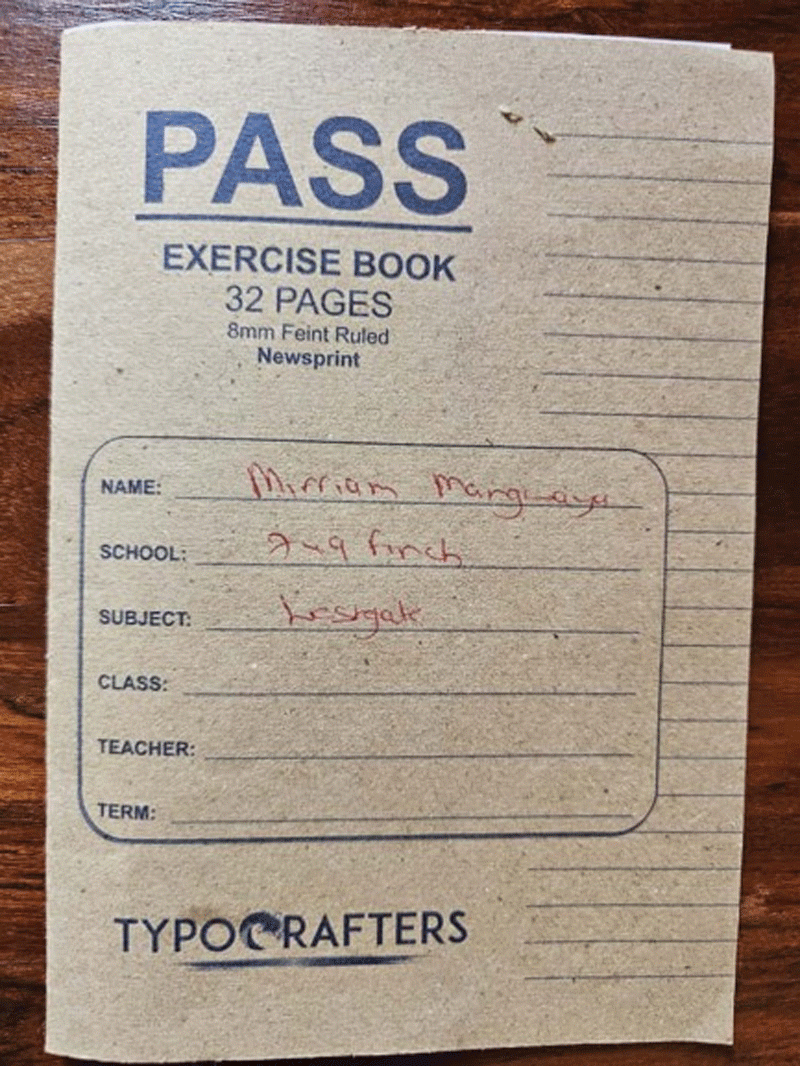
Patients at the counter were handed, not the official Harare City Council clinic card, but ordinary A5 32-page exercise books, those found in stationery shops.
When it was the reporter’s turn, the clerk greeted her cheerfully, masking the shady undertone of the transaction.
As the reporter reached for her money, the clerk leaned forward and said: “There are no clinic cards. You can go to the shops to buy a book.”
The reporter hesitated.
The nearest shops were nearly a kilometre away, and leaving the queue to walk there meant hours of delay on return.
The suggestion felt more like deliberate frustration than an honest solution.
Sensing the reluctance, the clerk lowered her voice and offered an alternative: “But I have a book here. It costs a dollar.”
The reporter handed over the money.
A book was provided, but the transaction was not receipted.
Only the consultation fee was officially recorded.
At local shops, the very same exercise book costs just 15 cents.
Yet at the clinic counter, patients were forced to pay almost seven times the price, with the proceeds pocketed by staff.
The investigation revealed that nurses and clinics’ supportive staff often appear reluctant to work unless there was some form of cash flowing into their pockets.
On July 7, 2025, at Mt Pleasant Clinic, Truth Diggers joined a group of about five patients waiting helplessly in the reception area at around 10am.
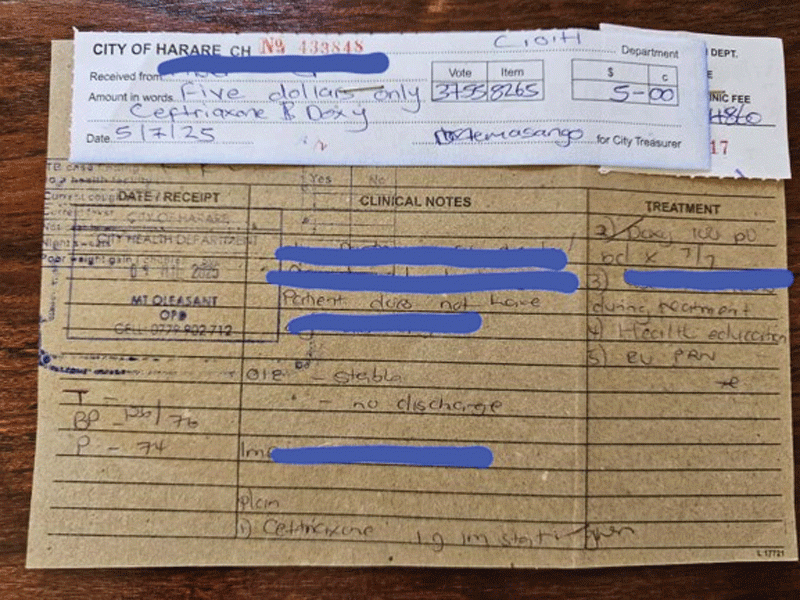
By then, some had already endured nearly two hours without being attended to.
At around 11 am, a middle-aged man, seemingly in a hurry, walked into the clinic and requested to be examined.
He was told the clerk, who handles payments and initiates the patient process, had not yet arrived.
When he requested the clerk’s number, a nurse opted to call her instead.
The conversation on the other end was inaudible, but after she hung up, the nurse relayed the message: “She says she is on her way, but she is not sure what time exactly she will be here.”
Frustrated, the man left, promising to return.
Minutes later, the clerk finally walked in, and the day’s work began.
Before long, the hurried patient returned and, on his turn, approached the counter to pay the consultation fee.
Courteously, he asked the clerk why she had reported for duty so late.
“I was delayed at the bus stop waiting for transport that charges US$0,50 instead of the ordinary US$1, because I had no money. The council has been delaying paying us our salaries, so I can’t afford the ordinary fares.”
Residents’ representatives have also decried what they describe as systemic corruption at council-run clinics.
Combined Harare Residents Association (CHRA) director Reuben Akili told Truth Diggers that corruption in municipal health facilities has become a recurring concern raised by residents across the capital.
“The issue of corruption at council clinics has dominated our meetings with residents,” he said.
“Communities are frustrated because they are being forced to pay for services that should either be affordable or free.
“What is worse is that the money is not going into the council coffers. It is being pocketed by individuals.”
Akili added that residents feel abandoned by a system that was meant to provide primary health care, but instead has been captured by unscrupulous practices.
Contacted for comment, Harare City Council spokesperson Stanley Gama said: “I will come back to you.”
Gama did not respond to follow-up questions sent to him last Thursday.
*Truth Diggers is the investigative unit of Alpha Media Holdings (AMH), publishers of NewsDay, Zim Independent, The Standard and Southern Eye. AMH also operates an online broadcasting channel HStv