
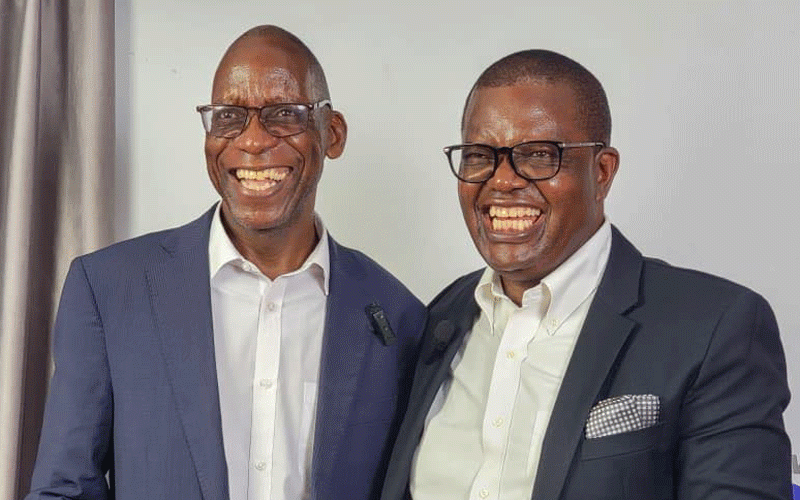
In a chilling testament to Zimbabwe’s escalating crisis, Lovemore Madhuku (LM) — renowned lawyer and NCA leader — recounts a brutal assault by masked men while police stood idly by.
This interview on the platform In Conversation with Trevor hosted by Alpha Media Holdings chairman Trevor Ncube (TN) exposes a country descending into "total lawlessness," where constitutional protections are being dismantled to entrench power.
At the heart of the struggle is Constitutional Amendment Bill 3 (CAB3), a maneuver designed to scrap direct presidential elections and extend executive terms.
Madhuku’s testimony provides a vital window into the capture of the Zimbabwean state and the high price of opposing a regime prioritising elite interests
TN: Greetings, and welcome to In Conversation with Trevor, brought to you by Heart and Soul Broadcasting Services. Today, I'm in conversation with professor Lovemore Maduku, a lawyer, an academic, and the president of the National Constitutional Assembly (NCA). How are you feeling? The last time I saw you, you were lying in a hospital bed in terrible pain.
LM: Yes, much better. I believe I have recovered.
TN: On the March 1, 2026, men wearing balaclavas in unmarked Ford Raptors stormed the NCA offices and assaulted you and 16 others. Walk us through that. Why do you think they did it, and what was it like?
LM: On that day, we were having a meeting, our first meeting after the publication of the bill. It was held in a big tent, and people were arriving early. By around 8 am., I saw two police vehicles parked outside, but they weren't doing anything. Smaller vehicles came and went.
- Madhuku slammed over Sikhala rants
- Polad a tool to sanitise Mnangagwa legitimacy
- Madhuku speaks on Zim’s new power grab
Keep Reading
We had opened our gate slightly to admit people. Just as someone announced over the mic that we would start in five minutes, about six or seven men forced their way in.
They argued with our security, saying it wasn't a private meeting. I stepped between them and our members. I tried to reason with them, saying, "This is a private NCA meeting. If you don't want it to proceed, tell us, and we will disperse our people."
I didn't get to finish my sentence. One of them said, "What do you think you are? You're causing problems."
Then they started hitting me with batons. One of them fired a shot into the air, and most people scattered. I stayed, receiving blows. This went on for about five minutes.
TN: Were you scared at some point that these people were going to kill you?
LM: I don't know what happens in those moments. Your mind doesn't go that far. You just receive the blows as they come. Initially, I thought they were going to arrest me, so I sat down meaning, "I'm under arrest."
But that didn't happen. After the beating, they rushed out, got into their Raptors, and drove away. The police vehicles were still there, visible to everyone. They watched everything and did nothing.
TN: This isn't the first time you have been assaulted. My count is this is the third time by unknown people. The police were there. They watched. They did nothing. What does that say?
LM: It's very clear these people were working with the police. It was a political action, orchestrated with the police watching.
The message is: we don't want anyone opposing these people, and the best way to deal with opposition is through violence.
The police later issued a statement condemning the attack, then claimed it was fake and said we hadn't notified them which we had. They didn't know how to react.
TN: What does that tell you about where we are as a country?
LM: We are now totally lawless. We are no longer a society based on a constitution or the rule of law.
We are now a society based on the rule of one person or a small group of people running the country.
They tell you what to do, what not to do. There is no respect for the constitution or legal order, only respect for the interests of those in power.
They have captured the state framework: the police, the army, the CIO, everyone must answer to them.
TN: Help me understand this. President Mnangagwa says he is a constitutionalist, that he will not go against the voice of the people.
But he's not giving the people the opportunity to voice anything. You were at the sports centre. You saw what happened.
There's a school of thought that says the men who came with balaclavas represent the cartels—those benefiting from corruption, controlling fuel, mining, construction contracts.
As you sit there, does your mind go there? Do we have cartels that have captured the state and are using the highest office to advance their own motives?
LM: That's a very common theory, and it might be correct. But for me, I don't normally go that far. I'm affected by my legal mind, the constitutional framework. We are a nation with a constitution. We elect a president.
That person has the responsibility, as set out in the constitution, to uphold it. The constitution gives him the powers to control all state frameworks so that we remain a lawful state, run under the rule of law. If other people come in and are allowed to do what they did, we must not lose focus. We must focus on the president.
We have already put mechanisms in place: a constitution, a president, courts, a legislature. The ultimate authority is the president. If he allows others to play around him, we must focus on him. We must not allow that.
TN: But if he stops us from expressing ourselves, if he beats you up for gathering to get a sense from others, what options do we have?
LM: First, the mechanisms in the Constitution to deal with a failing president would have failed.
Remember the last time we ended up with an impeachment process that didn't go all the way. At that time, it was the president coming into office.
I hope people take time to look at what we were accusing that president of doing or failing to do.
The topmost allegation was that he had allowed certain individuals outside his office to run the country's affairs.
He had given up his power to those surrounding him. That was the main charge. Operation Restore Legacy actually started on that note — that the president had become surrounded, and we needed to take those people out.
TN: Help us, in a nutshell, as a lawyer. Explain what CAB3 is doing, which people should reject. What is CA3 all about?
LM: CAB involves two very serious issues. The first is that CAB3 wants to bring nonsense to the position of term limits. Governments come and go. Leaders come and go.
Our constitution says very clearly that a president comes and goes, with a maximum period of 10 years for anyone serving in the office of president. If you are lucky to be re-elected, you might have a few more — but the maximum is 10 years.
If you finish someone else's term, like President Mnangagwa did in 2017, that is not counted. So if he's lucky, he might then have eleven years. But CAB3 says that is nonsense.
It will allow the president to go beyond that period — add as many years as he wants. In this case, he wants two more years.
CAB3 will give him those two more years without the say of any other person, except those who surround him in Parliament.
And just to ensure the president doesn't do that alone, we will also add two years to MPs and two years to councillors.
That's what CAB3 is. But it's not just about giving the president two more years. It's also sending a message that this is doable. If you give him two more years, he might want an additional three more years, and we'll do that.
CAB3 is introducing something totally unacceptable: the idea that a leader in office can decide how much more time they want to remain in office without going back to the people.
The second thing is this very strange proposal. For the past 35 years since 1990 we have chosen our president directly through popular election. CAB3 wants to change that.
The president will no longer be directly elected. Instead, Parliament will elect the president. There will be no presidential campaigns, no manifestos, nothing.
You just choose members of Parliament, and then they sit and elect a president who need not even be a member of Parliament.
You could first know of that person on the day MPs have already elected them. There's no requirement that the proceedings be public.
You could just wake up to be told that yesterday Parliament made someone president.
That is completely against our political culture and our political thinking. We would move from a direct election of a president to an indirect process—an imposition.
Then, of course, they've said around that that the length of time any person will be in office would change from five to seven years. That is just designed to cover up the first part about adding two years.
The other elements in CAB3 are not meant to be anything substantive, just cover.


