Confession time: how many readers have been beaten in their life? How many were beaten when they were at school? How many can still feel the effects of it?
Of course, at the time, it may well have been considered a badge of honour among one’s peers, and even now some people will be muttering that it never did them any harm.
Others, however, will be equally and suitably outraged and appalled that such sentiments can even be mentioned in this day and age. And indeed, it is no laughing or even boasting matter.
However, perhaps we are talking at cross purposes here – but not because we are cross.
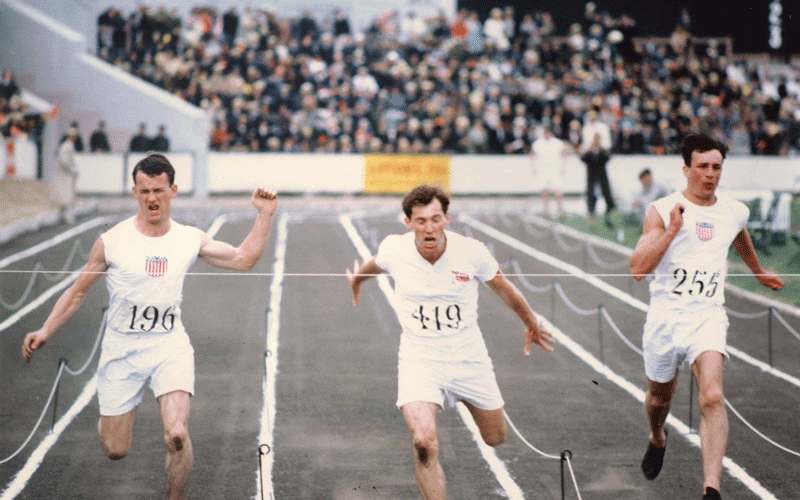
To explain that further, let us consider a short scene from the award-winning 1981 film ‘Chariots of Fire’, where one of the main characters, Harold Abrahams, is in a fit of depression when he had just lost a 100-metre race, that he was expected to win, to his great rival Eric Liddell.
He was being comforted graciously and patiently by his girlfriend, a celebrated actress, who reminded him that “you were marvellous” before adding, with wonderful understatement as a quieter afterthought, that Liddell “was more marvellous – that’s all.
On the day, the best man won”.
Unsurprisingly, she tired of his dark silence and told him to “snap out of it, you’re behaving like a child” to which he simply shouted out “I lost!”
- Chamisa under fire over US$120K donation
- Mavhunga puts DeMbare into Chibuku quarterfinals
- Pension funds bet on Cabora Bassa oilfields
- Councils defy govt fire tender directive
Keep Reading
She did then quietly and poignantly remind him that she had been there and was watching but still he bemoaned his loss and felt like giving up, to which, undeterred, she responded, “If you can’t take a beating, it’s perhaps for the best!”
Ah! So, let us just ask again: how many have been beaten in their life? How many were beaten when they were at school?
How many can still feel the effects of it? Yes, we are talking about that type of beating! Abrahams was quick in his response to his girlfriend and justifiably cried out “I don’t run to take a beating! I run to win!” before adding strongly “And if I can’t win, I won’t run!”
We can understand that feeling, that response, that expression of sheer desperation and disappointment.
The cool dispassionate logical response from the girlfriend, though, to his cry should be heard by us all: “Well, if you don’t run, you can’t win!” Maybe a beating is in fact a badge of honour!
Can we take a beating? And are we helping our children to take a beating?
Are we seeing our children having a tantrum, all because they lost? Are they storming off, in a huff, dejected, forlorn, and giving up, simply because on the day someone or some team happened to be better than them?
Are they just like that child who does not get his way in the playground at breaktime who picks up the ball and marches off, saying “It’s my ball and I’m not playing anymore!”?
Are children behaving like children, because we have not taught them how to play, how to take a beating?
If we reflect further on what we said previously, that while one team will win the World Cup, forty-seven who have qualified for the Finals will not, does that mean all those countries should just give up because they were beaten?
They do not play to take a beating; they play to win. So, really, they should not take part… Perhaps we need to take up the beautiful simple logic that Abraham’s girlfriend applied and conclude that because he does not run to take a beating but runs to win, then only one will win so only one team should enter.
Perhaps Fifa should meet beforehand and decide which team will win so that the others should not have to face the utter disappointment of losing.
Yet why was it that when Usain Bolt was at his peak (which, it has to be admitted, lasted some time) and was always likely to win, all the other runners still ran against him?
Surely they knew that on form (as we noted with soccer teams in the previous article) they knew they could not expect to win? Why did they bother? Did they not read the script: “If I can’t win, I won’t run!”?
In short, we need to help our children not to behave like children all their life. We need to help our children to learn to take that beating (we might have added “like a man” but as we have seen, and still see, not all men take a beating well, especially on the sports field).
It certainly will not do them any harm to learn that at an early age. Yes, they must run to win; yes, they must run so they will not take a beating. But they do not give up competing just because they cannot win. It is for the best.