When we think of poetry, our first thought might be that it tends to deal with romantic themes. We might consider Shakespeare’s Shall I Compare Thee to a Summer’s Day, Elizabeth Barrett Browning’s How Do I Love Thee, Lord Byron’s She Walks in Beauty, Thomas Hardy’s The Voice or even the Scots poet, Robert Burns with his A Red, Red Rose. Interestingly, Burns’s poetry also touched on other, stranger topics, most famously To a Haggis (that great Scottish culinary treat).
Burns also wrote a poem To a Mouse, explaining that he did so “On Turning her up in her Nest, with the Plough, November 1785”. The poem begins with the lines “Wee, sleekit, cowrin, tim’rous beastie, O, what a panic’s in thy breastie!” questioning why the mouse is so scared and wanting to run away, when he is not inclined to chase it. Later in the poem, Burns goes on to state the popular, universal, eternal truth that “The best-laid schemes o’ mice an’ men gang aft agley, an’ lea’e us nought but grief an’ pain, For promis’d joy!” In modern English, he opines that all our well-planned schemes often go astray, haywire, up the creek, and leave us only sadness and hurt.
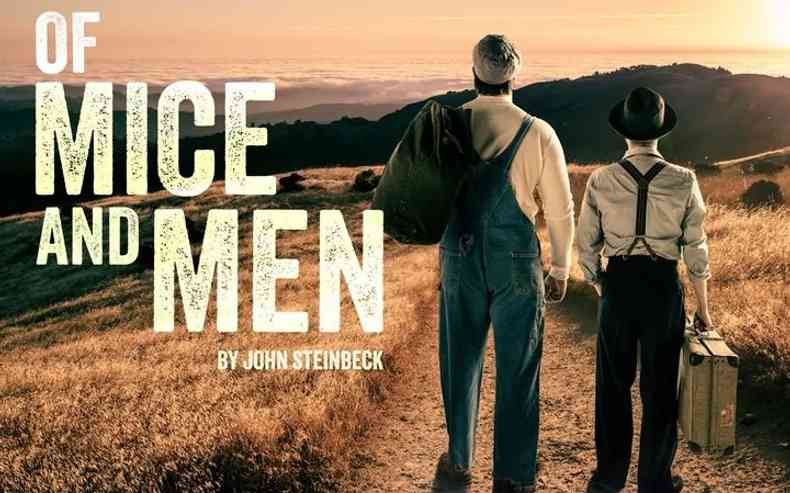
Many of us may have been spared Burns’s poetry, but have unromantic memories of having to study as a set book the John Steinbeck 1937 novella Of Mice and Men, (that takes its title from Burns’s poem), which describes two displaced, very different, migrant ranch workers, moving from place to place in California, searching for jobs during the Great Depression, with the romantic dream of settling down on their own piece of land, only for it, in Burns’ words, to “gang agley”. The novel has been described as “a parable about what it means to be human” by looking at the obstacles that stand in the way of their ambition. Steinbeck himself wrote that “In every bit of honest writing in the world, there is a base theme”, going on to explain that base theme as “Try to understand men”. It is about being men. In the words of another Burns poem, A man’s a man for aw that.
There is another well-known poem, written by Rudyard Kipling around 1895 entitled very simply If. In many ways, the theme of the poem is similar to that of Burns’s poem Of Mice and Men by taking the reader through numerous different scenarios, encouraging him to understand that if he can navigate the good and the bad, the calm and the stormy, with a balanced equilibrium, then he will have done well. He starts by saying “If you can keep your head when all about you are losing theirs and blaming it on you; If you can trust yourself when all men doubt you, but make allowance for their doubting too; If you can wait and not be tired by waiting, or being lied about, don’t deal in lies, or being hated, don’t give way to hating, and yet don’t look too good, nor talk too wise”. The possible scenarios are endless. If you can do this, if you can do that, if you can do the next…
He finishes off by challenging us that “If you can talk with crowds and keep your virtue, or walk with Kings—nor lose the common touch; if neither foes nor loving friends can hurt you; if all men count with you, but none too much; if you can fill the unforgiving minute with sixty seconds’ worth of distance run,” then one thing is certain.
What we would expect that to be would be that we will be a success — we will be a professor, a minister, a CEO, a success. Well, at least that is what we as parents or teachers often tend to state but it is not the conclusion of the poem. Instead, he wisely ends with the assurance that “You’ll be a Man, my son!” The aim for us all should be that we will be a man.
It perhaps links with a traditional proverb allegedly dating back to the 15th-century educator William of Wykeham, saying that “Manners maketh man”, which has at its heart the understanding that a person’s true character, worth, and humanity are defined by their behaviour, courtesy, respect, and dignity, by how they treat others, rather than their wealth or power or achievement — thus, be a man.
The implication will be that if we do not behave in the way described then we are not a “man” and we are no more than a “Wee, sleekit, cowrin, tim’rous beastie”; we are immature, small, inhuman.
- More woes for suspended Cottco boss
- Muzarabani eager for Chevrons to qualify for Australia 2022
- Japan brings cheer to Gokwe
- R. Kelly sentenced to 30 years in sex trafficking case
Keep Reading
The goal of education is to make men, to develop better people, complete with humility, reliability, accountability, responsibility, integrity.
The very best curriculum we should follow is very simply but clearly to be found in the poem If, to produce real men – the question is if we will follow that curriculum. Will we be such a man or woman? Are we a man or a mouse? And what burns inside us?