The two books under review deconstruct the view that over time ideologies like living species suffer extinction. Using African nationalism as a case in point for this assertion, Lungani Zwangobani projects the nation as a living being formed in memory, traversing the present and in the process creating its future.
At the centre of both texts’ thematic framing is the role of ideology as a catalyst to the motion and force which gives existential continuity to nations. Zwangobani places Afro-optimism at the centre of both his accounts to demonstrate that the evolution of the national question in Africa was and will be forever sustained by organic value systems which are anchored on the continent’s continued fight for freedom.
With this rich perspective, it is befitting that the two books will be officially launched by Vice-President Kembo Mohadi next Thursday. This an important gesture demonstrating the state’s fidelity to championing ideation even in moments when pitfalls of national consciousness are textually stripped bare. Both books are sincere about porous elements endangering the decolonisation project.
This dual book launch demonstrates the growing role of literature in narrativising a nation’s journey and its people’s collective memories in creating building blocks to posterity.
Through creative and evidence-based framing of the Zimbabwean’s story, both books are useful review entry-points of the social contract which nationalist movements have with the people of the continent.
Beyond interrogating how these movements are key in delivering the anti-colonial social contract of delivering prosperity, both texts are an expression of the author’s faith in the enduring importance of liberation movements in guaranteeing developmental perpetuity in Africa.
A Daring in November: iNgwenya-ngwenyama, An Indomitable Spirit
This fictional allegory explores the intricate tapestry of Zimbabwe’s past, present, and imagined future through the life of Victor, a man born in 1980 whose personal journey mirrors the rhythm of national independence.
- Zanu PF bigwigs thrown under the bus
- Feature: Killings raise gender violence concerns in Zim
- Bulawayo a great, clean city: Mohadi
- Probe Zec commissioners, govt told
Keep Reading
The story is primarily set in Damba village, within the Silobela area, a place originally designated as a colonial "native reserve" intended for those relegated and displaced. Central to the narrative is the mystical iNgwenya-ngwenyama, a "crocodile-lion" spirit that symbolises an invincible national resolve that awakens during seasons of reckoning.
The plot follows Victor as he navigates the hardships of a struggling economy, famously illustrated by a scene where his wife, Nqobile, questions if "three fish" from a drying river is the best a man can provide for his family. Victor’s struggles are deeply linked to the trauma of his elders, particularly Uncle Nkathazo, a war veteran living in a cramped Mbare flat who recounts the horrors of the liberation struggle, the Chimoio massacre, and the subsequent "moments of madness" and economic dislocation. These memories serve as a backdrop to Victor’s own sense of being "captured" by urban decay and the broken promises of the past.
The narrative reaches a turning point during the November 2017 transition, described as a moment when the "crocodile-lion" spirit stirs and the people dare to rise at an unlikely season. Following a stint in Harare, where he encounters the "warships" of state bureaucracy, Victor experiences a spiritual and practical awakening. He decides to return to Damba, transforming the village from a "reserve" into a "productive preserve" through the adoption of Vision 2030 principles.
By the end of the book, Victor has established a thriving agricultural plot using modern technology, such as drones and smart irrigation, which serves as a "university of the people" for local youth. The story concludes with a shift in leadership; Victor realises his purpose is in the fields, while he encourages Nqobile to run for the councillor seat, signalling a new era where governance is driven by those who "listen better" and prioritise developmental delivery.
Why Zanu PF Must Succeed: Golden Jubilee Reflections
This factual political treatise advances the thesis that Zimbabwe’s national trajectory is fundamentally inseparable from the internal renewal and performance of its governing party. As the nation approaches its Golden Jubilee (50 years of independence), the author argues that the "national question" has shifted from the consolidation of sovereignty to the mandate of delivery. The book posits that Zanu PF, as the central organizing force of the state, must transition from a reliance on "liberation legitimacy" to "performance-based legitimacy".
The text is divided into structural pillars, beginning with the developmental party-state concept, where political dominance is used as a tool to coordinate the state around a national development agenda rather than merely retaining power. It explores the history of the party from 1980 through various phases of stabilisation and crisis, characterising the 2017 transition as a necessary "internal system correction" that allowed for the birth of the Second Republic. Under this new era, the party is tasked with modernising its systems and converting "control into economic transformation".
A significant portion of the book focuses on Vision 2030 and the National Development Strategy (NDS1/2), emphasising infrastructure-led growth, digital transformation, and results-based public administration through performance contracts. The author highlights youth as the strategic pivot, arguing that the Zimbabwe Youth Council must be reformed from a simple administrative registry into a developmental authority that ensures youth are active producers in the economy rather than peripheral observers.
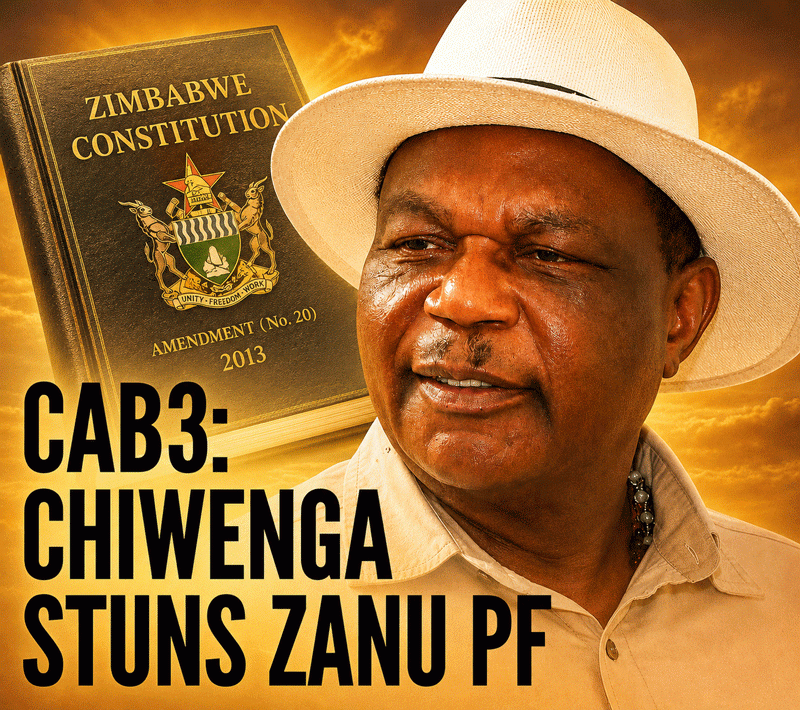
The book also addresses constitutional modernization, defending reforms such as longer planning horizons (extending presidential terms) to synchronize political cycles with long-term industrial projects. Finally, the work concludes that at the 50-year mark, the party faces a legitimacy test: it must succeed in delivering prosperity, as its failure would risk national stagnation. The "unfinished mission" of Zimbabwe is thus described as the responsibility to ensure that the freedom won by one generation becomes the prosperity enjoyed by the next. This intergenerational political-economy democratisation presented in both books represents a continuum which guarantees governance excellence through the years of a nation’s evolution.