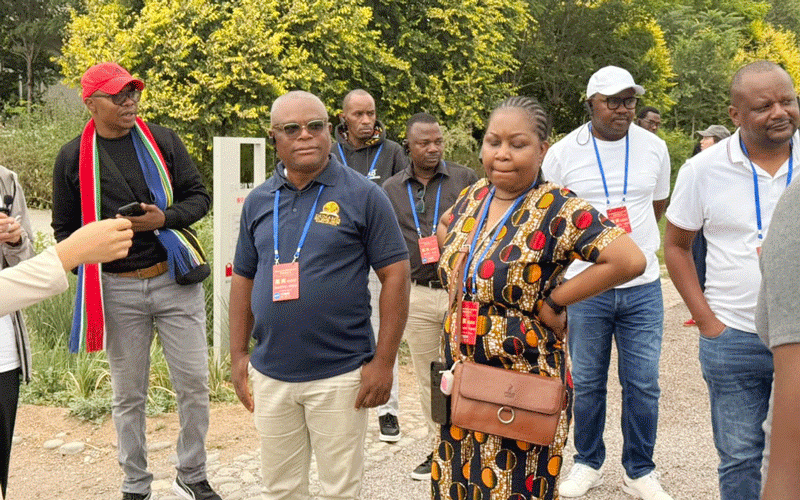
In the last fortnight, I had the distinct privilege of being among a delegation of journalists from across the African continent on a learning visit to the People’s Republic of China.
Our journey, which was at the invitation of the Chinese Communist Party, took us deep into the heart of the Ningxia Hui Autonomous Region.
While the primary focus of our visit was to attend the International Seminar on Xi Jinping’s Thought on Socialism with Chinese Characteristics for a New Era and its Relevance to the World in the city of Yinchuan, the true education lay in the landscape itself.
As we travelled through this territory, it became clear that Ningxia serves as a living laboratory for what is perhaps the most significant humanitarian achievement of the modern era: the eradication of extreme poverty.
Ningxia is situated in northwest China, nestled within the upper and middle reaches of the Yellow River.
With a land area of 66 400 square kilometres, it governs five prefecture-level cities — Yinchuan, Shizuishan, Wuzhong, Guyuan, and Zhongwei — alongside 22 county-level districts.
Historically, this was a land defined by hardship and aridity, yet today it stands as one of China's most celebrated examples of east-west cooperation in poverty alleviation.
Our tours of the China-Central Asia Cooperation Centre for Combating Desertification, the Beryl Yanhonzishu Goji Estate, and the Yuanshi Vineyard revealed vividly how China has managed to lift over 800 million people out of extreme poverty in the last four decades.
- Chamisa under fire over US$120K donation
- Mavhunga puts DeMbare into Chibuku quarterfinals
- Pension funds bet on Cabora Bassa oilfields
- Councils defy govt fire tender directive
Keep Reading
This historic achievement accounts for about 75% of global poverty reduction. By 2021, the Chinese government declared all absolute rural poverty eradicated, meeting the United Nations' Sustainable Development Goal 10 years ahead of schedule.
The success of this transformation is not a matter of chance, but of a meticulously designed strategy known as the paired assistance programme.
Since 1996, China has been pairing its more developed eastern provincial-level regions with relatively less developed western ones, creating a bridge of resources and expertise.
This initiative was championed by President Xi Jinping when he was a senior official in Fujian, where he oversaw the progress of cooperation between Fujian and Ningxia.
Under his leadership, these regions took the lead in establishing a joint conference mechanism and initiating a mutual exchange of officials through temporary assignments.
Thousands of officials made the journey from the prosperous east to the impoverished west, ensuring that development was not just a distant goal but a supervised, daily reality.
As we stood in the Minning Pavilion for East-West Paired Assistance, the weight of this commitment became tangible.
The programme was not a temporary publicity stunt, but it was a decades-long endeavour that resulted in all 803 000 impoverished people in Ningxia being lifted out of poverty by 2020.
This achievement stands as a testament to the Communist Party of China’s visionary leadership, sound policy implementation, and an unwavering commitment to improving the lives of the people.
In places like the Minning Hemei E-Commerce Workshop, we saw rural women who were once isolated from the economy now integrated into global trade, proving that even the most remote communities can thrive when provided with the right infrastructure and support.
For African journalists, these observations inevitably lead to a sobering reflection on our own national path.
Our political leadership frequently claims to follow China’s development model, yet the comparison reveals a yawning gap between rhetoric and reality.
The Chinese experience has demonstrated that the eradication of poverty requires four key pillars which are strong political will, correct theoretical guidance, precise operational mechanisms, and broad social mobilisation.
In Ningxia, we saw these pillars in action through an approach that emphasises tailoring policies to local conditions and accurately identifying impoverished households to ensure resources are deployed efficiently.
In Zimbabwe, we often have the “theoretical guidance” in the form of glossy policy documents, but we lack the precise operational mechanisms that turn plans into progress.
China’s success was built on accurately knowing exactly who was poor and why, rather than applying vague, one-size-fits-all solutions.
Their model required a level of accountability where thousands of officials were sent to the frontlines of rural development, their own career advancement often tied to the success of the villages they served.
In contrast, Zimbabwe’s political will often seems to dissipate once the speeches are over and the cameras are off, leaving the actual work of poverty alleviation to stall in a sea of bureaucracy and lack of implementation.
The transformation of once-impoverished communities into thriving centres of economic activity, as seen in the vineyards and estates of Ningxia, proves that poverty is not an inescapable destiny but a structural failure that can be corrected through discipline.
If Zimbabwe is to truly follow this path, the leadership must move beyond merely borrowing Chinese slogans and begin adopting the Chinese culture of results.
We have the land and the talent, but we lack the "east-west" mindset where our more prosperous sectors are mandated to uplift the struggling ones through a supervised and permanent mechanism of assistance.
China did not achieve its miracle through luck, but through a strategy that prioritised the people over political posturing.
The vineyards of Ningxia were once desert sands, and they only bloom today because of a leadership that was willing to pair vision with the hard, precise work of grassroots mobilisation.
For Zimbabwe to witness a similar transformation, our leaders must stop treating the "Chinese path" as a convenient talking point and start treating it as a rigorous blueprint for national survival.
Only then will we move from the rhetoric of “Vision 2030” to the reality of a country where no household is left behind.