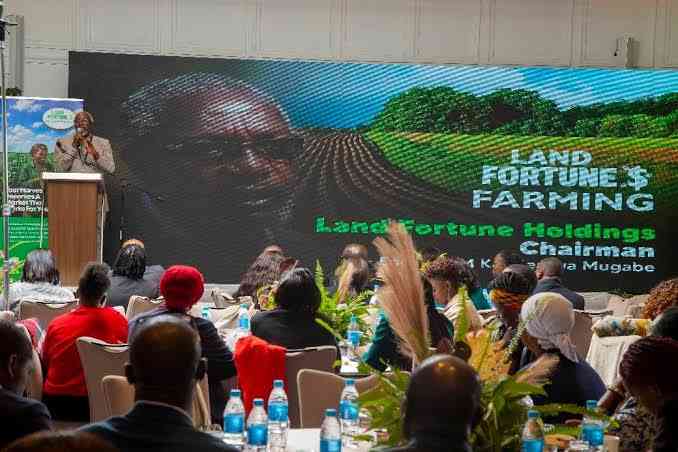
A week or so ago, within the welcoming confines of the Hyatt Regency Harare, I found myself thinking less about technology and more about the village markets I grew up knowing.
Before dawn, farmers would arrive with baskets of tomatoes, bags of maize, groundnuts, vegetables, chickens and goats.
Buyers negotiated prices beneath old trees, transporters waited patiently for full loads, and conversations travelled as quickly as the produce itself. Many fathers, who rarely participated in market days, would wake to discover there was no chimutsa left.
By sunrise, prices had already been agreed, transactions completed, and the musika was in full swing before children even began their walk to school.
Long before the digital age, our communities understood something economists continue to emphasise today: markets are not simply places where goods are exchanged.
They are institutions that shape livelihoods, create opportunity and determine how wealth circulates within communities.
That memory returned vividly during the launch of Land Fortune Marketplace. While many saw another digital platform entering Zimbabwe's agricultural landscape, I saw something different—a chance to modernise one of Africa's oldest economic principles: collective enterprise.
Zimbabwe is steadily embracing digital innovation. Motorbike deliveries are becoming commonplace, ride-hailing platforms have transformed urban transport, and online shopping has become increasingly familiar to consumers.
- Why Maser CEO Suri thinks AfCFTA is a winner for start-ups
- AfCFTA bolsters Zim SMEs
- Outcry over state of Binga-Dete road
- Why Maser CEO Suri thinks AfCFTA is a winner for start-ups
Keep Reading
Agriculture should not be left behind. What stood out about Land Fortune Marketplace was not merely its technology, but its ambition to simplify supply chains, provide real-time market information and create trusted payment channels while strengthening the largely women-led cooperative systems that have sustained rural economies for generations.
Anyone familiar with our agricultural markets knows the frustrations that persist.
Stories of unscrupulous middlemen, inconsistent prices and information asymmetry are common. Too often, the people who carry the greatest production risks—the smallholder farmers—receive the smallest share of the value created.
The platform's vision reminded me that technology should not replace our traditional market systems; it should strengthen them.
For decades, agricultural transformation across Africa has largely been measured by one question: how much food can we produce? Governments and development partners invested heavily in irrigation, improved seed, mechanisation and climate-smart agriculture. These investments remain essential, particularly as climate change continues to threaten agricultural productivity.
Many farmers harvest excellent yields but remain trapped in poverty because markets are fragmented, transport is unreliable, pricing information is uneven and bargaining power rests largely with buyers.
Through initiatives such as the My Food is Zimbabwean campaign and many other farmer-centred programmes, we have encouraged communities to increase production. We must now devote the same energy to improving the systems that convert production into sustainable incomes.
Across the continent, the Comprehensive Africa Agriculture Development Programme (CAADP) has evolved from focusing primarily on production towards building resilient agrifood systems that stimulate agribusiness, create employment and strengthen regional trade.
The recently adopted Kampala CAADP Declaration reinforces this vision by placing greater emphasis on competitive value chains, youth participation, digital innovation and efficient markets.
Zimbabwe's own development trajectory reflects this shift. Conversations around the National Development Strategy 1, agricultural transformation, horticulture value chains, agro-industrialisation and opportunities presented by the African Continental Free Trade Area increasingly recognise that agriculture cannot transform the economy unless markets evolve alongside production.
Platforms such as Land Fortune Marketplace have the potential to bridge longstanding gaps between producers, buyers, transporters, processors, financial institutions and agricultural service providers.
More importantly, they democratise information. A farmer in Murehwa should have the same access to market intelligence as a trader in Harare. A cooperative in Gokwe should be able to connect with buyers beyond its immediate district. Digital platforms begin to level that playing field.
I often hear people say that Zimbabwean youth are no longer interested in agriculture. I disagree. I believe many young people are not rejecting agriculture—they are rejecting an outdated model of agriculture that offers uncertain incomes, limited innovation and few opportunities for professional growth.
Today's young people are building businesses through digital platforms, mobile payments, software development, artificial intelligence and e-commerce. They understand technology instinctively. Our challenge is not convincing them to farm. Our challenge is ensuring that agriculture becomes part of the digital economy they already inhabit.
Agriculture suddenly extends far beyond planting and harvesting. It creates opportunities in logistics, produce aggregation, warehousing, quality assurance, digital marketing, fintech, drone services, software development and data analytics. These are not peripheral activities—they are the foundation of modern agricultural value chains and represent meaningful pathways for youth employment and entrepreneurship.
For generations, village cooperatives enabled communities to pool labour, purchase inputs collectively, share equipment and negotiate stronger prices. Although many cooperative structures weakened over time because of governance challenges and changing economic realities, the philosophy behind them never disappeared. Rural communities still understand that working together creates resilience.
Imagine every village operating as a digitally connected cooperative. Farmers update available produce in real time. Buyers place advance orders before harvest. Transport is coordinated collectively, reducing costs. Warehouse space is shared more efficiently. Digital payment records build financial credibility, making it easier for members to access loans and insurance. Extension officers deliver advisory services directly through integrated communication channels while market information reaches farmers instantly instead of travelling slowly through informal networks.
Instead of fifty farmers negotiating individually with buyers, they aggregate produce into commercially attractive volumes capable of supplying supermarkets, processors, exporters and institutional markets. Collective bargaining improves, transaction costs decline and communities retain more of the value they create.
Africa has already shown what is possible when technology solves everyday problems. Kenya's M-Pesa transformed financial inclusion because it made transactions simpler and more accessible. Twiga Foods demonstrated that digital innovation could reorganise agricultural markets by strengthening relationships between producers and buyers. Their success was not built on technology alone, but on understanding the realities of the communities they served.
Rather than copying external models, we can develop digital platforms grounded in our agricultural systems, our cooperative traditions and our rural realities. If Land Fortune Marketplace succeeds, it will not be because it resembles successful platforms elsewhere. It will succeed because it understands Zimbabwean farmers, Zimbabwean markets and Zimbabwean communities.
Of course, technology alone cannot solve every challenge. Digital inclusion must remain central. Low-data applications, USSD functionality, multilingual interfaces, WhatsApp integration and intuitive user experiences are essential if no farmer is to be left behind. Equally important is trust. Farmers must know that the information they share is protected and ultimately serves their interests.
As Zimbabwe aligns its agricultural reforms with the aspirations of CAADP, AfCFTA and its own national development agenda, I believe our greatest innovations will emerge not only from policy documents or conference halls but from communities willing to organise differently and young entrepreneurs willing to solve old problems with new tools.
That is why I believe the significance of Land Fortune Marketplace extends far beyond digital commerce. I see villages becoming connected business communities rather than isolated production centres.
I see women entrepreneurs reaching wider markets without unnecessary intermediaries. I see youth building businesses in logistics, software development, digital finance and agricultural services while remaining economically rooted in rural Zimbabwe.
The true measure of success will never be downloads or transaction volumes.
Success will be measured by whether a young graduate chooses to build an agribusiness instead of leaving the countryside, whether a village cooperative secures its first long-term supply contract, whether a woman farmer earns a fairer price through transparent market information, and whether rural communities become centres of enterprise rather than places young people feel compelled to leave.
If the twentieth century was built on the village cooperative, perhaps the twenty-first will be built on the digital cooperative.
If we get that right, Land Fortune Marketplace will be remembered not simply as another application, but as one of the innovations that helped reconnect Zimbabwe's farmers to opportunity—one marketplace, one village and one generation at a time.
*Darlington Mafa is the coordinator for Rima Africa Trust and has passions in agritech, community climate change mitigation and adaptation and environmental restoration. These weekly articles are coordinated by Lovemore Kadenge, an independent consultant of Zawale consultants (Private) Limited, past president of the Zimbabwe Economics Society and past president of the Chartered Governance Accountancy Institute in Zimbabwe. Email [email protected] or mobile +263772382852