
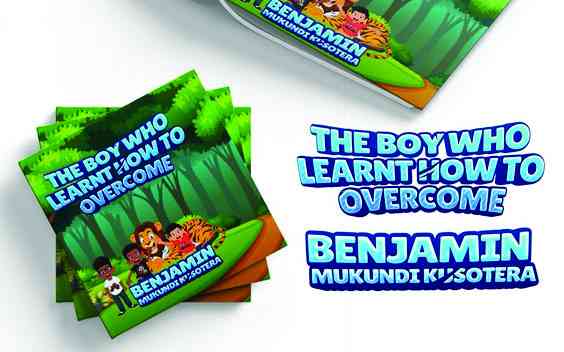
In a world where children are often expected to be resilient without being fully understood, The Boy Who Learnt How to Overcome stands out as a rare and authentic reflection of childhood reality.
Written by Benjamin Mukundi Kusotera, an eight-year-old Zimbabwean author, the book is deceptively simple yet emotionally profound. It draws readers into the inner world of a child navigating fear, difference, bullying and self-discovery—experiences that are painfully familiar to many children in Zimbabwe and beyond .
At the heart of the story is Mukundi, a young boy growing up in a farming community with his family.
His life is grounded in ordinary routines—school, chores, play and family interactions.
This ordinariness is precisely what gives the story its power.
Mukundi is not portrayed as extraordinary or heroic at the beginning; he is simply a child trying to belong.
His challenge, a stutter, becomes the lens through which the book explores vulnerability, cruelty and ultimately, courage.
Bullying forms the emotional backbone of the narrative.
- In Full: Fourteenth post cabinet briefing: May 31, 2022
- Rwanda calls out Zim on genocide
- Govt sweats over Rwandan fugitive links
- Accident, piracy affected my career: Zembe
Keep Reading
Mukundi’s stutter makes him a target for mockery and intimidation at school, particularly from Mandla, a bully who exploits his fear and silence.
The book does not sanitise this experience. Instead, it captures the quiet pain of being laughed at, the anxiety of break time, and the helplessness of feeling smaller than others.
In doing so, it reflects the lived reality of many Zimbabwean children who endure bullying related to speech, poverty, disability or perceived weakness—often without the language or support to articulate their pain.
One of the most striking strengths of the book is its honesty. Mukundi does not suddenly become fearless, nor does his stutter disappear.
His journey is gradual, marked by doubt, setbacks and reflection.
This realism is crucial. It teaches young readers that overcoming does not mean becoming perfect; it means learning how to live confidently with one’s imperfections. In a society where success is often framed as flawlessness, this is a deeply humanising message.
A key turning point in the story comes through storytelling itself. Mukundi hears stories—particularly the tale of animals uniting against a bully—which introduce the idea that strength lies not only in individual bravery but in unity.
This lesson resonates strongly within African and Zimbabwean cultural traditions, where storytelling has long been used to pass down wisdom, values and survival strategies.
The metaphor is clear: alone, one may feel powerless, but together, even the strongest bully can be confronted.
The figure of the liger—Mukundi’s favourite animal—emerges as a powerful symbol.
Half lion, half tiger, the liger represents courage, confidence and inner strength. When Mukundi begins to imagine himself as a liger, he is not escaping reality; he is reframing it.
This imaginative tool allows him to face his fears and speak up, even when his voice trembles. For children, especially those in challenging environments, imagination often becomes a critical survival mechanism.
The book validates this, showing imagination as a source of empowerment rather than fantasy.
Adult guidance also plays a crucial role in Mukundi’s growth. Characters like Uncle Masimba and his teachers listen, advise and reassure rather than dismissing his struggles.
This is a subtle but important intervention in a context where children’s emotional challenges are sometimes minimised as trivial.
The book quietly reminds parents, educators and caregivers that listening can be transformative. Confidence, it suggests, is not built through punishment or pressure, but through patience and affirmation.
Faith undergirds the narrative in a gentle and accessible way. Mukundi’s repeated affirmation—“God made me, I am courageous, I am confident”—anchors his self-belief. In Zimbabwe, where faith remains central to many families’ moral and emotional frameworks, this spiritual grounding feels organic rather than imposed.
It reinforces the idea that worth is inherent and divinely given, not determined by peers or circumstances.
Beyond its content, the book’s authorship carries its own quiet significance.
That an eight-year-old Zimbabwean child authored this story challenges assumptions about who gets to tell meaningful stories.
It affirms that children are not just passive recipients of wisdom but active thinkers and storytellers. In a publishing landscape often dominated by adult voices and foreign narratives, The Boy Who Learnt How to Overcome reclaims space for local, youthful perspectives.
Ultimately, this is a story about voice—finding it, trusting it and using it.
Mukundi’s victory is not defeating a bully through force, but through confidence, support and the courage to say “no.” In today’s Zimbabwe, where many children grow up navigating uncertainty and pressure far beyond their years, this message is both timely and necessary.
The Boy Who Learnt How to Overcome is rooted firmly in childhood reality. It does not exaggerate pain, nor does it offer easy solutions.
Instead, it offers something far more enduring: hope grounded in truth, courage shaped by community, and the reassurance that even the smallest voice deserves to be heard.
- Fungayi Antony Sox is literary champion, communications and publishing specialist with a decade of experience working with authors, creatives, brands and organisations across sectors. For feedback email him on [email protected] or contact him on +263 776 030 949.


