Contrary to popular belief, controversy is not simply offence, shock, or scandal.
In its most productive sense, controversy emerges when art interrupts comfort, challenges dominant narratives, and forces society to confront realities it would rather ignore.
It is not manufactured chaos, but friction created when truth collides with power, morality, or silence.
This distinction is crucial. There is controversy that is engineered for attention, and there is controversy that is earned through honesty. Hip-hop, historically, has thrived on the latter.
The genre did not become influential because it was provocative; it became provocative because it was truthful.
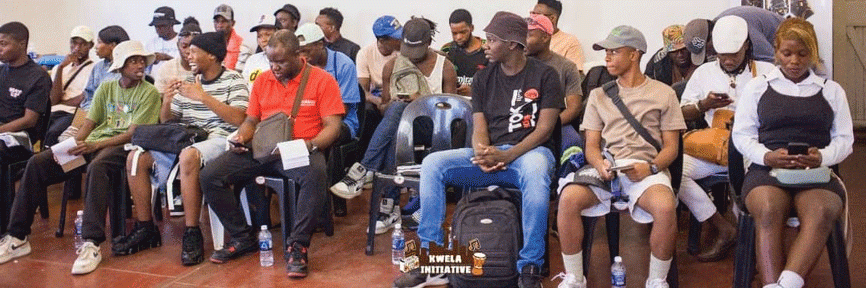
It was against this backdrop that, on 2 February, the Kwela Initiative, moderated by Asaph, convened a discursive forum in Bulawayo, bringing together local hip-hop artists, creatives, producers, and curators. Functioning as a workshop rather than a spectacle, the gathering asked a question that is as much about marketing strategy as it is about culture: does controversy still sell in 2026 and if so, what exactly is being sold?
A notable outcome of the Kwela Initiative discussions was the degree to which many participants demonstrated a clear awareness of hip-hop’s historical foundations, repeatedly referencing its origins as a form of social documentation rather than spectacle.
Contributors situated contemporary debates around controversy within a longer lineage that traces back to the Bronx in the late 1970s, when hip-hop emerged as a response to poverty, policing, racism, survival, and aspiration. What was often labelled by mainstream institutions as “dangerous” or “degenerate” was, as several participants implicitly acknowledged, in fact a form of testimony an insistence on being heard.
- Out & about: Cardi B sways Ye, Lil Durk on a ‘Hot Ish’ ride
- Hexco results out
- Hip-hop show aims at financial literacy
- Byo guitarist turns to the mic
Keep Reading
This historical consciousness shaped how controversy was understood during the forum. Participants drew on global precedents to argue that controversy has never been the primary product of hip-hop, but rather a by-product of storytelling that confronts uncomfortable truths. Early examples were invoked where groups such as public enemy unsettled dominant political narratives by articulating black consciousness, while NWA. provoked outrage through unfiltered accounts of police brutality. Even figures like Snoop Dogg were cited not as deliberate provocateurs, but as embodiments of social realities that many audiences found unsettling to confront.
The discussions further reflected an understanding that this model has persisted across generations, adapting rather than disappearing. Participants referenced how artists like Jay-Z transformed autobiography into a powerful narrative engine, selling stories of ambition, contradiction, and evolution that generated controversy precisely because they resisted moral simplification.
Others pointed to Kendrick Lamar’s work as an example of controversy turned inward where self-interrogation, historical memory, and moral complexity disturb listeners without resorting to spectacle. J. Cole’s career was similarly understood as proof that refusing excess and spectacle can itself be controversial in an industry conditioned to noise. Even the trajectory of Ye was discussed as a cautionary example, illustrating how controversy initially rooted in innovation and vulnerability can lose cultural value when spectacle overtakes narrative coherence.
What emerged clearly from these exchanges was a shared recognition that hip-hop’s most enduring impact has never come from shock alone. The marketing lesson, implicitly articulated across the discussions, was consistent and historically grounded: controversy resonates only when it is earned through story. When controversy becomes a substitute for narrative rather than its consequence, its power diminishes, leaving little behind beyond fleeting attention.
Hip-hop in Zimbabwe is a borrowed genre, but relevance is not inherited; it is locally negotiated. One of the most critical insights to emerge from the Kwela forum was that much local hip-hop adopts the aesthetics of controversy without grounding them in local truth.
The creatives present in the forum expressed concern that controversy is often used as a shortcut to visibility rather than as an outcome of artistic conviction. Shock becomes performance. Outrage becomes branding. In marketing terms, this creates high attention but low brand equity.
Bulawayo, however, is a city saturated with story: migration, industrial decline, township humour, cultural pride, economic precarity, spiritual tension, and historical memory. The problem is not a lack of material it is a failure to market story as value.
Moderated by Asaph, the Kwela Initiative positioned itself not as a publicity stunt but as a discursive intervention. By foregrounding dialogue, disagreement, and reflection, it reframed controversy as intellectual inquiry rather than scandal.
From a marketing perspective, this is significant. Kwela is already building what brand theorists call cultural capital: legitimacy, trust, and depth.
However, like many Zimbabwean creative platforms, it faces structural constraints, particularly limited sponsorship and sustainability.
The challenge, therefore, is strategic: how does an initiative generate visibility and value without collapsing into sensationalism?
The answer lies in repositioning controversy as method, not marketing identity.
In 2026, marketing in the cultural industries is no longer about shouting the loudest; it is about holding attention, not just capturing it. Algorithms may reward outrage, but audiences reward coherence, credibility, and meaning.
Globally successful hip-hop artists do not market controversy; they market narrative arcs. Albums, visuals, interviews, performances, and even silence are aligned around a central story. Controversy emerges naturally when that story disrupts dominant myths.
For Bulawayo artists, the implication is clear:the strongest marketing strategy is narrative-led authenticity.
When artists lead with real stories of place, struggle, contradiction, faith, and ambition controversy becomes unavoidable, but also legitimate. This kind of controversy travels further and lasts longer because it is recognisable as truth.
The Kwela discussions revealed a clear shift away from moment-driven hype toward meaning-driven marketing in hip-hop. Participants agreed that in 2026, what truly sells is not spectacle but story.
Audiences invest in journeys process, growth, and lived experience rather than stunts. When artists tell honest stories rooted in real conditions, controversy emerges naturally; manufactured outrage becomes unnecessary.
Originality, it was argued, comes from radical localisation: local language, humour, memory, and voice matter more than louder provocation.
While algorithms reward virality, a smaller but committed audience continues to sustain careers built on lyricism, concept, and experimentation. Cultural longevity is produced through collective ecosystems of artists, curators, and platforms rather than isolated acts of controversy.
Within a Zimbabwean context, participants stressed the need for a marketing approach grounded in community legitimacy, ancestral memory, and lived truth. Here, artists do not sell rebellion for its own sake, but articulated experience. In this framework, the most radical marketing strategy remains telling the truth well.
Raymond Millagre Langa is a Zimbabwean cultural practitioner, researcher, and creative strategist whose work sits at the intersection of arts, education, and community development. He is the founder of the Indebo Edutainment Trust and is known for using storytelling, edutainment, and participatory cultural practices to advance social dialogue and heritage consciousness.