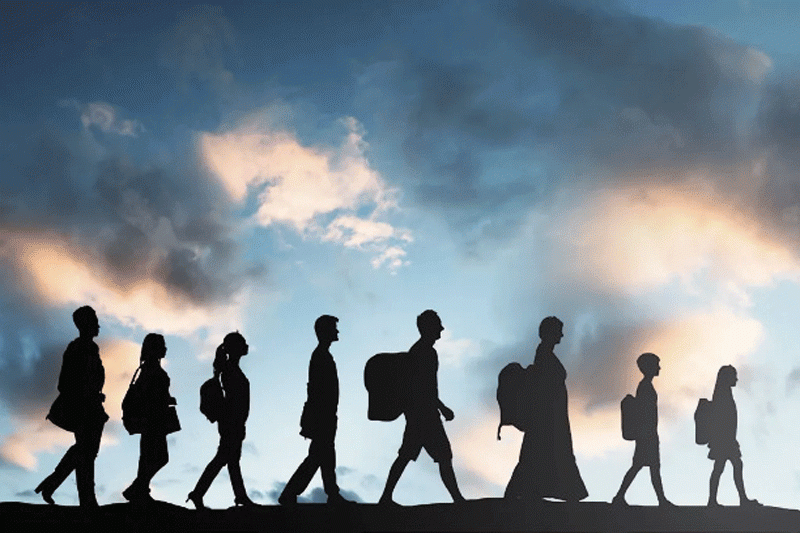
"The migrant carries more than a suitcase. They carry interrupted dreams, inherited memories, unfinished struggles, and the hope that tomorrow may offer what yesterday denied."
There is perhaps no issue that reveals the contradictions of contemporary Africa more vividly than migration. Across the continent, people continue to move across borders in search of safety, opportunity, freedom, and dignity.
Yet the very movement that has defined African history for centuries has become one of its most contested realities.
In public discourse, migrants are increasingly portrayed as invaders rather than survivors, burdens rather than contributors, and threats rather than fellow human beings.
Behind every migration statistic lies a deeply personal story. There is a journalist escaping political persecution. There is an artist seeking freedom of expression.
There is a mother attempting to secure a future for her children. There is a graduate fleeing economic stagnation. There is a family displaced by conflict, climate shocks, or collapsing institutions.
Migration is, therefore, not merely about movement across geographical borders; it is about the human pursuit of survival and possibility.
Yet contemporary migration discourse rarely begins with these stories. Instead, it often begins with suspicion. Migrants are accused of taking jobs, increasing crime, overwhelming public services, and undermining local economies.
- Open letter to President Mnangagwa
- Feature: ‘It’s worse right now than under Mugabe’: Sikhala pays the price of opposition in solitary cell
- Masvingo turns down fire tender deal
- Human-wildlife conflict drive African wild dogs to extinction
Keep Reading
Such narratives dominate political speeches, social media debates, and community conversations. While these concerns emerge from genuine frustrations surrounding poverty, unemployment, and inequality, they frequently obscure the deeper structural realities that shape both migration and social hardship.
What is often forgotten is that migration itself is not the problem. Rather, migration exposes problems that already exist. It reveals inequalities between nations. It exposes failures of governance. It highlights political repression, economic instability, and uneven development. The migrant becomes visible because the systems that failed them have become impossible to ignore.
Migration scholars Stephen Castles and Mark Miller describe migration as one of the defining features of globalization. Their work reminds us that migration is not an isolated phenomenon but part of interconnected global systems of economics, politics, labour, and power.
Human mobility follows opportunities, just as water follows pathways of least resistance. People move because conditions compel them to move.
This reality is evident across Southern Africa. Many migrants who arrive in South Africa do not do so because they have rejected their countries of origin.
Rather, they arrive because circumstances have made remaining increasingly difficult. For decades, Zimbabweans have crossed borders seeking economic opportunities amid prolonged economic challenges.
Others have fled shrinking democratic spaces, political intimidation, restrictions on freedom of expression, and uncertain livelihoods. Similar stories emerge from the Democratic Republic of Congo, Somalia, Ethiopia, South Sudan, and other regions affected by conflict, instability, or systemic hardship.
Migration in these contexts becomes an act of survival. It is often the final response to conditions that have exhausted all other alternatives. To understand migration without understanding these realities is to misunderstand migration altogether.
Yet xenophobic narratives continue to flourish. Why? The answer may lie less in migration itself and more in the politics surrounding it.
French philosopher René Girard's Scapegoat Theory offers important insight. During periods of social crisis, societies often seek visible targets upon whom collective frustrations can be projected. Migrants become convenient scapegoats because they are politically vulnerable and socially identifiable. They become symbols through which broader anxieties about unemployment, poverty, crime, and social change are expressed.
This process is not unique to South Africa. It has occurred throughout history and across continents. However, within the African context, it carries a particularly painful irony.
South Africa's liberation struggle was sustained through continental solidarity. Zambia hosted liberation movements. Tanzania trained cadres. Botswana provided strategic support. Zimbabwe and Mozambique offered refuge to freedom fighters. The struggle against apartheid was never solely a South African struggle. It was an African struggle.
Today, however, some descendants of those very nations find themselves facing hostility within the democratic South Africa their solidarity helped make possible.
This contradiction raises profound moral questions. Has Africa forgotten its own history? Have we become strangers to one another within borders we did not create?
African historian Paul Tiyambe Zeleza argues that mobility has always been central to African civilization. Long before colonialism introduced rigid borders, African societies were connected through migration, trade routes, cultural exchange, and kinship networks. Communities moved across territories in response to environmental conditions, economic opportunities, and social relationships. Movement was not an exception to African life; it was an essential part of it.
Colonialism disrupted these realities. Artificial boundaries divided communities, restricted mobility, and redefined belonging according to administrative categories. In many respects, contemporary xenophobia reflects the lingering influence of these colonial divisions. The tragedy is that Africans now often police boundaries that were originally designed by colonial powers to separate them.
Frantz Fanon warned that colonial domination extends beyond territory into consciousness itself. Even after political independence, colonial ways of thinking can persist. Xenophobia may therefore be interpreted as one manifestation of a deeper colonial inheritance. It reproduces patterns of exclusion, hierarchy, and othering that colonial systems once imposed upon African societies.
The migrant thus becomes more than an outsider. They become a mirror reflecting unresolved questions about African identity itself.
Nowhere is this struggle more visible than within the arts.
Historically, artists have occupied unique positions within society. They are witnesses, storytellers, critics, visionaries, and custodians of memory. Throughout history, migration has profoundly shaped artistic expression. Some of the world's most influential literary works, musical traditions, films, and visual artworks have emerged from experiences of displacement and exile.
African migration has similarly enriched cultural production across the continent. Zimbabwean musicians have influenced South African music scenes. Congolese rhythms have shaped urban soundscapes. Migrant poets, actors, filmmakers, and visual artists have expanded creative possibilities through cross-cultural collaboration. These exchanges demonstrate that migration is not merely a movement of labour. It is also a movement of ideas, imagination, and cultural knowledge.
Yet migrant artists often occupy precarious positions. They contribute significantly to cultural life while simultaneously facing exclusion, discrimination, and limited access to opportunities. Their experiences reveal a paradox at the heart of xenophobic societies: migrants may be welcomed for their talents yet rejected for their identities.
The arts possess the power to challenge this contradiction. Unlike political rhetoric, art invites empathy. Unlike statistics, stories humanise. A theatre production depicting displacement can reveal emotional truths hidden beneath policy debates. A song about exile can communicate longing, grief, and hope more powerfully than any political speech. Through artistic expression, migrants cease to be abstractions and become human beings once again.
Achille Mbembe's concept of Necropolitics deepens this analysis further. Mbembe argues that power often determines whose lives are valued and whose suffering remains invisible. Migrants frequently occupy spaces of uncertainty where they contribute economically and culturally yet remain socially vulnerable. They exist physically within society while simultaneously being excluded from its full protections and recognition.
This creates what may be described as zones of conditional belonging. Migrants are often welcomed when their labour is needed, celebrated when their talents are beneficial, yet rejected when social tensions intensify. Such conditional acceptance undermines the principles of dignity and equality upon which democratic societies claim to stand.
The solution to xenophobia therefore requires more than law enforcement or political statements. It requires a transformation of consciousness. It demands that societies move beyond fear toward understanding, beyond exclusion toward solidarity, and beyond stereotypes toward genuine human encounter.
Ubuntu offers perhaps the most powerful framework for such a transformation. "Umuntu ngumuntu ngabantu" reminds us that our humanity is realized through our relationships with others. Under Ubuntu, dignity is not diminished when shared. It is multiplied.
The migrant is not simply a foreigner crossing a border. They are a parent seeking security, an artist seeking expression, a worker seeking opportunity, and a human being seeking dignity. Their aspirations differ little from our own.
As climate change, political instability, economic inequality, and globalization continue to shape the future, migration will remain a defining feature of African life. The critical question is therefore not whether migration will continue. It will. The question is whether African societies will respond through fear or through solidarity.
History will judge us not by how effectively we built walls, but by how courageously we defended human dignity.
The future of Africa may well depend on our ability to recognize that the stranger at the border is often carrying the same hopes, fears, and dreams that define our own humanity.
*Raymond Millagre Langa is a Zimbabwean scholar and creative thinker whose work explores decolonial philosophy, African identity, culture, youth experiences, and social transformation. He is also associated with community-driven intellectual and artistic initiatives that merge education, philosophy, and creative expression as tools for public engagement and consciousness-building.