National development is often measured through economic growth, infrastructure expansion and policy implementation, yet these outcomes rarely emerge in isolation.
Behind every successful development agenda are ideas that challenge existing assumptions, question conventional approaches and offer practical alternatives to long-standing national challenges.
Books have historically provided one of the most enduring spaces for these conversations, allowing scholars, practitioners and policy thinkers to move beyond political rhetoric and contribute sustained, evidence-based perspectives on the future of their countries.
At a time when public discourse is increasingly dominated by headlines, social media commentary and rapidly changing news cycles, the publication of research-driven books remains an important contribution to national dialogue.
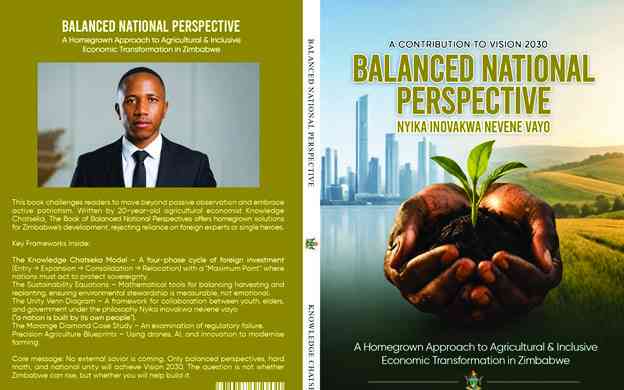
It is within this context that agricultural economist Knowledge Chatseka has released Balanced National Perspectives: A Homegrown Approach to Agricultural and Inclusive Economic Transformation in Zimbabwe, a publication that seeks to contribute to Zimbabwe's evolving development conversation through locally grounded thinking and practical policy ideas.
Rather than presenting development as a collection of isolated economic interventions, the book explores how agriculture, education, innovation, governance and citizen participation can collectively shape sustainable national transformation.
Central to the publication is the Knowledge Chatseka Model, a framework built on the conviction that meaningful development cannot simply be imported from external contexts or replicated from international models without considering local realities.
Instead, the framework argues that Zimbabwe's development trajectory should be informed by its own socio-economic conditions, institutional capacities and cultural context, recognising that lasting solutions are often rooted in local knowledge, local participation and locally driven innovation.
- New perspectives: Funding of an epidemic in an epidemic
- Village Rhapsody: Why project managers fail in Zimbabwe
- Village Rhapsody: Why project managers fail in Zimbabwe
- New perspectives: Funding of an epidemic in an epidemic
Keep Reading
The philosophy underpinning the publication, Nyika inovakwa nevene vayo (a nation is built by its own people), extends beyond a patriotic slogan and becomes a development principle that places responsibility for national progress on collective action rather than individual institutions alone.
It suggests that governments, businesses, academic institutions, development organisations and citizens all have a role to play in shaping economic transformation, and that sustainable development is more likely to emerge where collaboration replaces fragmented approaches to problem-solving.
Agriculture occupies a central position within the book's broader development narrative, not simply as a productive sector, but as an important driver of employment creation, food security, industrial growth and rural development.
The publication argues that strengthening agricultural systems creates opportunities that extend far beyond farming itself, influencing manufacturing, trade, entrepreneurship and household livelihoods, while contributing to broader economic resilience. In doing so, it reinforces the growing recognition that agriculture remains one of Zimbabwe's most strategic assets in pursuing inclusive and sustainable development.
Alongside agriculture, the publication places significant emphasis on education, human capital development, innovation and social inclusion as equally important pillars of national transformation. Economic growth alone, it argues, cannot deliver meaningful development without investments in people, institutions and knowledge systems capable of sustaining long-term progress. By positioning these elements as interconnected rather than independent priorities, the book adopts a holistic perspective that reflects the increasingly complex nature of contemporary development challenges.
Perhaps one of the publication's most significant contributions lies in its recognition of young people and women as active participants in development rather than passive beneficiaries of policy interventions. Development discussions frequently focus on youth unemployment, skills development and social protection, yet far less attention is given to the role that young professionals, entrepreneurs, researchers and innovators can play in generating ideas and influencing policy. By recognising these groups as contributors to national transformation, the publication aligns itself with broader conversations about inclusive leadership and citizen participation in development.
The release of Balanced National Perspectives also reflects the continued relevance of publishing as a platform for shaping public discourse. While digital technologies have undoubtedly expanded access to information and democratised public participation, they have also accelerated shorter forms of communication that often favour immediacy over reflection. Books continue to occupy a unique space within this communication landscape by providing the depth, evidence and sustained analysis necessary to explore complex national issues beyond the constraints of headlines and social media conversations. In this respect, publishing remains an important instrument for documenting ideas, preserving knowledge and stimulating informed debate.
The publication also highlights the important role that emerging scholars can play in influencing national conversations. Development discourse has traditionally been dominated by senior policymakers, established academics and international institutions. Increasingly, however, young Zimbabwean professionals are contributing research, analysis and policy perspectives that broaden public debate and introduce new ways of thinking about economic and social transformation.
This growing body of local scholarship reflects a positive shift towards knowledge production that is rooted in Zimbabwean realities while remaining relevant to wider continental development discussions.
As Zimbabwe continues to pursue Vision 2030 and implement policies aimed at accelerating economic growth and improving livelihoods, there is an increasing need for evidence-based contributions that encourage constructive dialogue rather than ideological division.
Publications such as Balanced National Perspectives demonstrate that nation-building is not shaped solely through legislation, investment or political leadership, but also through ideas capable of informing policy, challenging assumptions and inspiring collective action. By advancing a homegrown framework for agricultural and inclusive economic transformation, the book contributes to a broader conversation about how Zimbabwe can harness its own knowledge, resources and people to shape a more prosperous and sustainable future.
n Fungayi Antony Sox is the team leader & managing editor at TisuMazwi—a communications-driven social enterprise helping individuals and organisations shape, manage, and distribute their stories. He writes at the intersection of publishing, digital media, and African narrative transformation. A YALI alumnus and award-winning communications consultant, he has worked with over 300 authors, creatives, and institutions across Zimbabwe and Africa. He can be contacted at +263 776 030 949 or [email protected].