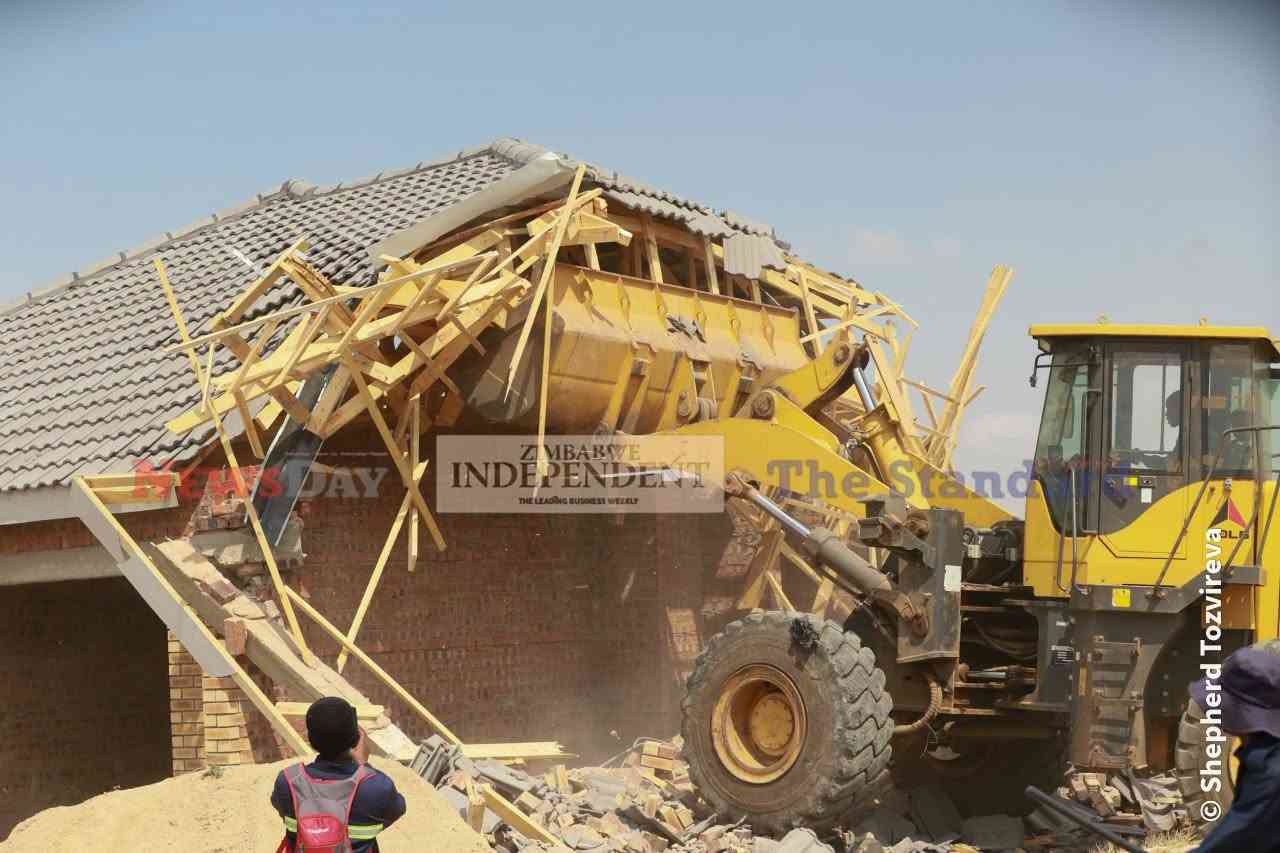
The demolition of homes at St. Martin’s on August 14 has generated serious concern and deserves a sober, balanced and comprehensive examination.
At the centre of the matter is a fundamental question: how can Zimbabwe pursue orderly urban development while protecting the dignity, rights and legitimate interests of ordinary citizens?
The St. Martin’s situation is particularly disturbing because behind every demolished house is a family, and behind every family are years of sacrifice, hard work and financial investment.
For many residents, these homes represented their life savings, security and aspirations for a better future.
A house is not merely a physical structure of bricks and mortar; it is a home where families build their lives, raise children and secure their future.
The distress caused by the demolitions must therefore be acknowledged.
At the same time, Zimbabwe cannot afford uncontrolled settlements, unlawful land allocations, land baronism or development undertaken outside established planning frameworks.
Effective urban planning is essential for sustainable development, infrastructure provision, environmental protection, public safety and orderly expansion of cities and towns.
- Mutorashanga residents confront authorities over shopping centre demolitions
- Evicted families brace for winter without shelter
- Editorial comment: Demolitions: Deal with the root cause
- Demolition of houses an act of inhumanity
Keep Reading
The issue, therefore, is not whether planning laws should be respected. They must.
The critical question is how those laws are enforced and whether enforcement is undertaken lawfully, proportionately, transparently and humanely.
This is where President Emmerson Mnangagwa's philosophy becomes particularly relevant.
President Mnangagwa has consistently advanced the principle of “leaving no one and no place behind” as a defining feature of Zimbabwe’s development agenda.
This philosophy recognises that national development must benefit all citizens and all communities, regardless of geographical location, social circumstances or political affiliation.
Development cannot be reserved for selected communities. It must reach rural areas, growth points, farms, mines, high-density suburbs, low-density suburbs, informal settlements and emerging communities. Every Zimbabwean has a stake in the country's development.
This inclusive philosophy must also inform how government and local authorities respond to challenges involving land and housing.
It does not mean that planning regulations should be disregarded. Rather, it means that enforcement must be balanced with compassion, due process and practical solutions.
Where settlements have emerged outside approved planning frameworks, authorities should, wherever reasonably possible, consider regularisation, upgrading, lawful relocation or other sustainable interventions before resorting to demolition.
Where demolition is genuinely unavoidable because of compelling planning, environmental, safety or other lawful considerations, affected residents must be treated with dignity and subjected to fair and transparent processes.
The St. Martin’s experience also highlights the vulnerability of citizens seeking affordable housing.
Many ordinary people may purchase residential stands believing that they have been legitimately allocated, without possessing the technical expertise to determine whether every planning requirement has been satisfied.
Such citizens can become victims of land and space barons.
The fight against land baronism must therefore distinguish between those who deliberately exploit citizens and citizens who may have been deceived.
The person who illegally allocates or sells land for personal gain should not be treated in the same manner as the citizen who, in good faith, invested their hard-earned money believing they were acquiring a legitimate residential stand.
This calls for stronger coordination between the central government, local authorities, planning authorities and communities.
Citizens must have access to accurate information and reliable mechanisms for verifying land before investing their savings.
Most importantly, St Martin’s must become an opportunity to develop better systems for managing land and housing disputes.
Zimbabwe cannot achieve sustainable development by repeatedly destroying its citizens' investments.
Equally, sustainable urban development cannot be achieved by allowing unlawful settlements and land allocations to continue unchecked.
The solution lies in combining firm regulation with humane governance, effective planning with social responsibility, and enforcement with due process.
This approach is consistent with President Mnangagwa’s vision of an inclusive and prosperous Zimbabwe.
The President’s philosophy of leaving no one and no place behind should be reflected not only in major infrastructure projects and economic programmes, but also in how ordinary citizens experience government and local governance.
The St. Martin’s residents should therefore be viewed not simply through the lens of planning enforcement, but as citizens whose aspirations for decent housing form part of the national development journey.
The tragedy of St. Martin’s should not become merely another controversy that eventually disappears from public attention.
It should become a catalyst for reform in land administration, housing delivery, urban planning and local governance.
Zimbabwe is pursuing Vision 2030 and the creation of an upper-middle-income society.
That journey must be inclusive, lawful, compassionate and people-centred.
We must protect the integrity of our cities without compromising the dignity of our people; enforce the law without losing our humanity; confront land baronism without punishing its victims; and pursue development without leaving communities behind.
If the national development agenda is truly to leave no one and no place behind, then every citizen, including the people of St. Martin’s, must have a meaningful place in the Zimbabwe we are building together.