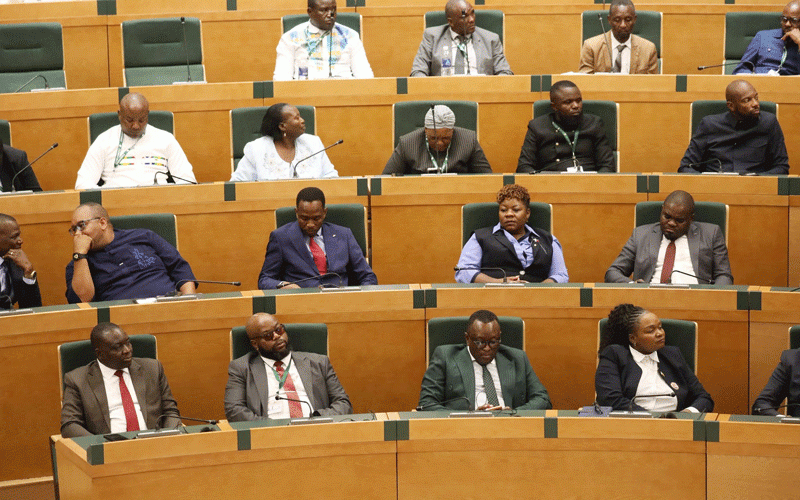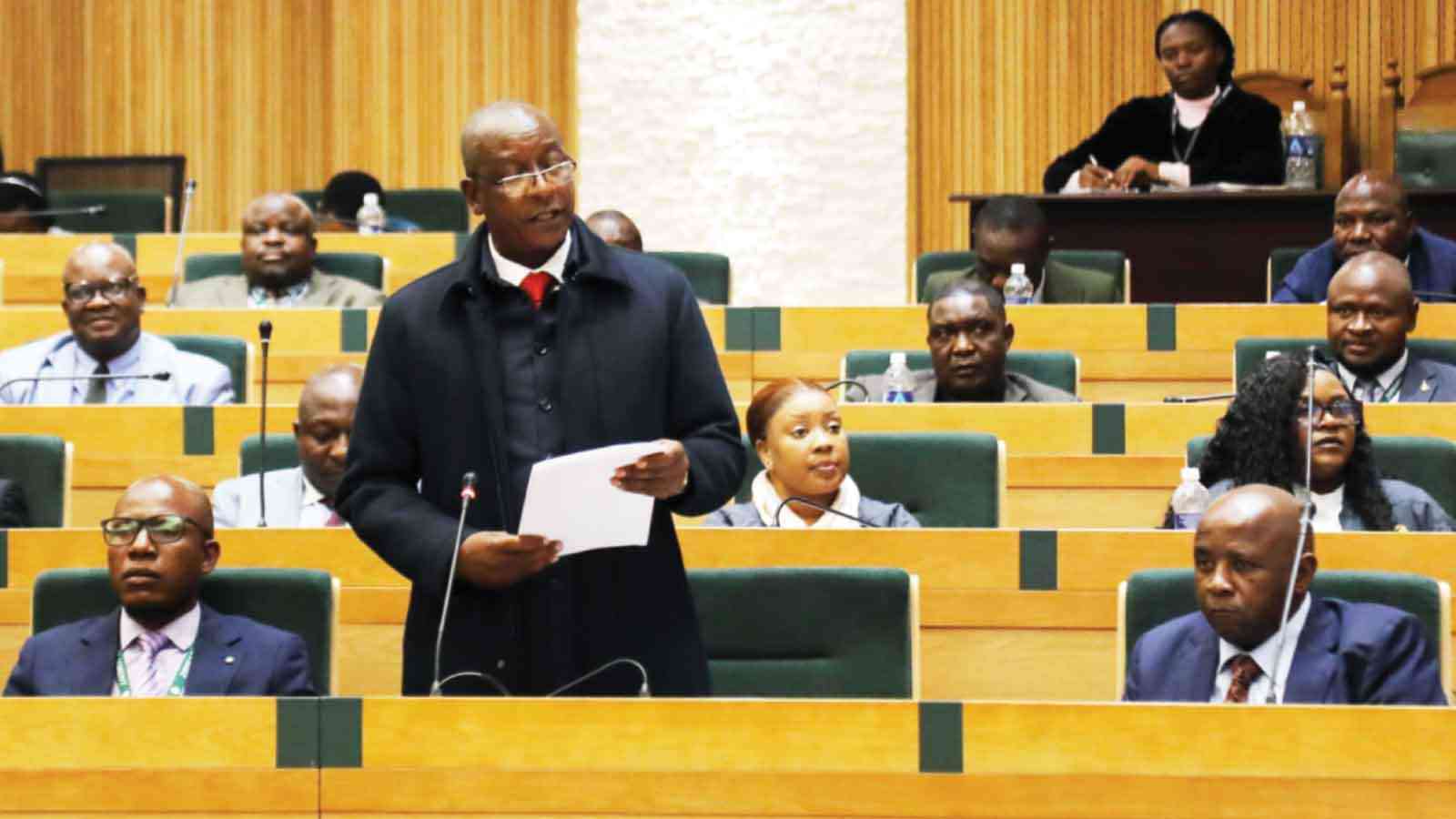
On June 9, 2026, the National Assembly became a theatre of intense constitutional debate during the second reading of the Constitution of Zimbabwe Amendment (No. 3) Bill (CAB3).
Proponents of the bill framed the proposed changes—including the extension of presidential terms to seven years and the move to parliamentary elections for the head of state—as essential for national stability and the realisation of Vision 2030.
However, rising in fierce opposition, constitutional expert and Hatcliffe MP Agency Gumbo characterized the Bill as a fundamental assault on Zimbabwe's democratic architecture. Gumbo’s address emphasized that "strong nations are built by strong institutions, not by extended incumbents
Thank you Hon. Speaker. I rise this afternoon to oppose Constitutional Amendment Bill (No. 3) (CAB3).
I do so not out of partisan obligation, not out of political convenience or political expedience and certainly not out of hostility to constitutional reform.
I do so because this Bill strikes at the very core of our constitutional democracy.
At the outset, let me debunk a notion that we have heard being advanced by the proponents of this bill.
A notion that the opposers of the Bill suggest that constitutional reform is a nullity or it must not happen in modern democracies.
- ED’s influence will take generations to erase
- ‘Govt spineless on wetland land barons’
- Govt under attack over banks lending ban
- Zim Constitution must be amended
Keep Reading
This is not the point we wish to make before this House today.
Constitutional reform by its very nature must be progressive.
Constitutions can and must indeed be amended in order to suit the aspiration of the modern community and modern society.
So, the question is not whether or not constitutions must be amended.
The question is, what sort of amendments must be entertained in modern democracy.
The constitution of Zimbabwe, as it currently stands, is not an ordinary statute. It is not a party manifesto or a government programme.
It is the supreme covenant between the people and those entrusted with the exercise of political power.
The constitution exists for one fundamental purpose: to limit power, distribute power and to make power accountable to the people.
The constitution of 2013 was not handed to Zimbabweans by politicians. It emerged from struggle and sacrifice.
It emerged from decades of demand for accountable government, democratic participation, constitutional restraint and the protection of fundamental rights.
The story of constitutional reform in Zimbabwe is written in the resistance against one-party state ambitions.
It is written in the struggle for labour rights, democratic renewal and in the constitutional reform movement that culminated in the 2013 constitution.
The framers of the constitution understood a simple but profound truth.
Democracy is strongest when power is limited, accountable and periodically renewed.
CAB 3 proposes fundamental changes to the architecture of our democracy. It extends the term of office of the president from five years to seven years.
It also extends the life of Parliament from five years to seven years. It postpones elections accordingly.
It removes the direct election of the president by the people and bestows that power on Parliament.
The bill restructures electoral administration and expands executive influence within institutions of government and it weakens or abolishes constitutional oversight institutions.
Taken individually, these clauses may appear technical but taken together they reveal a pattern.
What pattern is that? It is the pattern of centralisation, concentration and reducing the frequency with which political power must account to the people.
Democracy is not merely about elections. It is about accountability and accountability requires regular opportunities for citizens to review those that they put in power; that is why term limits, election cycles and constitutional safeguards matter.
The memorandum accompanying this bill advances a number of justifications.
We are told that the amendments are there and are necessary to promote stability, continuity, institutional efficiency, political inclusivity and long-term development. This is what we are told.
Attractive as these words and promises might sound, constitutional democracies must always interrogate not merely the language of reform but the consequences of reform.
History teaches us that constitutional changes aimed at extending tenure are rarely presented as projects for consolidation.
They are almost always presented as projects of stability, continuity and development, as we are told in the memorandum to this bill.
Mr Speaker Sir, the question that is before this House is therefore not whether development is desirable.
The question that is before this House is whether development requires the weakening of institutions of democracy.
The evidence from constitutional scholarship and I speak as a constitutional law expert.
Across Africa, countries that have respected constitutional term limits have generally built stronger democratic institutions than countries that have weakened or removed them.
Research on presidential term limits in Africa demonstrates that constitutional succession contributes significantly to democratic consolidation and institutional development.
The African Centre for Strategic Studies has observed that countries that weaken or circumvent constitutional term limits tend to experience higher levels of corruption, weaker accountability systems and increased governance challenges.
Constitutional development across Africa teaches one fundamental lesson: strong nations are built by strong institutions, not by extended incumbents.
The allegation around the African context is not plucked from thin air. It derives from scholarly research by the Africa Centre for Strategic Studies.
If anyone has an objection to that assertion or study they must present a counter-study and convince this House why this bill is good.
Constitutional development across Africa has shown that leadership renewal in many democracies occurs not because incumbents voluntarily surrender power but because constitutional safeguards require them to do so.
This is precisely why term limits exist, not because leaders are necessarily bad, not because continuity is undesirable, but because democracy assumes that no individual, however capable they are, should become indispensable to constitutional order.
Mr. Speaker Sir, what are we told? We are told that Vision 2030 requires continuity.
I respectfully submit that if national visions depend upon the continuity of particular office holders, then what we have is not institutional development but personalised development.
I also submit with respect that a national vision should belong to the nation. It should survive presidents, parliaments, changes in governance and any partisan government.
A bit of comparative constitutional debate. Botswana's development did not depend on one president.
Ghana's democratic consolidation did not depend on one president.
Mauritius' economic success did not depend on one president and the Hon. Speaker is well-travelled and knows these issues.
Their progress was sustained by institutions capable of carrying national programmes across successive administrations.
The constitution should strengthen institutions so that national development survives leadership change.
It should not alter constitutional safeguards so that leadership survives beyond ordinarily set term limits.
Moreover, there is another dangerous proposition embedded in the rationale advanced for this bill.
The suggestion is that democracy and development exist in tension and that constitutional limitations may be relaxed in pursuit of developmental objectives.
With respect, that is a fallacy. It is a false dichotomy. Zimbabwe does not have to choose between democracy and development.
Zimbabweans deserve both. Development without accountability is fragile. Development without constitutional restraint is unsustainable.
Development without legitimacy ultimately undermines itself. The constitution is not an obstacle to national progress.
The constitution is one of the preconditions for national progress. The constitution is the people's last line of defence. I am particularly troubled as I take this case to land.
I am particularly troubled by the provisions relating to Section 328 (7).
The framers of the constitution deliberately inserted safeguards preventing incumbents from benefiting from amendments that extend tenure.
They understood the temptation that power presents. They understood that those who possess authority often seek to extend it as we see today.
Section 328 (7) was therefore designed to ensure constitutional neutrality.
That is what is threatened today, Mr. Speaker. It was designed to ensure that constitutional amendments do not become an instrument for self-extension.
Yet this bill seeks to provide that the very incumbents who are presently in office, the president, Parliament and councils, may benefit from the extension of tenure.
We must cringe as a nation at such suggestions. We must ask ourselves honestly, if constitutional safeguards can simply be overridden whenever it becomes convenient, what purpose do they then serve?
What then remains of constitutional restraint? What then remains of constitutional supremacy?
Furthermore, I also oppose the proposal to remove direct election of the president.
This is one of the most profoundly consequential changes by this Bill. In a constitutional republic, sovereignty belongs to the people.
The president derives legitimacy directly from the citizens. The people are not spectators in a democracy but are a source of authority.
The right to choose the Head of State directly is not a procedural detail; let us be clear. It is a democratic principle. The people should elect the president.
Parliament should not replace the people as the source of presidential legitimacy.
If there are deficiencies regarding electoral administration, we must strengthen electoral administration.
However, we do not resolve challenges by removing citizens from the centre of the democratic process.
I am equally concerned by provisions which weaken the independence of electoral administration in this country.
We created, by national consensus, an independent institution for the running of elections; why?
This is because we were coming from a history and a vicious cycle of disputed elections in this country.
We decided as a nation, let us allow an independent institution to run the way power is exchanged and the way power is renewed in this country.
We seek to go back to the very ills that were cured by the creation of an independent commission.
Mr. Speaker Sir, we stand here not because we are so happy with the commission's work in the past.
Our cause of contention is the manner in which the independent institution has been capacitated to run elections, in the manner in which there has been undue interference with the running of elections.
The suggestion to have the Registrar-General run the voters' roll and keep it and register voters, puts the executive back into electoral processes.
This is one thing which we fought against by coming up with the 2013 constitution.
The solution to institutional challenges is not to weaken...
Historically, the challenges that we have faced as a nation in as far as elections are concerned have been embedded in the overreach of the executive in the function of the Zimbabwe Electoral Commission.
When we talk of an election, we go pre-election, during the election process and the post-electoral process.
All these functions are anchored in the judgement of a free, fair and credible election. We must not be retrogressive in our proposal for amendments.
I note that there is also a proposal to amend the function and role of the military in constitutional democracies and constitutional defence.
I must remind you that the government of the day is a direct beneficiary of the clause that gives power to the military to uphold the constitution.
We must not forget that. Now, we see attempts at coup-proofing.
We see attempts at limiting the role of the military to being probably ana mahobho, Mr. Speaker Sir. We are opposed to that amendment.
We believe that the constitution of this country must be upheld.
Whenever there is executive overreach or an attempt by an executive to interrupt the very structure and architecture of our constitution, power must be given to those that can protect the citizens.
That is, protecting the sovereignty and integrity of constitutionalism in this country. I know my time is up and I submit. Thank you