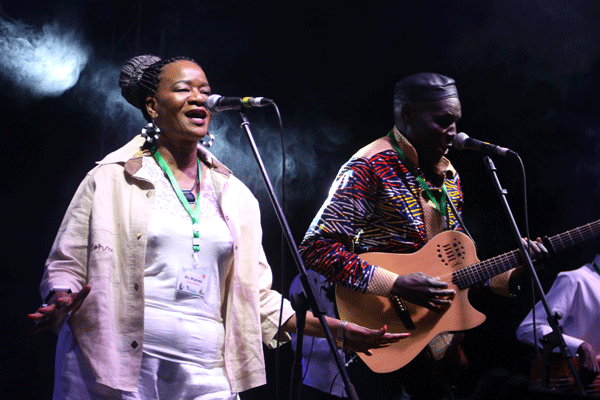
Listening to Oliver “Tuku” Mtukudzi’s 65th 12-track album Eheka! Nhai Yahwe which was launched last week as the icon celebrated his 64th birthday, I was left with no doubt whatsoever that he remains my favourite local musician of all time.
By Chipo Masara

Having discovered my love for music at an early age and with Tuku never missing from my playlist, I have long acknowledged the undeniable fact that Samanyanga is a musician of note, not only in Zimbabwe, but on the global stage. His husky voice — which to my ear is getting even better with age — never fails to impress.
With so many things going wrong in Zimbabwe — once a great nation but now reduced to tatters — many have found it easy to shy away from any association with their country of birth, especially those that have taken refuge in better-run countries like Britain and the United States. But the mere mention of Tuku is bound to bring them back to their senses, thanks to the man’s great performances all over the world that have earned him a devoted following across Africa and beyond.
To me, music is not just about the beat — as most so-called musicians of today seem to think. There is a combination of things that make one a musician. For instance, to earn the right to be called a musician, one must have mastered the art of playing at least one musical instrument — an art most of the current crop of “musicians” in the country cannot, sadly, even begin to fathom.
Being able to compose music is also a very important part of being a musician. But I cannot imagine composing good music being an easy task, hence I will not take anything away from those that cannot, just as long as they value their musical careers enough to acknowledge that they can’t and invest in hiring the services of a real composer.
Mtukudzi is that kind of musician that has over his 41-year musical career, exhibited all these musical qualities, and many more. The man has a musical voice that will convince anyone that listens that here is a man who was born to be a musician. His blend of traditional sound, Afripop, chimurenga and jit gels perfectly with his husky voice, whose tempo he is well able to raise or lower in sync with the beat. And did I mention he can dance?
Unlike other musicians that keep using a similar type of beat — making it such a mammoth task to set their songs apart — listening to any of Tuku’s albums will take the listener to different places. In all the years that Tuku has been producing music, he has always managed to achieve that general appeal that many look for in musicians. No wonder the man is a darling not only to fellow Zimbabweans, but to people of all colours and cultures. It is common to find white people shaking away to Tuku’s music, even when they might have no clue what he is singing about. It is because the way his music is arranged and how it perfectly merges with the beat, is enough to convince anyone that they are listening to some good music.
- Chamisa under fire over US$120K donation
- Mavhunga puts DeMbare into Chibuku quarterfinals
- Pension funds bet on Cabora Bassa oilfields
- Councils defy govt fire tender directive
Keep Reading
But maybe what sets Tuku’s music apart on the local scene is the message that his music carries. Even his highly danceable tunes contain powerful messages. He is known for tackling social issues in his music, and hits such as Tozeza Baba — in which Tuku takes the voice of children who dread the coming home of their drunk of a father who always beats up their mother —come to mind. He has also tackled poverty and the Aids epidemic that has been responsible for so many deaths, which might explain why Unicef resolved to appoint him their Goodwill Ambassador. His ability to sing in both Shona and Ndebele, and at times even English, may have to an extent helped create a oneness between the Shona and the Ndebele groups — the country’s two main ethnic groups — whose past circumstances have often been seen to pull them in opposite directions.
Meanwhile, the ability to make music that has a real message has proven an especially difficult task for most of today’s emerging artists, with the Zimdancehall genre that initially made a mark slowly dying out as it has to a larger extent failed to evolve and continues to be associated with drunkenness, drug abuse, “beefs” (rivalries) and obscenities. The fact that most Zimdancehall songs have beats that sound like they were stolen from Jamaica has not helped. I wish some of the youths would take time to go to Pakare Paye Arts Centre — a performance platform for developing and fostering young talent, which is Tuku’s brainchild — and learn a thing or two about what makes one a world-acclaimed musician. Rising star Gary Tight will attest to that.
Tuku is proud of his roots and his culture and has never in the history of his career tried to be someone he is not. He is proud to be a member of the Korekore group and his new album Eheka! Nhai Yahwe is further testimony to that. He also takes great pride in his Nzou Samanyanga totem, so much that on the local scene we simply call him Samanyanga. In my eyes, Tuku has been a major Zimbabwe cultural ambassador as he has through his countless performances managed to represent the Zimbabwean culture in all parts of the world.
Not to take anything from the current crop of musicians in the country — Jah Prayzah, Winky D, Sulumani, Soul Jah Love and Killer T included — but I do not see any one of them achieving the level of musical perfection that Tuku has reached.
That is not, however, to say we do not have people that are making good music in the country, because we do. One only needs to listen to Jah Prayzah’s song Mdhara Vachauya to acknowledge this. But after listening to Mdhara Vachauya, I always find myself going back on my playlist to listen to Munendipasa Manyemwe — my all-time favourite tune.