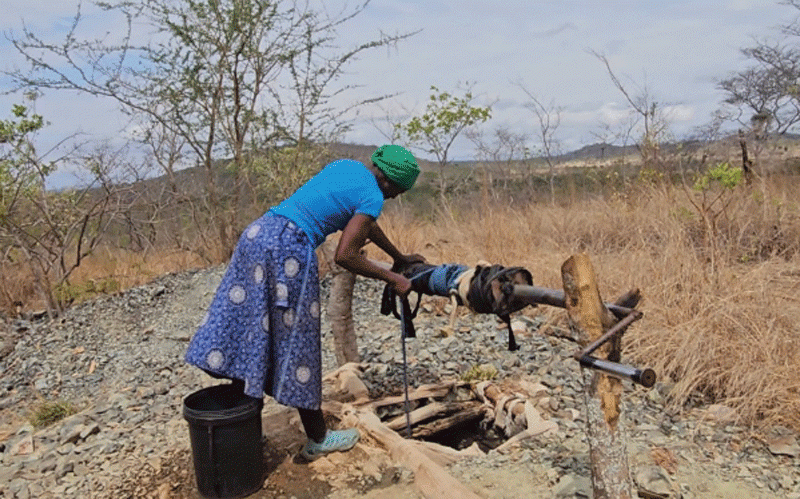
For more than half a century, a deep communal well at the edge of Bikita Minerals quietly sustained life in Murape village.
From 1972, it quenched thirst, fed gardens and anchored livelihoods in one of Masvingo’s driest districts.
Today, this well that produced generations lies buried beneath a toxic slime dam constructed by Bikita Minerals, a Chinese-owned lithium mine, in late 2023, and villagers are now forced to drink from abandoned contaminated pits in a daily struggle for survival.
An investigation supported by the Information for Development Trust (IDT) — a non-profit outfit supporting local and regional accountability journalism — has uncovered a widening pattern whereby foreign-owned mines, often enjoying strong government backing, are diverting, contaminating or seizing water sources.
This is crippling rural livelihoods and, in turn, weakening the capacity of villagers to fight the risks, hazards and disasters — El Nino-induced droughts and floods included — associated with worsening climate change.
Hidden costs
From Bikita to rural Mvuma’s Manhize in the Midlands province where Dinson Iron and Steel Company (Disco) operates — and beyond — poor villagers are paying the hidden cost of Zimbabwe’s lithium and other natural resources with access to clean water, ancestral land, food security and basic human dignity.
A British company that owned Bikita Minerals back then sunk a 40-metre well at its periphery after realising the villagers had no reliable water supply.
- News in depth: Fears of violent 2023 polls grow as ED fails to deliver on promises
- Corruption watch: No-one is taking the Motlanthe report seriously
- Corruption watch: CCC needs to be accountable
- Tsikamutandas wreak havoc in Manicaland
Keep Reading
Today, Murape is a ghost settlement of about 20 households — from about 50 in recent years — with roughly 100 occupants still remaining as frustrated families abandon the area in search of better living conditions.
The mine changed hands several times after Zimbabwe’s independence in 1980 until January 2022, when the current Chinese miner, Sinomine Resource Group, took over in a US$180 million deal.
That marked the beginning of a new tragedy for villagers under Chief Marozva in Ward 12, who were already grappling with the effects of climate change.
The company built the slime dam without consulting locals, as required by law.
Mystery surrounds the existence of an environmental impact assessment (EIA) certificate for the slime dam.
The Environmental Management Agency (EMA) denied having any record of the project, implying the dam was constructed outside regulatory procedures.
This emerged after the Bikita Land Institute of Development (BILD) challenged EMA to compel Bikita Minerals to produce its EIA.
In a letter dated November 19, 2025, EMA’s Masvingo provincial environmental manager, Milton Muusha, stated: “As EMA, we don’t have (such) a project…in our database.”
The lithium miner, however, insists it carried out an EIA, but refused to provide the certificate to this publication.
“Bikita Minerals holds a valid EIA certificate for the spodumene processing plant and tailings dam, in compliance with Zimbabwe’s environmental regulations.
“The certificate is accessible for viewing at the EMA provincial offices in Masvingo,” said company spokesperson Victoria Mtomba.
A physical visit to EMA’s Masvingo office drew blanks, with officials saying the request had to be made in writing. By the time of publication, no response had been received.
The EMA national spokesperson, Amkela Sidange, did not help either, referring media queries to her director general, George Manyumwa, who could not be reached for a comment.
The Zimbabwe Environmental Law Association (Zela), which is probing the issue, described the burying of the well as illegal.
“Constructing infrastructure over community water points is prohibited under the Mines and Minerals Act,” said Zela in a statement.
Bikita Minerals says it compensated villagers by providing tap water within its premises.
This does not make sense to the people of Murape, because it means they have to travel for about 4km to the tap.
In any case, they say, the company does not want them inside the mine.
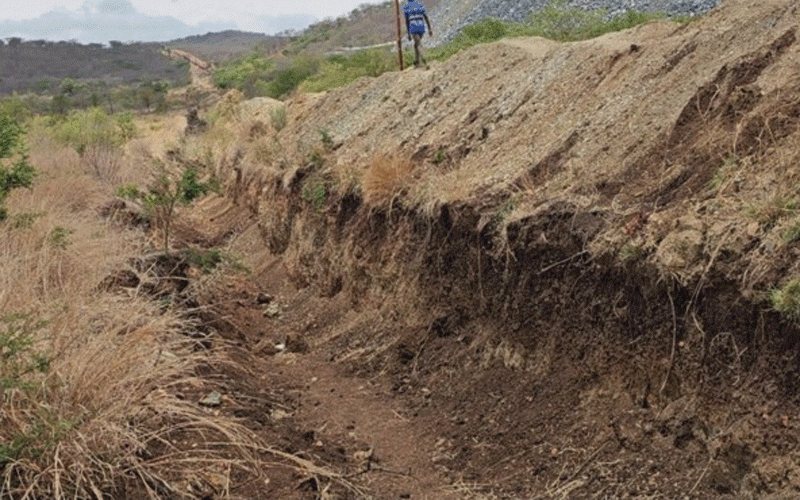
In 2024, the mine dug a two-metre-deep perimeter trench to keep villagers out after they began sneaking in to fetch slime water following the destruction of the well.
With no alternative, residents now trek long distances to find water. They have resorted to abandoned gold mining shafts, some as deep as 25 metres, where stagnant, maggot-infested water collects.
Villagers say their cries have been met with silence from their Member of Parliament, relevant government offices and authorities.
During a visit to Murape, one woman with a baby strapped to her back risked the hazard pf confronting armed security guards to lead journalists to where the communal well once stood.
Word had quickly spread that the media was in the area, and company security personnel were already on the prowl.
Another villager, Evelyn Nhamo (36), said the loss of the well has brought severe suffering to her family.
She described how earlier that day she skimmed snake scales and bones floating on water she had drawn from a disused pit.
“We don’t have an option,” she said, seated beside a heap of unwashed dishes and laundry. “That’s the only source of water that we now have.”
Nhamo has abandoned gardening and poultry production that once provided income, and bathing has become a luxury because of the severe scarcity of water.
“I can’t even do gardening anymore. I used to rear chickens for sale that helped me take care of my children. We don’t bathe every day because the water is not enough,” she said.
She sends her teenage daughter to relatives in a neighbouring village during menstruation because of better water access there.
Crisis shifts tradition
Sixty-five year-old Isaiah Chamunorwa, emotion evident in his watery eyes, casually remarks how the struggle for access to water has transformed patriarchal tradition.
“This problem has changed our traditional values,” he said. “We grew up knowing that fetching water was for women. Now, even men go out searching. When it is a day for fetching water, no one stays behind. As long as the children can walk, they go too.”
Fungai Dafi (42), who lives near an abandoned mine shaft that now serves as the main water source, described the physical toll of drawing water using an old pulley system.
“The shaft is about 20 metres deep and it’s tiresome to draw water from,” she said. “It is difficult especially for us women to draw water that is just enough for domestic use. We use water sparingly and ration even that for drinking.”
Water scarcity has come with an extra cost.
James Manyati (40), who once grew cash crops and reared poultry using water from the well, now rents small plots in neighbouring villages with reliable water.
“I pay rentals to do gardening and chicken rearing in other village because I can’t do that at my place,” he said.
The Murape crisis has sucked in the Joint Operations Command (JOC), which brings together the army, intelligence, police and prison services.
Former Bikita Minerals spokesperson Colen Nikisi, who left the company during this investigation, claimed trenching the villagers out was ordered by JOC to curb lithium theft.
He also alleged that the Zimbabwe Human Rights Commission (ZHRC) blocked the drilling of a replacement borehole and classified villagers as “illegal settlers.”
“The well was in the mining premises and when we obtained the Environmental Impact Assessment certificate (for the dam), it was communicated to the villagers,” Nikisi said.
At law, though, the villagers are supposed to be consulted first.
“We contemplated drilling another borehole and that is when the ZHRC came in and said ‘No’, these villagers are illegal. So a plan was agreed where the mine would offer assistance and government would provide land for relocation and drill a borehole there. As for the trench, it was dug on the instigation of the JOC, as trespassers were stealing our ore.”
The police officer commanding Bikita district, Carton Chigona, a JOC member, declined to comment and referred questions to Lieutenant Colonel Andrew Dzikiti, the commander of 4.2 Infantry Battalion in Gutu, who could not be tracked for a comment.
ZHRC dismissed Nikisi’s claims.
Chairperson Jessie Majome said the commission never blocked borehole drilling or declared villagers illegal occupants.
“The ZHRC does not issue directives,” Majome said. “It is inconceivable that it would promote the infringement of fundamental human rights, including access to water, which is protected under Section 77(a) of the constitution.
“Our role is to promote and protect the enjoyment of these rights. It is important to note that the ZHRC operates within a framework that does not authorise it to issue directives; rather, its role is to make recommendations for redress when human rights violations are identified.”
Environmental activist, Farai Maguwu, director of the Centre for Natural Resource Governance (CNRG), described the conduct of the foreign mining firms as pervasive.
“These miners are now like a pandemic,” he said. “Everywhere they go, they block rivers, push people off their land and take away the water. Instead of defending its people, the government protects the investors. These areas have become high-security zones where villagers are afraid to speak because they know they will be punished for complaining.”
River blocked
About 200 kilometres northwest of Bikita, villagers in Manhize, rural Mvuma, face a similar crisis.
The Chinese-owned Dinson Iron and Steel Company (Disco), which is running what officials have touted as Africa’s largest steel plant upon completion, has blocked the once-perennial Munyati River, erecting a concrete wall to divert water exclusively for its operations.
Dinson started constructing the US$1.5 billion steel plant—which President Emmerson Mnangagwa has described as a “paradigm-shifting milestone”—in June 2022.
The company has clashed with villagers over farmland takeovers and slow relocations, which have disrupted food production. Residents previously told journalists that security agents were deployed against them during protests.
Munyati River, once a key water source for downstream communities, is now a dry sandy bed. Water marks on rocks show it once reached depths of about two metres.
Livestock now dig into the sand in search of water. Villagers say they have abandoned home gardens that once sustained families.
Fatima Keni (62) of Sable Flat in Ward 7 said the drying of the river put a stop to winter farming.
“My whole livelihood was based on gardening,” she said. “I used to grow tomatoes, vegetables and maize even during the dry seasons, and that money kept my children fed and in school. Now the river is dry and I have nothing. I cannot water even a small bed of vegetables. We are just waiting for the rains, but even the rains no longer come as they used to.”
Village head Simbarashe Sauro acknowledged the benefits of employment created by the mine but said the blocked river had devastated livelihoods.
“We are grateful that our young people now have jobs (at Disco),” he said. “But blocking the river has brought suffering to those who depended on it to farm, drink and keep animals alive. Government must address this because the community is paying a heavy price.”
Disco spokesperson, Wilfred Motsi, admitted that the company was drawing water from the river, but said villagers were not cut off.
“There is a pipe underneath (the bridge) that takes water downstream,” Motsi said, adding: “We even drilled boreholes for the villages so that they can have access to clean water other than river water.”
However, this investigation established that only one borehole was drilled.
But then, it broke down immediately after, and there was no piped water downstream of the river as Motsi claimed.
The Mines ministry requested written questions but had not responded by publication.
Parliamentary portfolio committee chairperson, Remigious Matangira, said lawmakers were unaware of villagers’ complaints.
“We have yet been petitioned by citizens or organisations with regard to that issue,” Matangira said. “If we are petitioned, we will then direct (the petition) to the responsible committee.”
The government-controlled Zimbabwe National Water Authority (Zinwa) is siding with Disco.
Zinwa spokesperson Marjorie Munyonga said Dinson had plans to construct a dam on Munyati River as a long-term water source.
“While preparations and other preliminary works for the dam construction work are underway, Dinson have constructed two weirs as temporary sources of water, from which they are getting water,” Munyonga said.
“The weirs were constructed in full compliance with the relevant regulations after Dinson obtained the necessary permits from the Upper Munyati sub-catchment council.”
She said Dinson was expected to ensure that the weirs have outlet works for release of water for use by downstream communities.
While the natural flow of river water can be diverted, said Zela in a statement, “there has to be alternatives as to what will happen to the aquaculture, the people downstream, the livestock, and so on.”
Government last month issued new directives requiring companies to obtain permits to abstract river water.
A national pattern
In Hwange, villagers from Diki were arrested for allegedly obstructing a water project at Kalope Dam, where Chinese firm ZhongJin Heli Energy was laying pipes with Zinwa authorisation.
Residents feared depletion of their only water source.
In Gwanda South’s Mandihongola village, Mabetha Dam dried up after Crawford Minerals and Dinson Mining Investment drilled boreholes inside the dam to extract water for lithium operations.
“Regarding the case of Mabetha Dam, concerns around the boreholes being drilled within the communal dam were raised and appropriate remedies effected,” said Munyonga.
“Any residual matters on the same matter will always be dealt with at appropriate levels.”