
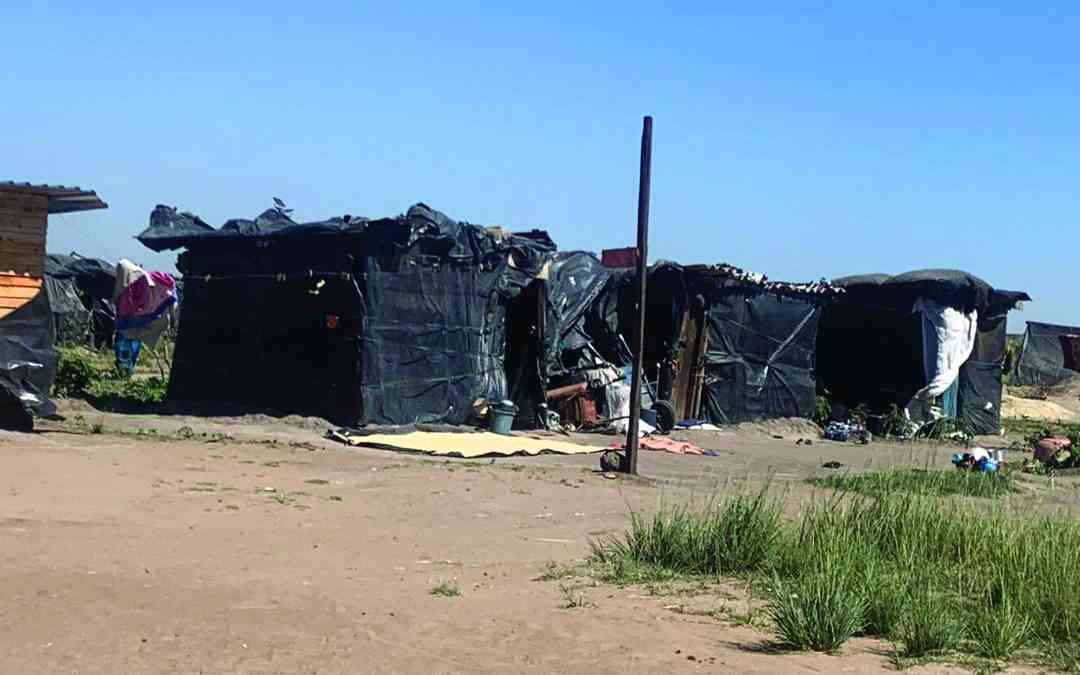
In the dusty stretches of Nyabira, a temporary holding site in Mashonaland West, a humanitarian crisis is unfolding in slow motion.
More than 1 500 former farm settlers, who were forcibly evicted from Willdale Farm in Mt Hampden in Nyabira last November, now face a terrifying second displacement.
The government has issued a blunt directive: vacate the camp and “return to your places of origin.”
For many of the affected families, this order is not merely impractical—it is a logical and physical impossibility.
Having lived and worked on Willdale Farm for over three decades, these families have raised children and grandchildren who have never known another home.
What was once a place of livelihood and identity has been stripped away, replaced by the crushing uncertainty of life in a makeshift shelter.
Seventy-year-old Elizabeth Chidakwa is the face of this upheaval.
Speaking from her temporary home in Nyabira, she expressed the despair of a woman whose history has been erased by administrative decree.
- Abductions are a crime against humanity: ZLHR
- 'Gukurahundi survivors denied food aid'
- Scrap nomination fees for PWDs
- ZLHR pushes for PVOs Bill abolishment
Keep Reading

“Where can I go? The only home I know is Mt Hampden. I was born and raised there. My parents came from Chipinge and died there,” she told reporters.
For Chidakwa, the repeated forced moves are a source of profound trauma.
“We built our lives there. Our children grew up there. Now we are being told to leave again, but go where?” she asked.
The situation has become increasingly desperate since authorities withdrew the welfare support that briefly sustained the families during the initial transition.
Chidakwa described the government’s approach as insensitive, noting that the basic necessities of life—food and water—have become scarce.
“When we were evicted, the government provided us with water and food, but all that has stopped and we are now suffering,” she said.
“Even the First Lady used to come here with food, but she has since stopped”.
The government’s directive to "return home" ignores the complex migration history of southern Africa.
Many of those facing eviction are the descendants of migrant workers who arrived in Zimbabwe decades ago from Zambia, Malawi, and Mozambique to work on the country’s commercial farms.
Charles Siwagwe, another settler, explained that returning to his ancestral roots is simply not an option.
“My parents came from Ndola in Zambia, but I don’t know any relatives there. Even my father never went back when he was alive. I cannot go to a place I do not know,” he said.
Siwagwe’s sentiment is shared by many who feel their ties to neighboring countries are historical footnotes rather than lived realities.
“We are being told to go back, but for us there is no ‘back.’ This is the only place we have ever known,” he added.
Mainesi Aron echoed this, stating that his family’s Mozambican origins offer no practical solution to their current homelessness.
“I have never been to Mozambique in my life. I don’t know any other home besides Mt Hampden,” he said.
The social and psychological consequences of this instability are particularly acute for the youngest members of the camp.
“Our children are missing school. They are growing up without certainty. This is not just about land it’s about our future,” Aron warned.
Despite these pleas for clemency, the government’s stance remains unyielding. Mashonaland West Provincial Affairs and Devolution minister, Marian Chombo, confirmed that the directive was final.
“There was a Cabinet decision, and the provincial Joint Operations Command also resolved that everyone who was evicted came from somewhere and must return to where they came from,” she said.
While the authorities have provided a three-month extension, set to expire at the end of May, they have warned that enforcement is imminent. “We are serious about this,” Chombo said.

“The government is offering transport to ferry people to wherever they choose to go whether Manicaland, Mashonaland Central, or Matabeleland.”
The justification for the eviction is rooted in economic planning; Chombo noted that the Nyabira site is designated for farming and industrial use.
“We want the land to be used for its intended purpose without disturbances,” she said.
However, the local Member of Parliament, Kudakwashe Decide Mananzva, has appealed directly to President Emmerson Mnangagwa to reconsider.
Mananzva pointed out that the population at the camp has already dwindled from 4 000 in December to approximately 1 500 as families scattered in desperation.
“The people who remain have nowhere to go. Their parents came from neighbouring countries such as Zambia, Malawi, and Mozambique decades ago, and they have no connections there,” he said.
He argued that the forced removals directly contradict the government’s own slogan of “leaving no one behind.”
Political analyst Catherine Maboya warned that this policy risks creating a permanent underclass of internally displaced people (IDPs).
“These are Zimbabweans in every practical sense. Forcing them out without a clear resettlement plan will only deepen poverty and vulnerability,” she said.
The underlying driver for these evictions is reportedly the development of the Zim Cyber City project, a multi-million-dollar tech initiative.
This has drawn sharp criticism from human rights watchdogs, who see it as a pattern of prioritising capital over citizens.
The Zimbabwe Lawyers for Human Rights (ZLHR) have stepped in to represent those facing prosecution for allegedly occupying gazetted land without authority.
The ZLHR argued that these evictions violate Section 74 of the constitution, which protects citizens from arbitrary eviction.
In a scathing statement, the organisation said: “The insensitive and callous eviction of people against clear constitutional provisions that protect against arbitrary eviction stamps from both the local and central government’s intention to continue violating their constitutionally protected rights and commit rights abuse excesses with impunity.”
The legal group further characterized the evictions as “inhuman and degrading treatment” that contravenes both domestic law and international human rights instruments.
They have urged the government to “invest efforts and resources in creating a stable, safe and just society” rather than demolishing properties and uprooting lives without due process.
As the May deadline looms, the families in Nyabira remain in a state of paralysis, caught between a home that no longer wants them and a "place of origin" that does not exist.


