
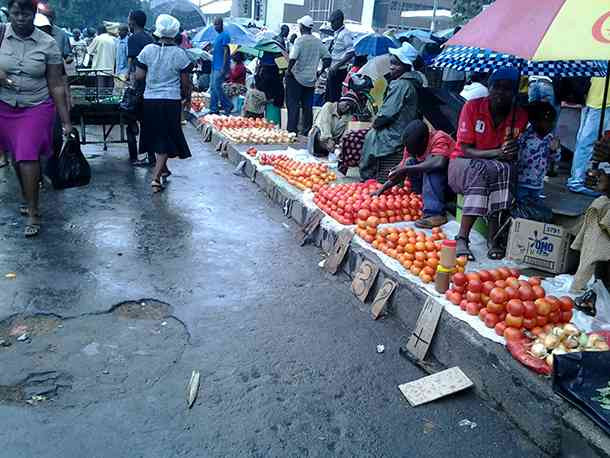
The government appears to have lost the battle to reclaim the capital’s pavements.
Despite a relentless barrage of ultimatums, informal traders continue to flood Harare’s streets, particularly under the cover of night, turning the city’s thoroughfares into a bustling, unregulated marketplace that defies official control.
The Harare City Council has now offered a sobering assessment of the situation, conceding that the momentum of the informal sector is so great that perhaps “only a war or a crisis akin to the Covid-19 pandemic could force them off the streets.”
This admission comes in the wake of numerous failed directives from Local Government minister Daniel Garwe, who has repeatedly ordered local authorities to clear the vendors.
Last year, traders were given a mere 48-hour window to vacate, an order that was met with open defiance and threats of legal action.
Garwe has gone further, suggesting a ban on the importation of second-hand clothes and a total prohibition of night vending.
He argued that these activities fuel illegal acts, cripple formal businesses, and erode "urban order."
However, for those on the ground, the issue is not one of lawlessness, but of stark economic survival.
- Harare cancels Pomona waste deal
- Devolution gains remain a mirage
- Benzema confident Real will reach UCL final
- Harare cancels Pomona waste deal
Keep Reading
Samuel Wadzai, executive director of the Vendors Initiative for Social and Economic Transformation (VISET), argued that the persistence of street trading is a symptom of a much deeper structural malaise.
“The failure by vendors to vacate the streets—even in the face of ultimatums such as the one issued by Daniel Garwe—is rooted primarily in economic necessity,” Wadzai said.
He said for the vast majority of Zimbabweans, vending is a survival strategy in an environment where formal jobs are non-existent.
“Removing them from the streets without providing viable alternatives effectively cuts off their only source of income,” he warned.
The scale of this informal dominance is staggering.
Recent data suggests the informal sector contributes up to 64% of Zimbabwe’s national Gross Domestic Product (GDP) and supports millions.
An economic census conducted between June 2024 and March 2025 revealed that of the 204,798 operational business establishments in the country, 76.1% are informal.
While the economic contribution is undeniable, the environmental and logistical toll on the city is mounting.
Delish Nguwaya, CEO of Geo Pomona Waste Management, recently told a parliamentary committee that his firm has already collected more than 300 000 tonnes of waste from illegal dumpsites across Harare.
Nguwaya has called for "decisive action" against vendors, accusing the City of Harare of failing to provide basic services like refuse collection.
In response, Harare city council’s small medium and enterprises committee chairman Denford Ngadziore suggested that the solution required a dual approach.
He said the government must address the root cause—unemployment—while the council addresses the symptoms by creating better trading spaces.
Ngadziore has also advocated for a draconian shift in sanitation policy, pointing to the "Kigali model" in Rwanda. “Just go to Kigali in Rwanda, they have harsh anti-litter laws and the city is clean, so this should also be implemented in Harare,” he said, suggesting that the lowest fine for littering should be US$500 or two months' imprisonment.
Ultimately, the standoff highlights a persistent mismatch between top-down policy and the reality of life for Zimbabwe’s urban poor.
As Wadzai pointed out, many designated trading spaces are in low-traffic areas that are "economically unviable."
Until there is meaningful dialogue and the creation of genuine employment, the sidewalks of Harare will likely remain the front line of an enduring struggle between the need for urban order and the desperate necessity of earning a living.


