From the depths of the Wankie colliery to the pinnacle of Zimbabwe’s financial sector, Nicholas Vingirai’s journey is a masterclass in resilience and divine timing.
Initially a pioneering mine surveyor—the first black professional in his field—Vingirai (NV) was forced into hiding to escape military conscription under the Smith regime.
What began as a tactical disappearance led to a fortuitous entry into banking at Standard Chartered.
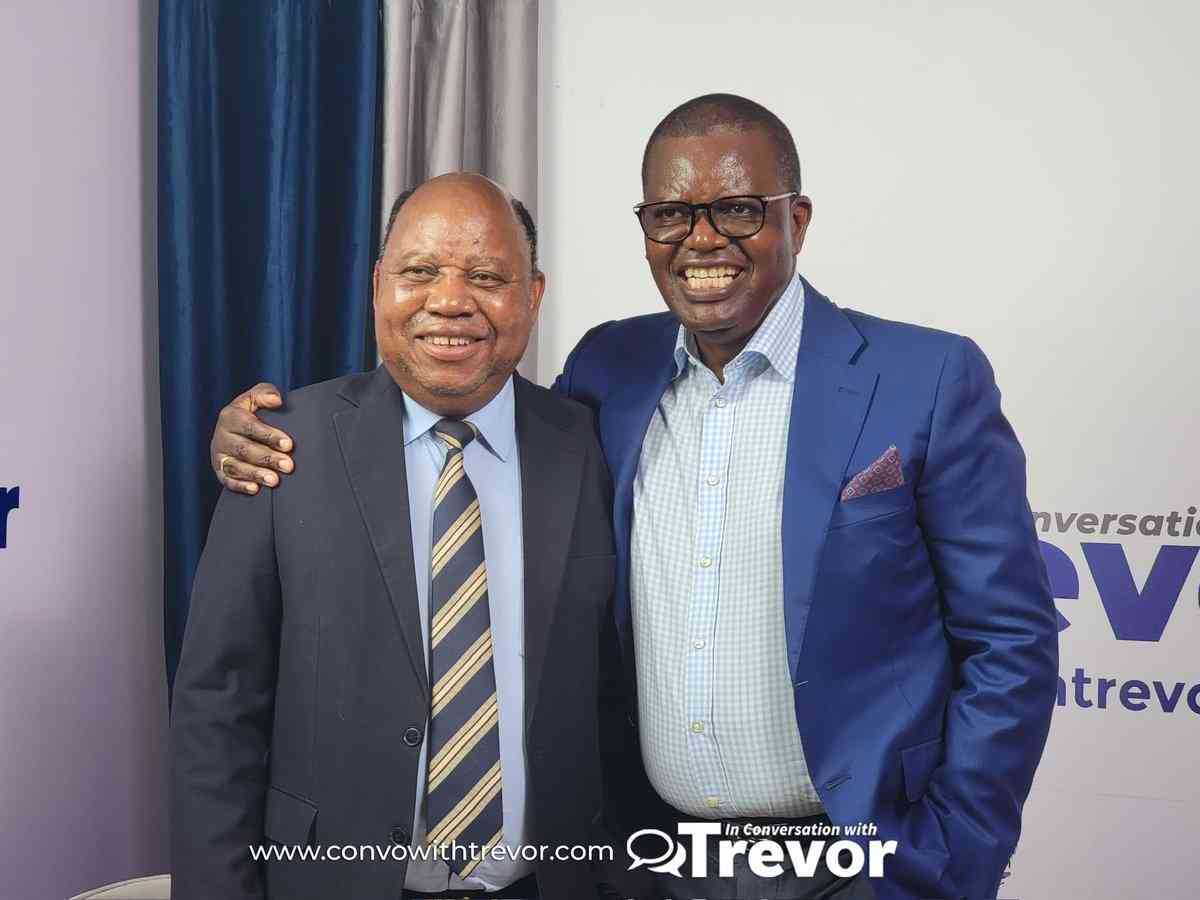
In a candid interview with Alpha Holdings chairman Trevor Ncube (TN) on the platform In Conversation with Trevor, the Intermarket founder reflects on how "high maths" and a transformative spiritual awakening in Ghana shaped his evolution from a surveyor of earth to a guru of capital.
Below are excerpts from the interview.
TN: Greetings, and welcome to In Conversation with Trevor, brought to you by Heart and Soul Broadcasting Services.
Today, I'm in conversation with Nicholas Vingirai – an astute banker, a serial entrepreneur, a venture capitalist, and a financial guru.
- In Conversation with Trevor: Chisamba: Let’s be proud of ourselves
- In Conversation with Trevor: ‘I tried to change Zanu PF from within’ – Margaret Dongo
- In Conversation with Trevor : How car crash changed my life
- In Conversation With Trevor: ‘We lost our humanity’
Keep Reading
Intermarket Financial Services Group – you built it from Intermarket Discount House to insurance and into all other spaces in financial services.
I want to go back to those early days. You went in as a mine surveyor. That was the profession you chose. Talk to me about what led you to say, "I want to get into mining, to be a mine surveyor."
NV: Trevor, in our day – and I'm not talking of age yet, just in our day – we had choices. A lot of choices.
The economy was more formal than we have today. Companies were vibrant. The opportunities to train for whatever profession you chose were multiple.
So here I was: in school, I was one of those people they called an all-rounder. You couldn't place me in the arts or in the sciences. I was everywhere.
My literature teacher saw me, years to come, as a poet, writing commentaries on poetry and literature because I was good in English.
My Maths teacher saw me as a scientist. My geography master loved the way I articulated geography.
So, along the way, I loved topography. We finished our A-Levels. So, I applied to go to university, and I wanted to be an accountant because of Maths.
But they offered me political administration. I looked at this political administration thing, and said, "I'm not a politician." I abandoned it.
Then Wankie and Anglo American wanted a whole lot of guys to train in various trades, and mine surveying was one of them. It was touted as the most difficult profession.
Every other one – engineering, civil, electrical – they said you get in there, you get your money quickly in terms of salary.
I went for the interviews and said I wanted to do mine surveying.
I remember they discouraged me a lot. There was no black in mine surveying at that time. They said it's a difficult profession; if you fail, you have no future.
The chances are you will fail along the way because we had to go to the mining school – Bulawayo Polytechnic – for six months, then back to the job for six months.
I insisted that's what I wanted. So they gave me an aptitude test. I chose it because of the combination of Geography and Maths.
I passed the aptitude test, and I was the first – I don't know whether to say indigenous or black – I was the first black for one at the colliery. So, they took me on as a mine surveyor.
TN: How long did you last in that profession?
NV: I was there for two years. But after six months of my training, they said, "This black guy is beating us to the game."
So, they accelerated my training, and after a year they gave me what is known as Number 4 Colliery – that's the rest in surveying.
My exams and practicals all came out top notch. I really loved the profession.
I made up my mind that this is where I am, and this is liveable. I'm sure a lot of people watching say, "We can't believe Nick." But it was beautiful.
TN: What did you enjoy the most about this job?
NV: The mathematics. We went to what we call the 8th degree accuracy – you're not supposed to be wrong in your calculation to the 8th decimal.
It must balance 100% because if you make an error, the error could be cumulative and cause a mine disaster.
TN: So then, Nick, you take this pivot. What made you decide after two years to get attracted to banking and leave mine surveying?
NV: I was not attracted to banking at all. What happened is, during those days under the Smith regime, they had what they called "call-up" – you had to go for serving in the army.
Initially, blacks were not eligible. Then, because of my rise in the mine, the fellow white Afrikaners began to complain: "He's enjoying the same things as us." It became national.
They changed the policy and said if you reach a certain level in industry and commerce, or if you want to go to university, and you are black, you have to go for service.
Believe it or not, I was served with call-up papers, and that was the last they saw of me. I disappeared.
TN: Fascinating. You disappeared.
NV: I disappeared to go to the bush, and they never found me.
TN: When did you decide, "I want to go into banking"? Share that part of your life briefly.
NV: After about five months of hiding, my father was working in Harare and I thought, by now they've forgotten about me, let me go to Harare and see where to start.
So, I went to Highfield. My father said, "Somebody came looking for you. They came here twice."
I panicked, thinking they must have traced me. While I was deciding whether to go back to the village, a guy pitched up – a friend, Kenneth Washoma.
He said, "That's the gentleman we're looking for." He told me his dad worked for Standard Chartered, and they had started a job for me.
He asked me to join an accelerated training programme. I agreed, went for an interview, and was one of eight picked.
But believe me, I thought it was a temporary arrangement while I waited for things to clear so I could go back to my profession.
I joined Standard Chartered and never looked back. I never left banking until today.
TN: I'm zooming in on that because there's a lesson. The things we choose, we think we're passionate about – and the hand of God, the direction of God.
You were passionate about mine surveying, thought you'd do it the rest of your life.
You run away from national service, somebody comes and calls you, and it's banking. You didn't choose this, but look at you now. Talk to me about that thought.
NV: With hindsight, I can say it's the hand of God.
But you can never know God to the full. I don't know whether if I had stayed as a mine surveyor I would still have achieved great things, because I was connected to it, I enjoyed it.
But when I look at what I went on to achieve in banking, I know it's God.
So, you can't limit God. I would say, follow the flow. I wasn't against banking – I enjoyed it too, but it was a bit simplistic coming from high maths to probabilities and counting money.
Still, I enjoyed it, maybe because it was all numbers. God can take you anywhere.
The important thing is you listen. At that time, I wouldn't say I knew God – He knew me. So, I just went with the flow as far as banking is concerned. And then events just began to converge.
TN: Ghana is where God found you. We always make the mistake of saying "I found God" – God is never lost, we are lost. God finds us.
Talk to us about that experience. A lot of people will not know this: I got born again because of you reaching out to me, saying "Trevor, you were in my spirit, let's have breakfast at my office in Intermarket."
That was the beginning of my being born again. But God had touched you in Ghana – talk to me about that.
NV: That was the turning point. In fact, that was the genesis of the Intermarket. It was not like I just woke up and said I can do it.
Something happened to me. I was invited to a meeting by a friend – actually, I was dropping a friend at a meeting. When we got there, there were three of us in the car.
We heard beautiful music – spiritual music. We decided to all go in. We entered hoping to leave in 10 or 20 minutes.
We didn't leave until 9 p.m.
The leader of the group began to preach. I'd been to church many times, but I'd never heard preaching like that. I said, "I'm coming back on Wednesday."
The next time I found myself in my beautiful suit, I was the first one to stand up and say yes to the Lord Jesus.
After that – there are things we can share another time. For that reason, Ghana occupies a special place. If you want to understand freedom, visit Accra.
If you want to understand spirituality, go to Ghana – at least for me. I became who I am in the spirit out there. I actually thought I was going to go into full-time ministry.