The term ‘politically correct’ is an interesting one as it implies that everything in politics is correct. We will not enter in any such debate but rather consider its meaning for a moment. It is seen to refer generally to speaking or writing carefully in a way that does not hurt anyone’s feelings (that is actually just common sense, respect, empathy, but we will also leave that aside). However, it prevents people calling a spade a spade, speaking the truth directly, bluntly, and plainly, even if the subject is unpleasant, embarrassing, or impolite. We must use euphemisms instead, we are told.
We like euphemisms, though! We think they are helpful (though we all know the truth that lies behind them, which makes the whole exercise slightly pointless, as we know what lies behind, even if it is not said). We jokingly refer to a stay-at-home mother as the ‘Minister of Home Affairs’ or the ‘Domestic Executive’ while now some refer to Receptionists as being ‘Director of First Impressions’, a chef as a ‘Culinary Artist’ and a waiter as a ‘Food Service Provider’. Unemployed people are ‘Between Jobs’ while someone who was fired was declared ‘Resource Optimised’. We cannot call people ‘short’ (what is wrong with being short?) but declare them ‘vertically challenged’. We disguise the truth.
Sometimes we use such euphemisms to try to impress people by the sound of the work. Now we love to include the word ‘engineer’ into titles to make it seem more impressive – so a janitor is a ‘sanitation engineer’. Sometimes we use many words where fewer would do in a deliberate attempt to be vague or evasive – in non-political correct terms, we could have said ‘we use circumlocution’.
So, here we are going to say it as it is, with great respect and sensitivity but equally with bluntness and directness, with reference to school sports coaches. School sports coaches are not in the sporting profession; they are in education. First and foremost, above all else, coaches are in education, not sport, just as a science teacher is not in science but in education. They are there for the education of the children. School sports coaches use sport as a medium to educate youngsters.
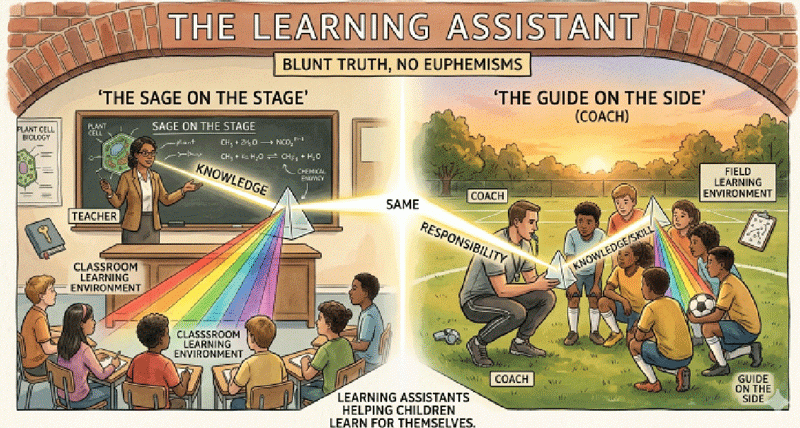
Of course, coaches love to be seen as different and many are not trained teachers. They want to be called ‘Coach’ with their Christian name attached, unlike teachers. They want to be seen differently but they are not; they are in education. Rich Holmden, in a paper written in 2023 on the difference between teaching and coaching, defined the difference between the two roles as “Teaching aims to provide new knowledge and skills, while coaching aims to transfer responsibility for refining and developing knowledge and skills. Teaching is a generally a one-sided, directive and instructional conversation led by a ‘sage on the stage’, however, coaching is more two-way, ongoing and non-directive, where the coach is more the ‘guide on the side’, with the focus on the person being coached taking responsibility for their own decisions and actions.” (It is interesting that many school sports coaches do not give that responsibility to the players but make the decisions themselves).
The reality is that both teachers and coaches are at different times both teachers and coaches. A teacher teaches and coaches; a coach teaches and coaches. Both are in truth Learning Assistants, seeking to help children to learn for themselves. They are all the ‘sage on the stage’ and the ‘guide on the side’, at different times, for different reasons.
A school sports coach’s purpose is to help children learn life lessons, values and significance, through the means and medium of sport, to make them better people more than better players, just like teachers. They are there to help children find their purpose, not necessarily in sport but in life. They are to do it in the same way as subject teachers, using the same five Cs of twenty-first century learning. Sport is very much an essential part of the curriculum, as much as academic subjects, and so any coach must be as committed to the whole curriculum. Sports coaches are in fact teachers.
We have noted previously that it is crucial that we must stop playing games and do sport correctly. Sports coaches must understand that they are in education, that they are sports teachers as well, that they play a very significant role in the broad education of the children. We do not need to doll them up with fancy titles or epithets but be blunt and correct, politically or linguistically. They are in education, first and foremost, not in sport, and must start behaving like that. No joke. Dig it.
- Letters: Women representation faces hurdles
- Letters: Makandiwa, preaching heresy
- CSO petitions Sadc over diaspora vote
- Nkosana Moyo steps down as Apa leader