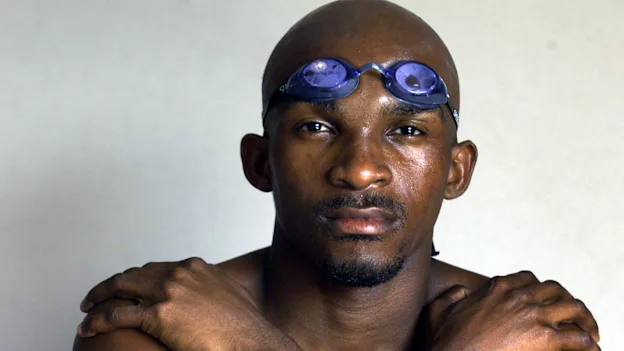
Eric ‘The Eel’ Moussambani, the Equatoguinean swimmer at the 2000 Sydney Olympics who famously won his heat of the 100 metre freestyle (only because the only two other competitors were disqualified due to false starts) in the slowest time (of 1:52.72) in Olympic history by a long way, did not advance to the next round (unsurprisingly), but he did set a new personal best and indeed an Equatoguinean national record.
Six years later, he had lowered his personal best to 52.18, more than 60 seconds faster than his Olympic race (but still 5.78 seconds behind the current world record of 46.40, set by Pan Zhanle). He later became the national swimming coach of Equatorial Guinea.
‘The Eel’, given favourable training conditions, better coaching, longer training times, showed incredible improvement after that first race where he clearly was seen as a fish out of water!
All credit to him, not just for his initial efforts at the Sydney Olympics, but for working hard to improve his times.
He was the best in his country but he was nowhere near top in the world. The fact is though that he would never ever win a medal at the Olympics.
He was never a top-quality swimmer. Like many other people who take swimming seriously, he would never reach the heights.
Many a swimmer will have only swum in the heats at successive Olympics, never making it to the final, let alone to the podium. Hang on a minute - many do not make it even to the Olympics.
When it comes to school and their children, parents demand that their child will get A*s.
- In the groove: Has Enzo Ishall rescinded his decision to quit?
- Interview: Ngwerume’s artistic exploits put Zimbabwe on global map
- Interview: Ngwerume’s artistic exploits put Zimbabwe on global map
- Top Zim triathlete makes history in the US
Keep Reading
They think that money will ‘buy’ them results; they think their child must definitely gain A*s if they work hard, study hard, have good teachers.
In truth, it is such parents who are floundering with such thinking. As has been said often (though not by Einstein, despite such claims), "Everybody is a genius. But if you judge a fish by its ability to climb a tree, it will live its whole life believing that it is stupid".
We need to point out a few things here though about this statement.
Firstly, no, not everyone is a genius; not everyone is an expert, no matter what field they work or study in.
Secondly, it is not for us to judge people, especially children, by their abilities, in particular specific abilities; they are not to be decreed insignificant, useless or trivial because of their ability or inability to do certain things to a certain level.
Thirdly, correct, they are in no ways stupid; they are different.
They have different abilities, interests and levels. Even different animals have different levels of ability.
There are different types of fish, whether grouped biologically, or by where they live, such as freshwater or saltwater, or by how they taste and cook. In sport, not all achieve greatness – but all can progress.
Expecting and even pushing all children to gain A*s or play national team is ridiculous.
Our children all have different abilities in different areas of life.
While thinking of fish, we might recognise that when we go out, we will want chips with our fish (whatever type of fish we may prefer), as well as vegetables; so with our children, we will want them to have sporting and cultural interests alongside their academics, especially where their academic levels are not as high (as Eric ‘The Eel’ and so many others never reached the heights of others).
At the same time, remember, fish is not the only thing on the menu; our interest, indeed our health, may determine where our strength should lie.
Does it all sound rather fishy? Consider then two films. Firstly, ‘Finding Nemo’, has as its theme that children should not be pushed into areas in which they are not interested or talented.
Parents need to support their children and acknowledge the child’s ability or lack of ability.
True love means letting go and trusting them to grow suitably. As the character Bruce, said, “Fish are friends, not food”. Animals survive and others thrive in different environments; so do children.
Then the film ‘A Fish Called Wanda’ has characters breaking free from strict social norms, and we need our children not to be constrained within certain boundaries that we impose, be they sporting or academic. When we push them like that, we are no better than putting them in a small goldfish bowl.
A final thought: we may have laughed at Eric ‘The Eel’ finishing so far behind the other swimmers at the Olympics but how many of us would have beaten him (or his subsequent Personal Best)? Oh, we cannot swim, we may be inclined to say.
So how come we expect all our children to get A*s and play first team?
Consider that while swimming round in our goldfish bowl. Our fish may not be a wonder!