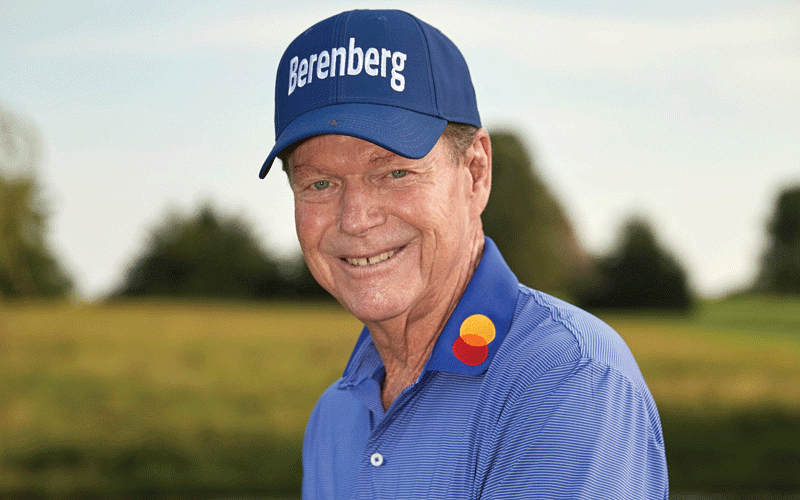
For those of a certain age who follow golf, the names Tom Watson and Turnberry Golf Course will be meaningful.
The 1977 Open Championship (one of golf’s four Majors) was held there in surprising but glorious sunny weather, causing it to be called ‘The Duel in the Sun’ when Tom Watson and Jack Nicklaus, two of the greatest golfers ever, slugged it out over the last two rounds.
It came to the last hole with Watson holding a one-shot lead over Nicklaus and drama of the highest order prevailed.
Watson drove straight down the middle but Nicklaus ended up in thick rough under gorse bushes; miraculously Nicklaus managed to play his ball out to the edge of the green but Watson played his shot to within three feet of the hole.
Surely it was all over? Nicklaus incredibly then sank his forty-foot putt, sending the crowd absolutely wild, to put a little pressure back on Watson – now three feet looked like thirty feet! Magnanimously (and respectfully) Jack Nicklaus urged the crowd to be quiet to allow Tom Watson to putt, which he did successfully, thus winning by one shot.
As they left the green with arms round each other’s shoulders, Nicklaus said, “Tom, I gave it my best shot but it wasn’t good enough. Congratulations, I’m really happy for you.” Class!
Thirty-two years later, the Open was back at Turnberry and Tom Watson, now with five Open Championships in his bag, found himself again one shot ahead as he stood on the eighteenth tee, incredibly, at the age of fifty-nine, with the possibility of being the oldest major champion in golf history (as well as equalling the record for most Open victories). This time the weather was different and his closest rival was Stuart Cink.
His drive landed where it had in 1977; his second shot was also heading straight for the flag but bounced over the back of the green.
His chip fell short and he missed the putt meaning he had to face a four-hole play-off which proved too much for him.
Like Nicklaus, he had also given the whole tournament his best shot and it was not good enough but instead of bemoaning the fact, he commented that “Sometimes you do everything right and lose.
Sometimes you do everything wrong and win. That's why you judge yourself by the swing, not the bounce.” This thinking had echoes of what another of golf’s greatest players, Bobby Jones, had once said: "Golf is the closest game to the game we call life. You get bad breaks from good shots; you get good breaks from bad shots — but you have to play the ball where it lies.” Powerful life lessons.
The 1986 Open was also held at Turnberry but in hugely-contrasting conditions to the ‘Duel in the Sun’ of 1977 with Greg Norman eventually winning a major title though his final score was twelve strokes higher than Watson's in 1977.
Norman’s summary of the battle against the elements was simple and concise: "Some of those shots impressed even me." Some of them, note!
Golf may indeed be the closest game to the game we call life but all sports teach us valuable and crucial lessons about life and indeed ourselves.
The Open Championship ten years prior to Cink’s victory at Turnberry was held at Carnoustie and saw one man (Paul Lawrie) come from the most shots behind at the start of the final round (ten shots back) to win and another man (Jean Van de Velde) blow the biggest lead on the final hole (three shots). Life lessons abound there.
Edgar Albert Guest, an American poet, began a poem entitled ‘Don’t You Quit’ with the words, “When things go wrong, as they sometimes will” and went on to record that “Life is queer with its twists and turns as everyone of us sometimes learns.
And many a fellow turns about when he might have won had he stuck it out. Don't give up though the pace seems slow - you may succeed with another blow.
Often the goal is nearer than it seems to a faint and faltering man.
Often the struggler has given up when he might have captured the victor's cup; and he learned too late when the night came down, how close he was to the golden crown.” Sporting analogies and advice abound there.
Stuart Cink, the winner at Turnberry after the play-off with Watson, himself knew the ups and downs, when he came from nine shots behind at the start of the final round to win a tournament in 2004.
His opponents perhaps began to have that sinking feeling when around Cink. Watson’s words that we should “judge yourself by the swing, not the bounce” need to be heard.
Results are not important; how we play is. Tom Watson and Turnberry show things can turn quickly; our attitude should not.