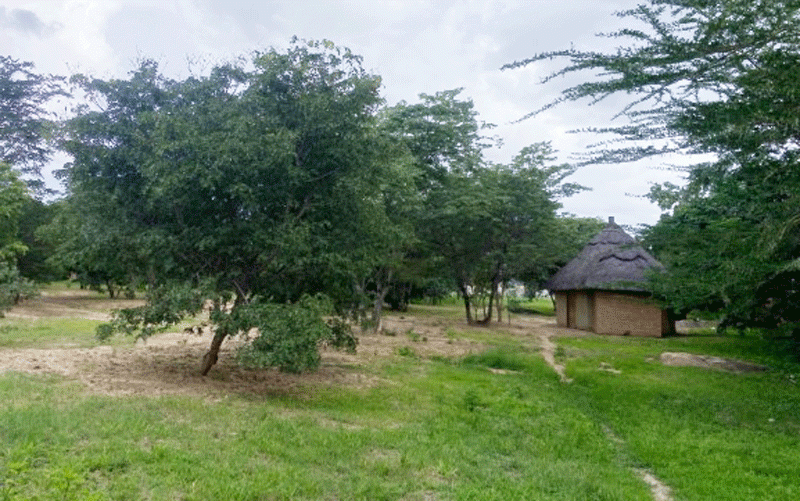
Tucked into the rocky embrace of the Panyatsime Heritage and Cultural Centre in Chitungwiza, an indigenous tree orchard is quietly stealing the hearts of visitors—one leaf, scent and story at a time.
Winding footpaths snake through a living archive of Zimbabwe’s natural and cultural history, where towering mukute (Albizia antelopes) trees spread their feathery canopies like ancestral guardians.
Their tannin-rich bark, once harvested for dyes and rope-making, whispers of a time when villages were bound together by nature’s offerings.
Nearby, hardy mupfura (wild loquat) shrubs burst with golden fruit, irresistible to birds and children alike.
Long before supermarkets, their seeds were ground into flour for nourishing porridge, while the bark doubled as a trusted remedy for fevers.
Overhead, mutondo branches arch gently, heavy with oval nuts once carved into beads and tools.
Elders explain how these trees marked sacred homestead boundaries and shaded communal gatherings and feasts.
Deeper into the orchard, the air thickens with fragrance and memory.
- Over 115 to exhibit at Mine Entra
- Young entrepreneur dreams big
- Econet bemoans power outages
- Govt opens ChiTown e-passport centre
Keep Reading
Moringa trees stand tall, their umbrella-like crowns offering leaves prized for medicinal teas that boost vitality and ward off illness.
When the wind blows, their pods rattle softly, like ancestral maracas calling the past into the present.
Musasa (Brachystegia) groves rise like natural cathedrals, their deep roots once believed to summon rain, their timber shaped into mortars for pounding sadza.
Visitors trace the gnarled trunks of mnondo (Harungana madagascariensis), learning how its milky sap healed wounds and helped craft hunting tools.
Each tree tells a story of survival—food in times of famine, medicine in sickness, lore passed from hand to hand.
But Panyatsime is far more than an orchard. It is a living village.
Thatched huts, granaries, kraals and open gathering spaces pulse with activity, transforming the centre into a breathing, beating reflection of Zimbabwean life.
Founded in 2018 by cultural custodian Rumbidzai Dihwa, Panyatsime was born from a simple vision: to rescue heritage from fading memory and place it firmly in the hands of the next generation.
“What started as a small piece of land has grown into a fully immersive traditional homestead,” Dihwa explains.
Panyatsime is a place to learn, unlearn, relearn, share and grow. This is not just preservation—it is participation.”
For schoolchildren arriving from Chitungwiza and beyond, history leaps off textbook pages and into lived experience.
Learners explore recreated homesteads complete with imba yekubikira kitchens, child-rearing huts and cattle enclosures, each structure revealing the rhythms, values and social order of traditional life.
Traditional games such as tsoro, nhodo and sarura wako sharpen logic, strategy and teamwork, while storytelling circles and music sessions revive ancestral proverbs and rhythms long muted by urban sprawl.
Guided nature walks deepen respect for indigenous biodiversity and environmental stewardship.
These experiences align closely with the Ministry of Primary and Secondary Education’s heritage-based curriculum.
Speaking during an Africa Day commemoration at the centre, senior education official Solomon Makokisi described cultural spaces like Panyatsime as “living classrooms”.
“They allow learners to see, hear, touch and perform the customs that shaped their forebears,” he said.
“They animate what books alone cannot.”
The journey continues at the table. Young visitors sample Zimbabwean staples—sadza paired with indigenous relishes—unpacking the cultural meaning behind each dish.
Here, food is more than sustenance; it is identity served on a plate.
During Culture Month and Africa Day celebrations, Panyatsime comes alive in spectacular fashion.
Students converge for dance, craft workshops and spirited discussions on identity and values.
Videos of these celebrations flood social media, cementing the centre’s reputation as a vibrant hub of culture, cuisine and community.
Dihwa said the missionwas as practical as it is philosophical. “We are nurturing pride in Zimbabwean culture while creating sustainable livelihoods rooted in heritage.”
Heritage officer Lilyosa Maganzo echoes the sentiment.
“If respecting elders, honouring values and living in harmony with nature is considered backward,” she said, “then the world has moved forward in the wrong direction.”
As a new school term approaches, Panyatsime is extending an open invitation to schools across the country.
Bring learners to play, to taste, to dance and to discover themselves beyond classroom walls.
In an age of rapid globalisation, Panyatsime offers something grounding and enduring: roots that give perspective, and stories that shape confident custodians of tomorrow.
“We are not just preserving culture,” Dihwa said. “We are evolving it—for today and for generations to come.”