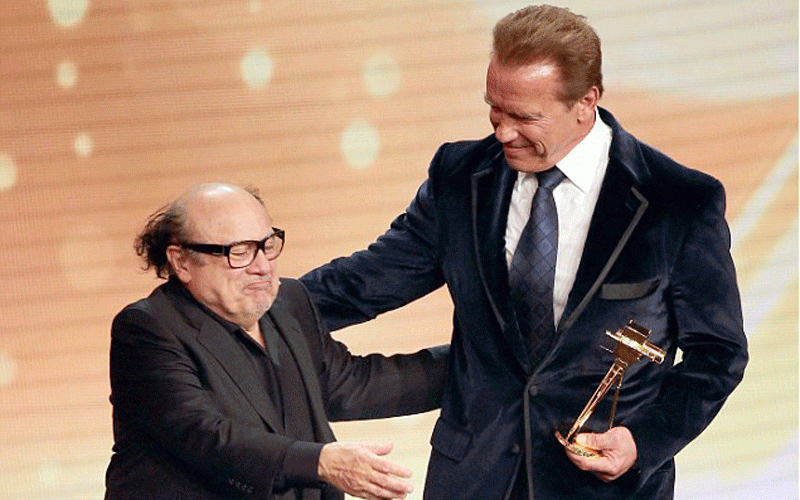
Some readers may recall the 1988 comedy film starring Arnold Schwarzenegger and Danny DeVito entitled Twins, telling the story of twins (the result of scientific genetic experimentation) separated at birth and raised in orphanages, who find each other later in life and then search for their mother. The comedy aspect is found, firstly, in the contrast between the two characters; the one is a streetwise, indebted, small-time criminal while the other turns out to be intelligent but naïve. The major comic element though is found in the fact that the twins are not identical, not least by being of very different heights — Arnold Schwarzenegger is 1,88m and De Vito is 1,47m.
It is interesting that we have some in-built ideas about height. We find it strange when women are taller than their husbands or spouses — we might think of famous Hollywood marriages like Nicole Kidman and Tom Cruise (where the former was 4 inches taller than the latter), or Zendeya and Tom Holland (where Zendaya is two inches taller than Tom) — we might see some coincidence in the two actors being called Tom when we think of the centuries-old story of Tom Thumb! However, there is no reason that we should always expect the man to be taller than his wife; height has got nothing to do with romance, marriage or success.
The important thing to realise is that our height really means nothing. If we think about it, there are advantages and disadvantages of being tall and of being small. The tall person might be able to see over a crowd but equally he will stand out in a crowd when he might not want to be. Standard clothes or beds will not fit or suit him. However, a small person may take the tall person’s advantages as disadvantages and vice versa.
Studies found on the internet may reveal that the average height of a male is 1,71m while that of a woman is 1,60m, but that does not mean anything of significance. “So what?” if we are above average or below average? Indeed, few parents will state that their child must be six foot or above. Few parents will consider their child a failure because he is not six foot. There are no prizes awarded for someone being taller than everyone else. They are simply born that way.
What is more, there is nothing that we can do, physically at least, to change our height. Some of us are taller than others; that does not make either category any better or more important than the other. We may want to be taller or smaller (for whatever strange reason), but there is nothing we can do to change it. We grow naturally. We might wear shoes with high heels to increase our height but other than that there is little we can do — or need to do. We are the height that we are!
It is interesting that while we can do nothing about our height, we can do something about our weight. We are often quick to judge people by their weight but even there, there are different aspects to consider. Some will be heavier naturally (being taller, having heavy bones, muscle or being older or lifestyle). Some may put on weight and others will choose to lose weight but again we do not give out prizes for the heaviest (nor the lightest) person. Weight, like height, is not significant.
If we accept all of that, why then do we put so much kudos and significance on someone’s academic ability when once again so much of that is natural? Some children are brighter than others as some are taller than others. Some children will never gain three A*s, but that is absolutely fine. (As with height, there are also advantages and disadvantages of being gifted academically). Tall people are not better people by virtue of being tall and neither are academic children better people by virtue of being academically bright. Are we too small-minded to see that? We should not and cannot stretch children to be brighter as we cannot stretch them to be taller. The very simple but key point is what matters is how we deal with and use our natural ability and situation.
A Tall Story is an “exaggerated, fantastical tale that is hard to believe”; the biggest tall story may well be when society and schools tell children who are brighter that they are more important than those who are not bright. We might as well give a prize to the tallest pupil in the school.
- Nyashanu basks in Arnold Classic success
- A tall story
Keep Reading
Children can still walk tall when they are small; children can still do well when they struggle academically. We just accept our height, our weight, our academic ability. Are we ‘tall’ enough to see that?