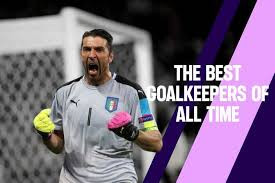
Who is the GOAT (the Greatest Of All Time)? We love to pose that question when discussing sport, just as we love to try to compare other things, like teachers, schools or films when all along comparing things has no benefit or need. The problem with such a question is how we choose to determine it. There is no scientific means to do so, rather inconsistent and inconclusive ones. The criteria for determining the best is that it is all too often selective; it will pick only certain criteria and not consider many others which perhaps should be considered before any judgment is made.
Consider, for example, if we look at soccer, who is the greatest goalkeeper in the world? We might just need to clarify whether we mean the best now or the best ever?
Many seek to have an answer to that question. On the surface it might appear obvious: the greatest goalkeeper is the one who lets in the least number of goals. That is what the Golden Gloves is awarded for. As a result, or perhaps to confirm that, people will believe he is likely to be playing for one of the teams that wins the most as they will generally concede fewer goals than others. However, such thinking would be naive, short-sighted, limited and inappropriate, for many reasons.
Firstly, it is not always the team who concede the least number of goals who win trophies – they simply score more than they concede. Secondly, a team that concedes few goals may have a very strong defensive line and a weaker goalkeeper, so that the ball never gets near the goalkeeper or requires him to make a save. Thirdly, how can a goalkeeper be declared the greatest when he only has one shot to save all match (or maybe even none)? What if a goalkeeper concedes two goals from twenty shots on target and another concedes two goals from only five shots on target - surely the better goalkeeper is the one who saves more shots on target, percentage-wise?
Fourthly, would it make a difference to our thinking if we looked at where the goals that were conceded were struck – what if the goalkeeper saved ten shots from within the six-yard box, a very difficult thing to do? Fifthly, will it make a difference if the shots were ‘thunderbolts’ or ‘tricklers’? We do not know if the goal slipped through the goalkeeper’s hands or he never even had the chance to move for a ball that went into the very top corner. A goalkeeper who lets in a ‘soft’ goal cannot be compared to one who lets in a sizzler.
Sixthly, should we maybe not consider how many mistakes the goalkeeper made in a match or season, as opposed to the number of saves made?
Seventhly, what if half the number of goals conceded came from penalties, awarded due to another player’s mistake, where the goalkeeper has much less chance of saving the ball? Or what if the goals were deflections off another player’s boot at the last second? Eighthly, if the goalkeeper who concedes the least number of goals has in his team the best strikers in the league, then he never has to face the best strikers – if he did, then maybe he would concede more goals! Can you rate his saves made against weaker opposition?
Then, what about weather conditions? Some might play in ideal conditions, where it is dry, with no wind, on a pristine pitch, making play easier while others may face lashing rain, high winds, dreadful pitch, making it more likely to make mistakes. How can we compare? And what about the equipment? The balls used now are very different from twenty years ago, even five years ago, enabling attackers to do things with the ball they could not do before – was it easier then or now? And the rules? Have the rule changes made it easier or harder for goalkeepers? They have certainly made a difference.
- Have we got to go on about GOATS?
Keep Reading
And finally, if we still do decide to determine who is the best goalkeeper based on these categories above, we ignore a goalkeeper’s wider importance and role in a team – he is not there simply to save goals. A good goalkeeper is going to distribute the ball well; is going to encourage his defence throughout the match; is going to command his defence and instil confidence in them; is going to see threats and opportunities before they occur – should we go on? Have you factored all these? So, why, of why, have we got to go on about GOATS? Does it prove or even help anything? We are in fact just silly billies or canny nannies - kid you not! Save that.