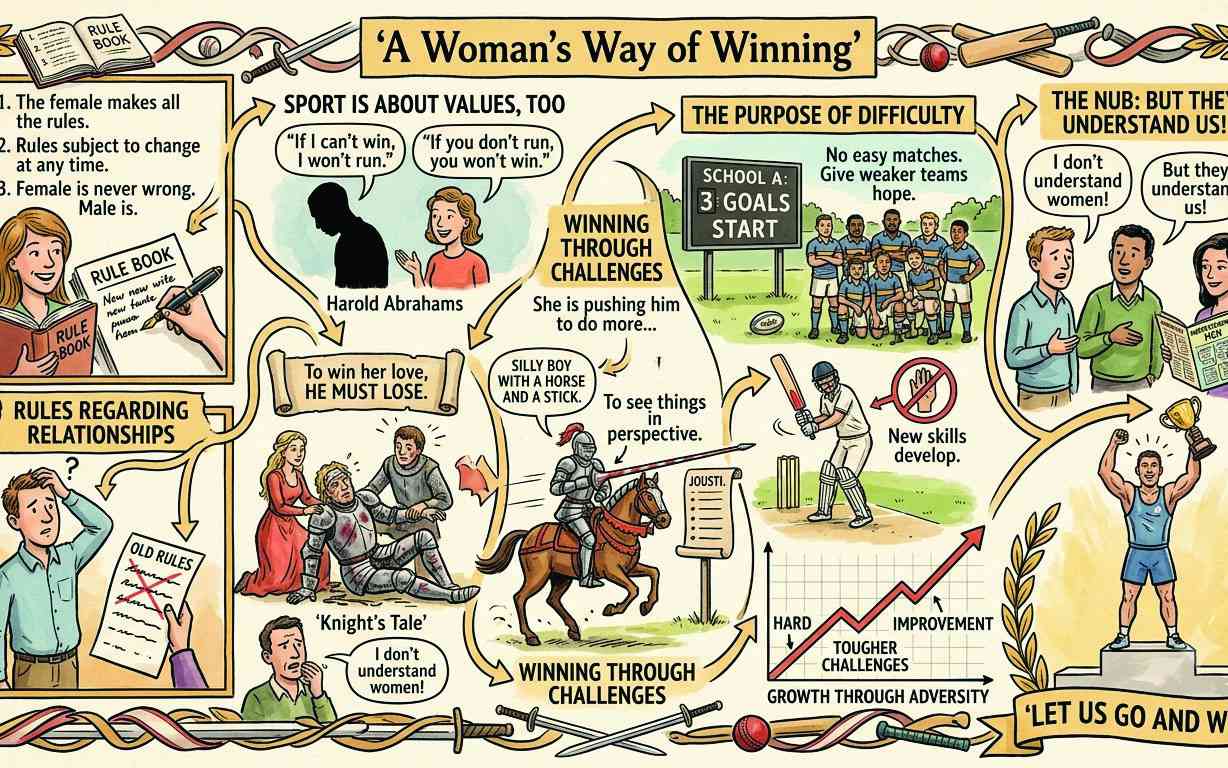
Depending on our gender (and the extent of our sense of humour), we may have smiled at, maybe even enjoyed, the old anonymous description of ‘Rules regarding Relationships’ where we learn that “The female makes all the rules.
The rules are subject to change by the female at any time without prior notification being given to the male.
The male is not allowed to know all of the rules. Should the female suspect that the male knows most or all of the rules, she must immediately change some of them.
The female is never wrong. Should the female appear to be wrong, this is always as a result of a misunderstanding arising from something said or implied or done (or not said, implied or done) by the male (who is wrong anyway).”
We could go on (yes, there is more, alas) but we have perhaps already said enough to upset many readers – and delight others!
Sport is all about rules; there have to be rules. Sport is also about relationships though, not in the sense of winning a woman’s love by sport but by relating the sport to values, to what is important.
And our wonderful women can teach us woeful men much about winning.
In previous articles we saw how Harold Abraham’s girlfriend (in the film ‘Chariots of Fire’) reminded him, when he moaned that “If I can’t win, I won’t run”, that “If you don’t run, you won’t win”.
- Paranoid Zanu PF regime cannot be trusted with solving Zim’s problems
- Zim’s poor batting hands India series
- Raza opens up on career threatening cancer scare
- Chevrons to maintain fearless approach against India
Keep Reading
Then in ‘Knight’s Tale’, the hero’s girlfriend tells him that if wants to win her love he must lose – not win, as he confidently declares he will do! No wonder one of his men mutters forlornly, “I don’t understand women!”
The confusion only deepens further when after the hero has resolutely, obediently, grudgingly lost - being brutally battered, bruised and eventually bandaged in the process, as well as totally bemused, befuddled, even bewitched - the fair lady sends a message now for him to win the tournament for her – from that near impossible situation.
Truly, we may not understand women – or sport.
Interestingly, as Harold Abrahams declared “I will not run” (if he could not win) so our hero in ‘Knight’s Tale’ also vehemently asserts “I will not run” but in this case he is saying he will not run from the exposure he faced (on pretending to be a knight when he was not), just as he did not run from the challenge that she set him.
She even set him a harder task when she described all his manly efforts on the sports field by describing him simply and purely as a “silly boy with a horse and a stick”.
How would he handle such demeaning? How would his pride in what he was doing (not simply his love for the lady) handle that? Simple: he fought through the difficulties. He passed the test!
We may well question, as our hero does, whether the fair lady is showing love to the hero by all her tactics but in truth she is. She is pushing him to do more.
She is helping to make him tougher, stronger, more resolute and perhaps above all to see things, including his sport, in perspective. We do not improve or develop by maintaining the same standard. We do not grow if we stay at the same level; we need things to be hard if we are going to improve. We need tougher challenges.
Perhaps then we should be introducing handicaps to our inter-school fixtures so that there are no easy matches for any team?
Perhaps we should give weaker teams twenty points or three goals start when they play against stronger teams so they have hope and the stronger team has a challenge.
Maybe the strong one may bat left-handed instead of right-handed to give others a chance – it would, after all, be a significant challenge through which the player would develop new skills.
When the man mutters forlornly, “I don’t understand women!”, his friend responds, “Nor do I,” before adding poignantly, “But they understand us!”. And there is the nub. Winning will not come in the long run if winning comes easily.
The fact is that in most cases, we must admit (albeit grudgingly), the woman is indeed right, painful though that may be to our male ego. We just cannot seem to win – but that is how we do win!
Do we not get that? After all, as we are reminded in that piece, “The mood of the male must at all times remain calm and docile - unless the female requires him to be in a different mood. The female must not by any word, hint, gesture, or any other means of communication intimate to the male which mood is required of him. Whichever mood is selected by the male is automatically wrong. The inability to mind-read by the male is not mitigating circumstances for contravention of any of the above rules.” Get it? Now, let us go and win!