Every national budget is a moral document.
It does more than allocate money. It reveals what a nation values. It tells citizens, without the need for speeches or slogans, what government considers urgent, what it considers important and, ultimately, whose lives matter most.
Zimbabwe today confronts a question that should trouble every citizen:
Should our national priorities be measured in ambulances or in Fortuners?
The question is neither rhetorical nor partisan. It goes to the very heart of public policy.
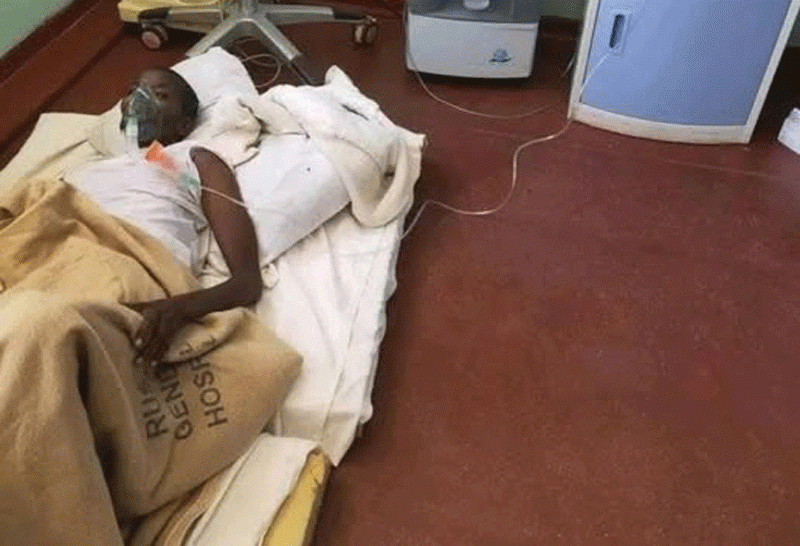
Recent reports paint a deeply troubling picture of Zimbabwe's healthcare system. Our sister publication NewsDay has reported that approximately 563 Zimbabwean mothers died during pregnancy and childbirth over the past year.
The Health minister Douglas Mombeshora has also acknowledged significant neonatal deaths, reminding us that far too many Zimbabwean children do not survive the earliest days of life.
These are not merely statistics.
- Interview: ‘Zim committed to tackling climate change’
- Finance minister reminded of PWDs
- ‘Zim needs infrastructure overhaul’
- Business sector plagued by uncertainty
Keep Reading
Each number represents a mother who never returned home to her family, a child who never had the opportunity to grow up, and families left to live with loss that could, in many cases, have been prevented.
At the same time, Harare continues to suffer from deteriorating public health infrastructure.
Hospitals face shortages of medicines, equipment, specialist staff and functioning facilities.
Water and sanitation systems continue to decline, increasing the burden of disease and placing even greater pressure on already overwhelmed health institutions.
It is, therefore, unsurprising that Harare has repeatedly been ranked among the world's least liveable cities, with the collapse of essential public services—including healthcare—being a significant contributing factor.
The challenge is enormous.
Government itself has acknowledged that Zimbabwe requires approximately US$1.6 billion to restore and modernise its healthcare infrastructure.
One would, therefore, expect every government policy to encourage additional investment into the health sector.
Instead, the country appears to be considering a policy that would prohibit medical aid societies from investing in and operating healthcare facilities.
If implemented, such a policy would represent a remarkable contradiction.
If government itself acknowledges that it lacks the financial capacity to rebuild hospitals and expand healthcare services, why would it discourage institutions capable of mobilising private capital, building hospitals, investing in technology and expanding healthcare delivery?
The answer is difficult to comprehend.
Zimbabwe does not suffer from too much investment in healthcare.
It suffers from far too little.
The role of government should therefore be to create conditions that encourage responsible investment, promote innovation and expand access to quality healthcare.
This is not an argument against regulation.
Medical aid societies should be transparent, accountable and properly supervised. Patients deserve protection. Contributors deserve value for money.
But regulation should strengthen healthcare.
It should never become an obstacle to healthcare investment.
The contradiction becomes even more striking when viewed alongside other public expenditure priorities.
It has been widely reported that approximately US$43 million has been spent acquiring Toyota Fortuner vehicles that have subsequently been distributed to selected church leaders, musicians, traditional leaders, political figures and some Members of Parliament.
Whatever justification may be offered for these distributions, many Zimbabweans view them as part of an expanding system of political patronage designed to consolidate support for the president and the ruling party.
Whether that perception is entirely fair is almost beside the point.
In politics, perception matters.
It is for this reason that many citizens now refer to Zimbabwe, with biting sarcasm, as the "Toyota Fortuner Republic."
Nicknames of this nature emerge when citizens perceive a widening gap between government priorities and public needs.
The comparison is unavoidable.
Imagine what US$43 million could have accomplished had it been directed towards Zimbabwe's healthcare system.
It could have purchased hundreds of fully equipped ambulances.
It could have refurbished maternity wards across the country.
It could have equipped neonatal intensive care units, expanded dialysis services, modernised district hospitals, procured life-saving medicines and diagnostic equipment, and significantly improved maternal and child healthcare.
It could have saved lives.
Politics, after all, is about choices.
Every dollar allocated to political patronage is a dollar unavailable for maternity wards.
Every luxury vehicle purchased represents resources that could have strengthened Zimbabwe's collapsing health system.
Every budget line tells a story.
The question is whether that story reflects the values of the nation.
Governments understandably provide transport for public officials to perform legitimate duties.
Few would dispute that.
The concern arises when expenditure benefiting political elites appears to outpace investment in services that literally determine whether mothers and newborn babies live or die.
No mother should lose her life because a hospital lacks basic equipment.
No newborn should die because an incubator is unavailable.
No citizen should travel hundreds of kilometres in search of treatment while scarce public resources are directed elsewhere.
These are not simply policy failures.
They are moral failures.
Healthcare is not a luxury.
It is one of the primary responsibilities of any government.
The measure of a nation's success is not the comfort enjoyed by those in public office.
It is the dignity, safety and wellbeing experienced by ordinary citizens.
Countries are not remembered because governments assembled impressive vehicle fleets.
They are remembered because they educated their children, cared for their sick, protected their mothers and built institutions that placed human life above political convenience.
Zimbabwe has both the talent and the resources to rebuild its healthcare system.
What has too often been missing is not capacity.
It is political priority.
The debate over whether medical aid societies should be prevented from investing in healthcare therefore misses the larger question.
How do we mobilise every available resource—public, private, faith-based, charitable and community—to save lives?
That should be the national conversation.
Healthcare should unite us, not divide us.
Investment should be encouraged, not discouraged.
Lives should matter more than politics.
Ultimately, every generation is judged by the choices it makes.
Future historians will not ask how many Fortuners were distributed.
They will ask whether mothers survived childbirth.
They will ask whether newborn babies were given a fair chance to live.
They will ask whether leaders chose political comfort over public health.
Those are the choices that define nations.
Zimbabwe still has the opportunity to make the right choice.
To become known not as the Toyota Fortuner Republic, but as a Republic that chose ambulances over excess, patients over patronage, and the health of its people over the politics of its leaders.
That is the choice before us.
And that is the choice history will remember.
*Senator Jameson Z. Timba is a Zimbabwean political leader, former minister of State in the Office of the Prime Minister, convenor of the Defend the Constitution Platform (DCP), a founding principal of Sungano yeVanhu–Ubumbano Lomphakathi (The People's Coalition), and a member of the Presidium of the Progressive Alliance. He writes on constitutionalism, democratic governance, public policy and African political affairs. More of his writings are available at www.jamesontimba.com.