Transformative leadership derives its greatest credibility not from rhetoric, but from action.
Leaders who lead by example inspire trust, mobilise collective effort, and convert vision into measurable outcomes.
In an era where citizens increasingly demand accountability and tangible results, leadership demonstrated through practical engagement carries exceptional moral and strategic weight.
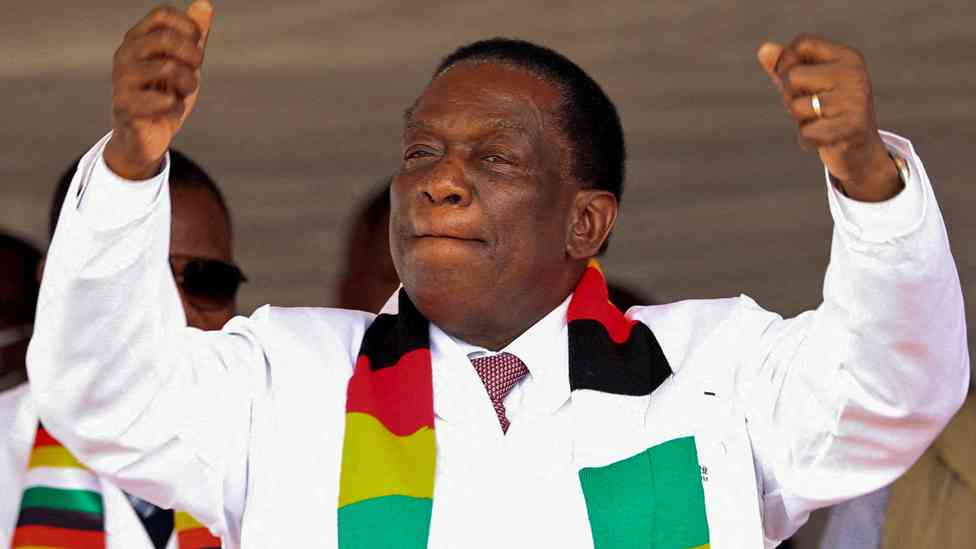
President, Emmerson Mnangagwa has provided a compelling example of such leadership through his unwavering commitment to national food security.
His active involvement at Precabe Farm in Kwekwe stands as a powerful demonstration that the responsibility of nation-building transcends titles and offices.
Even at the highest level of governance, the President has shown that rolling up one’s sleeves in service of national priorities is not optional, but essential.
The president’s hands-on engagement in agriculture is neither incidental nor ceremonial.
Rather, it reflects a deliberate leadership philosophy anchored in pragmatism, self-reliance, and long-term national sustainability.
- Out & about: Warner Music Group squashing the impossible
- NoViolet Bulawayo’s new novel is an instant Zimbabwean classic
- Jah Prayzah, Zanu PF rekindles ‘lost love’
- Ex-ChiTown chamber secretary fails to stop trial
Keep Reading
By personally participating in productive farming, Mnangagwa reinforces a fundamental principle: a nation that can feed itself secures not only its food supply, but also its sovereignty, stability, and future prosperity.
Food security is far more than an agricultural or economic concern.
It is a strategic imperative with wide-reaching implications for social welfare, public health, employment creation, industrial development, and national resilience.
A secure food system reduces vulnerability to external shocks, stabilises prices, improves nutrition, and lays the foundation for inclusive economic growth.
It is within this context that Zimbabwe’s Vision 2030 places food security at the centre of the country’s ambition to attain upper-middle-income status.
Against this national vision, the President’s work at Precabe Farm acquires deeper significance.
His engagement sends a clear signal that agriculture remains the backbone of the Zimbabwean economy and a central pillar of national development.
It affirms that leadership recognises farming not as a subsistence activity of the past, but as a modern, strategic enterprise that demands innovation, efficiency, and accountability.
Despite the immense demands of statecraft, President Mnangagwa continues to dedicate time and attention to ensuring that operations at his farm meet production targets, adopt efficient systems, and embrace modern agricultural practices.
This approach reflects a disciplined understanding of agriculture as a business — one that requires planning, investment, risk management, and performance monitoring.
In doing so, the President exemplifies the very standards of productivity and professionalism that government policy seeks to promote across the sector.
His example aligns seamlessly with the government’s broader agricultural transformation agenda, which prioritises climate-smart agriculture, irrigation development, mechanisation, and value-chain integration.
These policy thrusts are designed to enhance productivity, mitigate climate risks, and link agriculture to agro-industrial growth.
In fact, actively practising what the state advocates, the president bridges the often-observed gap between policy formulation and implementation.
The true power of this leadership lies in its replicability.
When the head of state demonstrates personal commitment to farming, it sends a clear message to farmers, agribusinesses, financiers, and communities alike that productivity matters, and agriculture must be taken seriously.
It encourages farmers to adopt best practices, embrace technology, and approach agriculture as a viable and profitable enterprise rather than a survival activity.
At the same time, such leadership challenges public institutions, private investors, and development partners to align resources, extension services, financing, and markets in support of increased agricultural output.
Leadership by example thus becomes a catalyst for system-wide improvement, fostering a culture of results, responsibility, and collaboration.
Precabe Farm itself stands as a model of productivity and potential.
More importantly, it illustrates what is achievable when commitment, planning, and innovation converge.
It offers a glimpse into Zimbabwe’s capacity to reclaim its historical status as the breadbasket of Africa, not through slogans, but through sustained effort and strategic investment.
Furthermore, the president’s actions effectively narrow the persistent divide between intent and delivery that has undermined development efforts in many contexts.
He reinforces a culture of execution, one where policies are not merely announced, but lived and implemented.
This culture of delivery is indispensable to national transformation.
As Zimbabweans, there is a clear lesson to be drawn from this example.
Food security cannot be achieved by government alone. It requires collective action from individuals, communities, institutions, and the private sector.
For that reason, embracing the President’s vision and emulating his dedication to agriculture, the nation can ensure that no one goes hungry and that Zimbabwe becomes a net exporter of food.
In conclusion, the president’s leadership by example serves as a powerful catalyst for Zimbabwe’s food security agenda.
His practical involvement in agriculture underscores the centrality of food self-sufficiency to national development and Vision 2030.
The path forward is clear: through unity of purpose, disciplined production, and shared responsibility, Zimbabwe can unlock its immense agricultural potential and secure a prosperous, food-secure future for generations to come.
*Clever Marisa (PhD) is a social scientist and public health practitioner. The views expressed here are his own and do not necessarily reflect the views of his affiliated institution or any organisation.