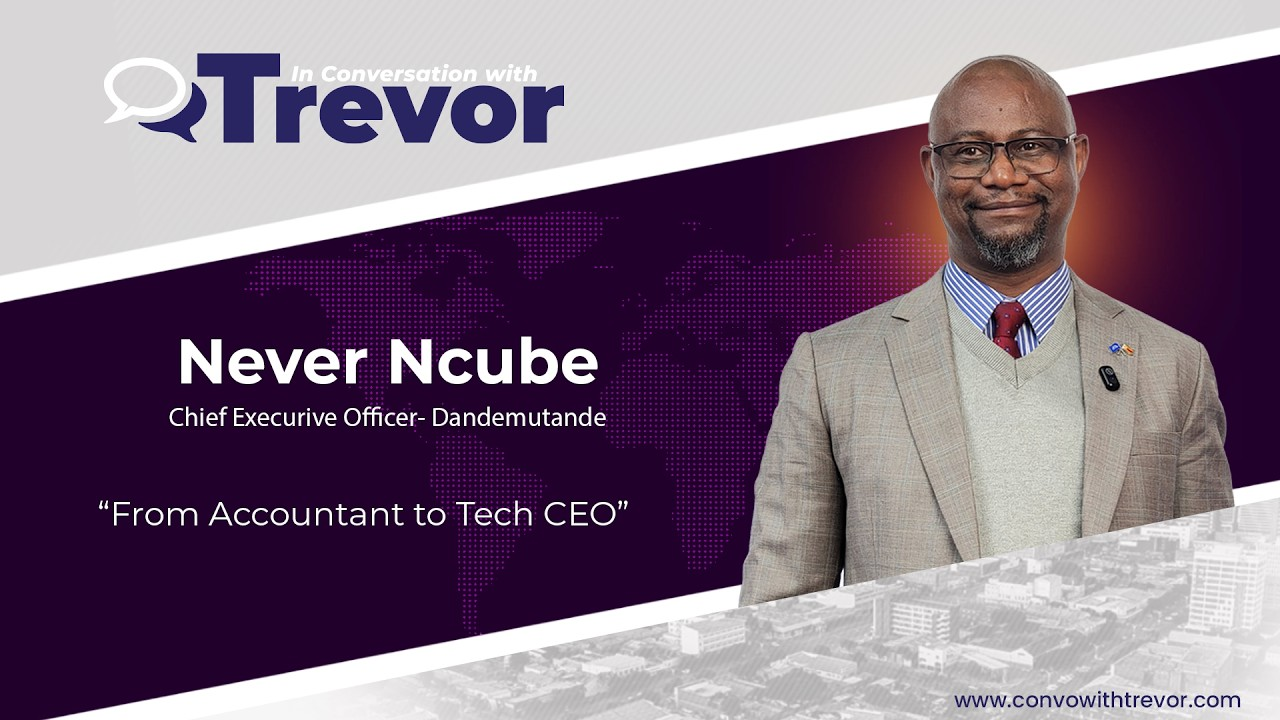
From surviving childhood polio and the crossfire of war in rural Zimbabwe to leading one of the premier regional technology firms, the life of Never Ncube is a masterclass in quiet resilience.
The chief executive of Dandemutande Investments has built a career on a singular, powerful corporate philosophy: "We sell sleep, not speed."
Yet behind his business success lies a deeply moving personal journey.
Having recently endured the devastating, consecutive losses of his uncle, wife, and mother, Ncube (NN) opens up about overcoming childhood ridicule, the power of family, and why hardship has only fueled his drive to mentor others today in the latest episode of In Conversation with Trevor hosted by Alpha Media Holdings chairman Trevor Ncube (TN).
Below are excerpts from the interview.
TN: Welcome to In Conversation with Trevor, brought to you by Heart and Soul Broadcasting Services. Today I'm in conversation with Never Ncube, the chief executive officer of Dandemutande Investments. Tell me about Dandemutande. What does the business do, and what services do you offer?
NN: Dandemutande was founded in 1997, 29 years ago. We started as a small ISP mainly servicing Delta Corporation, then grew into an internet access provider with a license from (the Postal Regulatory Authority of Zimbabwe) Potraz.
Through inorganic growth between 2015 and 2016, we merged with Highway and Africa Online. In 2016, we acquired Your Africa and a small satellite provider in Metaria called Beside Communication.
- In Conversation With Trevor: Munyati: Sports, arts are viable careers
- In Conversation with Trevor: Bango: ‘Street wisdom’ shaped me
- In Conversation With Trevor : Diplomatic posting was a mistake: Chihombori-Quao
- I’ve been a victim of racism in classical music: Mhambi
Keep Reading
We have grown beyond Zimbabwe.
We now have operations in Malawi, Botswana, and we bought into a business in Namibia called Africa Online, where we have 49% and are the managing partner.
TN: Which is the biggest segment of your business?
NN: Connectivity still accounts for almost 65% of our business. That's where the bacon is. But we're seeing growing demand for cloud and cybersecurity. Post-Covid, more people appreciate the need to have their systems on the cloud.
TN: Your tagline is "We sell sleep, not speed." What does that mean?
NN: Our customers aren't looking for how many megabits per second. They're looking for resilience and compliance, being able to do what they do best without worrying about technology in the background. We're saying, "If you're a partner of ours, we'll give you the comfort to do what you're good at while we look after your business."
TN: Connectivity is becoming increasingly commoditiSed. Is that your experience?
NN: The industry says connectivity is being democratised. When I joined this industry in 2012, we were selling one megabit per second at US$1 200. Today it's US$15. Customers still want it to go to US$4 or US$3 like other markets, but we'll get there. With more capacity coming into Zimbabwe, prices are coming down.
The opportunity lies in over-the-top services—cloud, cybersecurity, digital transformation, and AI. Not just forcing services on customers, but co-creating solutions with them.
TN: Is Delta still a shareholder?
NN: No. Delta was never a shareholder in Dandemutande. Some of its executives who are now retired were shareholders and remain minority shareholders.
TN: With connectivity becoming democratised, does the 891-kilometer fiber backbone investment between Beitbridge, Somabhula, and Bulawayo still make sense?
NN: Yes. With all the different connectivity technologies, satellite, fiber, the big pipes will always be driven through fiber. A lot of the content we use sits in South Africa, which justifies the pipe we built. Bandwidth demand will only increase. As prices go down, people consume more. We'll have smart homes, IoT, and everyone is talking about GPUs for AI training.
TN: Wouldn't satellite be the better way instead of digging trenches?
NN: Technologies work side by side and complement each other. For enterprise customers, fiber is still the number one priority solution, with satellite as backup. With fiber, you get more upload speeds than you can get on satellite.
TN: Tell me about your upbringing, where were you born?
NN: I was born in 1971 in Essexvale, Tribal Trust Land now Esigodini. Born into a family of 11 (4 boys, 7 girls). I'm the second from last. I grew up in a rural set-up for 17 years. I only went to Bulawayo after my O-levels in 1989. That was my first time there.
TN: You had a medical challenge early on?
NN: Yes. In 1972, I got mild polio. While being treated, I contracted tuberculosis and had to stay in an infectious disease ward for six months as a 1.5-year-old. I still remember a lady who was in hospital at the same time who always looks at me and says, "You should have died. I don't know why you didn't die." I say, "I'm here."
TN: What about the war experience?
NN: In 1977, there were abductions of children taken to Botswana to join the war. In 1978, I started grade one while many kids stayed home because their parents feared abduction. My parents said, "You've got to go to school—we don't think anyone will abduct you."
In 1979, I played truant with friends. At the end of term, I was probably number 34 or 42 out of 46 students.
I got a beating of my life, and I still remember that incident — it changed how I look at schooling.
In 1978, there was an encounter in Mwenezi. Guerrillas (or terrorists, depending on perspective) would come through villages around 2am, kick doors, and take parents for political orientation.
Two of them went to the shopping centre drunk, fired at a Swift truck, and war broke out. Bullets flew everywhere. The two were killed, and they dragged their bodies through the shopping centre to show everyone what terrorists looked like.
We all celebrated independence when it arrived. We had the first-hand experience of the guys coming back making noise and singing.
TN: What lessons did this rural upbringing teach you?
NN: Three things: Humility — I draw inspiration from those experiences. Resilience — you have to experience hardships to come out and say "I'm resilient" The power and love of a mother — my mother made all those decisions on our behalf
The 1982-1984 dissident era also shaped me. Half the road from Bulawayo to Beitbridge was under curfew. We'd ask for permission to go to school each day. We went to school with kids who were maimed.
I remember one boy whose upper lip was cut off. It shows the compassion we need as human beings, and that war is not a good thing.
Because I had mild polio, I couldn't put on shoes.
The only shoe I could wear was a "tenderfoot" because it's soft all the way up to Grade 7. The ridicule from other kids can be something that kills you if you're in an environment where you're different.
TN: What did that ridicule do to you?
NN: It actually gave me a new image. The way I got back at people was to be the best version of myself.
When I went to Mwenezi Secondary School, I responded by showing them I could be better academically.
From Form 1 to Form 4, I took position one every term. I was the best student of that school, class of 1988, and held the record for more than 20 years.
TN: How did you do that? Were you working too hard?
NN: Working smart, not necessarily too hard. But at times, Fridays to Sundays, I couldn't sleep well.
My mother was a Seventh-day Adventist who took a break from her faith to brew traditional beer to send us to school.
On Fridays to Sundays, the radio would blast while people came to buy beer, making noise all night. In that, there was a young boy studying on a paraffin light, making sure he was number one for four years.
When I excelled, no one laughed anymore.
TN: How did you end up studying accounting?
NN: Everyone from a rural setup wanted to be a teacher. My mother brought me to my uncle in Bulawayo. He worked for the bank. He chose the profession for me. My first choice was rural and urban planning, but my uncle said, "You've got 12 points. You're going to do accounting." And the rest is history.
I did my O-levels in Mwenezi, then went to Mzilikazi High School for A-levels. I participated in the Mathematics Olympiad where we represented Matabeleland in the finals in Harare and got second place, beaten by Gutama Boys.
TN: Who influenced you? Is your uncle still alive?
NN: In the last 30 months (2023 to February 2025), I've lost three of my most loved people:· May 2023: my uncle, who made me in terms of profession, June 1, 2024: my wife, February 2025: my mother
But I'm at peace.
TN: How do you mourn when precious people die in close succession?
NN: It is tough. But I've got family, the surviving siblings (now eight of us, we were 11, lost three) have really stuck together. We all grew up together, suffered together, and today we're still one strong unit. The Dandemutande family, the board, and everyone around me have shown love when it was needed.
TN: What has this season of loss taught you about life?
NN: It inspires me. Whether you believe it or not, death says we all have a short life. Let's not procrastinate. Let's use ourselves as much as we can. Let's give out of ourselves. I do a lot of mentoring and coaching to share whatever knowledge and experiences I have.