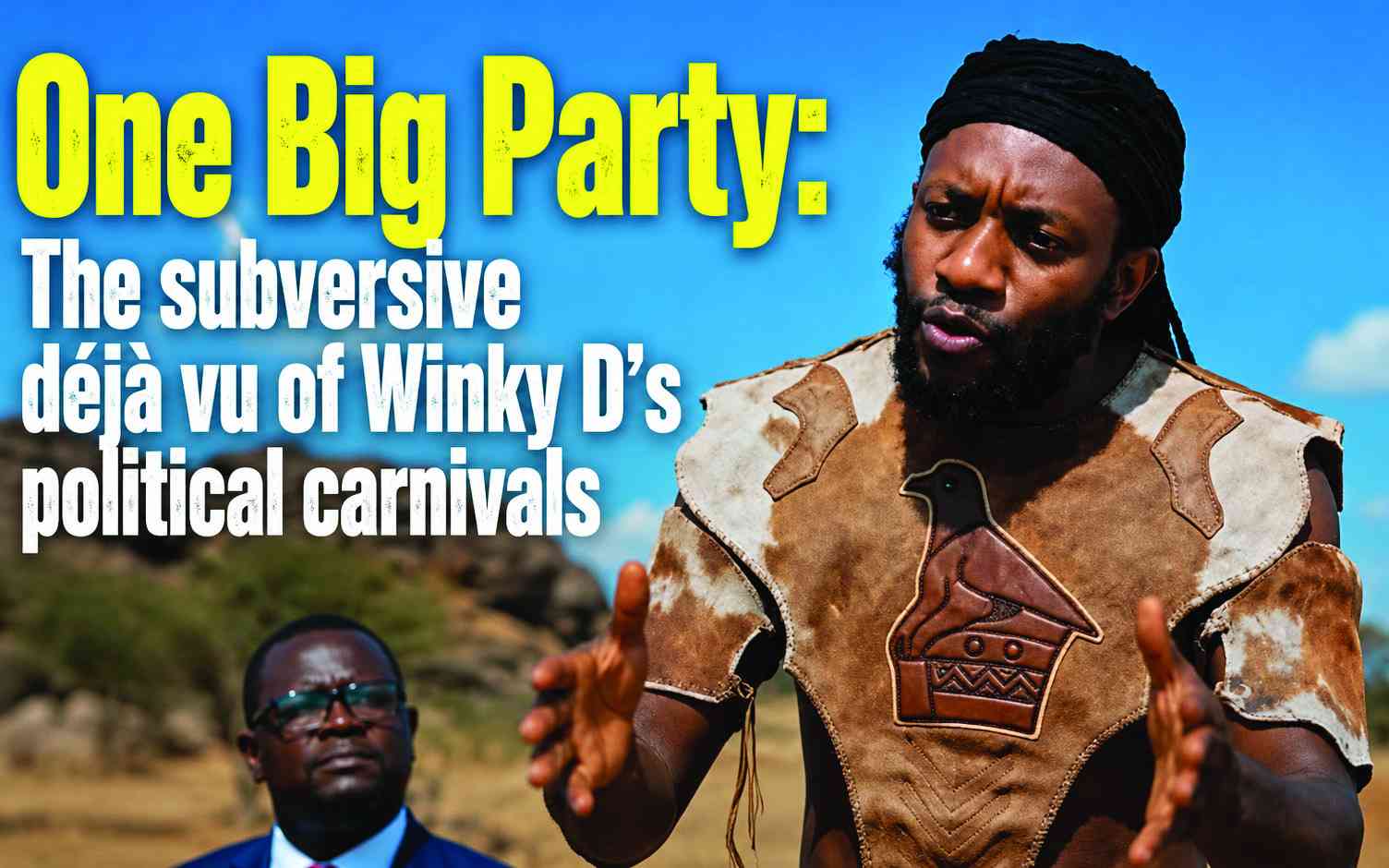
On first listen, one might think Winky D has simply blessed Zimbabwe with a high-energy party anthem to warm up the winter. But, as with most things in the Gafa philosophy, this is a party — but not just a party.
One Big Party triggers an immediate sense of déjà vu. Its sonic landscape and underlying themes echo Gafa Party (Toi Toi), the explosive track released nine years ago in October 2016 on the Gafa Futi album — the project that introduced Winky D’s extra-terrestrial alter ego, ChiExtraterrestrial.
The project was co-produced by Layaan Souljah and Oskid and it is also known as Pamberi NeGaffa.
Like its predecessor, One Big Party operates as a Trojan horse: a celebratory dancehall anthem on the surface, but beneath the infectious rhythms lies sharp social commentary, immense replay value and volatile socio-political undertones.
The title itself is a calculated misdirection. Borrowed from the highly anticipated New Year’s Eve showdown between Winky D and Jah Prayzah at Glamis Arena, the phrase “One Big Party” suggests national celebration and artistic unity.
Yet, within Zimbabwe’s deeply polarised political environment, Winky D’s dance floors have never been neutral spaces.
The subversion begins almost immediately in the opening lyrics:
“Kufumobata jongwe muromo…”
- Religion: Overcoming doubt and unbelief
- Winky D dominates Trevor’s In Conversation
- Religion: Overcoming doubt and unbelief
- Winky D dominates Trevor’s In Conversation
Keep Reading
On the surface, the Shona idiom speaks to waking up early and taking initiative to get the party started.
But the line also functions as a loaded political metaphor. “Jongwe” — the rooster — is the historic symbol of the ruling Zanu PF party.
By invoking the image of “grabbing the rooster by its mouth,” Winky D subtly introduces the shadow of political power before the beat fully settles.
The theme becomes even more pronounced in the infectious hook:
“Pamberi ne Gafa… Party inoyi yatonga, tinofara kusvika tafa!”
Here, Winky D deliberately appropriates the language and cadence of political mobilisation. “Pamberi ne…” (“Forward with…”) is synonymous with Zanu PF slogan culture, while “yatonga” (“it has ruled” or “it is ruling”) mirrors triumphalist political rhetoric.
On the surface, it sounds celebratory. Beneath that surface, however, the song reads as satire — a reflection on permanence, dominance and the endless continuity of power.
The line “tinofara kusvika tafa” (“we celebrate until we die”) becomes less about partying and more about the exhausting cycle of political endurance.
The timing of the release makes the commentary even more difficult to ignore.
The track arrives amid heated national debate surrounding Constitutional Amendment Bill Number 3, a controversial proposal widely viewed by critics as an attempt to centralise executive authority, alter succession mechanisms and potentially extend political influence beyond constitutional norms.
Against that backdrop, Winky D’s imagery of a “party” that intends to rule and dance forever feels deeply intentional.
What makes One Big Party especially fascinating is how boldly it contradicts Winky D’s earlier artistic position regarding political symbolism.
In his 2023 anthem Vafarisi, featuring Bazooker and Poptain, Winky D explicitly attempted to distance youth spaces from political polarisation, declaring:
“Hapana slogan… Hona hutsi harisi tear gas / MaBoyerman asina fear nhasi.”
(“There is no political slogan here… Look, this smoke is not tear gas / it’s the drug dealers who have no fear today.”)
In Vafarisi, rejecting slogans was a way of protecting youthful spaces from political co-option.
In One Big Party, however, Winky D flips the script entirely. Rather than avoiding political language, he weaponises it — turning slogans into instruments of satire and social commentary.
It signals a noticeable shift in posture: from defensive disengagement to open confrontation through metaphor.
Winky D’s broader “party” catalogue increasingly resembles an evolving psychological commentary on Zimbabwean life.
If Disappear explored temporary escape, Kudhakwa examined trauma-induced numbness, and Vafarisi defended the right to joy without political intrusion, then One Big Party feels like a return to defiant movement — dancing while the system burns in the background.
The song has also sparked intense discussion on social media, with journalists, activists and ordinary listeners interpreting it through sharply different lenses.
Award-winning journalist Hopewell Chin’ono praised Winky D for provoking difficult conversations through his music, particularly referencing to the track Chivanhu.
“I want to thank Zimbabwean dancehall star Winky D for the very insightful message in his new song, Chivanhu,” Chin’ono wrote.
“He touches on a serious topic that I have advanced on this page for years — respecting our past, respecting our ancestors, and refusing to be held hostage by foreign religions brought to us through colonial rule and missionary indoctrination.”
Chin’ono argued that African societies often struggle because many modern systems of value are detached from indigenous history and cultural identity.
“A people who do not understand their past, who embrace other people’s ancestors while disowning their own, and who disparage their history are bound to struggle,” he said.
Referencing themes raised in the song, Chin’ono added that part of China’s success stems from cultural confidence and authenticity.
“Winky D has truly matured into an artist who does not follow the wind, but has become the wind itself — the one that others follow,” he wrote.
“Consummate artists do not chase narratives; they shape them. They do not merely reflect society — they challenge it, provoke thought and help direct the national conversation toward issues that matter.”
Musician and businessman Mudiwa Hood also weighed in on the debate, applauding Winky D for tackling questions of culture and identity through music.
“Well done vaWinky D, this is a very good song. As a leader you addressed an important issue — tsika dzedu ne chivanhu takazvisiya kupiko,” wrote Mudiwa Hood.
“The culture we are being sold has Chichie mani amongst other things we do not like. No to Chichie man ne ngito, tarambaaa. We should embrace our culture and observe it… ine gwara rakanaka.
“Well done Baba Aburahama.”
Social media commentator Stvin Nsmbo also interpreted One Big Party as a revolutionary piece of music.
“Music is revolutionary and if the right words are said in relevant times, thought processes are provoked to influence change,” he wrote on Facebook.
“Listening to this song, I reflected on cruelty, selfishness, greediness and abuse of power by the president, his cabinet and the whole government system.”
Another Facebook user, Kudzai Beka, offered a more sceptical, but equally reflective take, arguing that Winky D’s genius lies in his ability to provoke dialogue while maintaining commercial relevance.
“He is raising good questions using the platform at which we have lost almost everything,” Beka wrote.
“He is starting a dialogue that would make him trend and make money for at least two months, and he will have a tour after that making more money.”
Beka also lamented the erosion of traditional values in modern society, adding:
“Our customs and heritage have been swallowed by technology and capitalism.”
Whether viewed as political satire, cultural critique or simply another expertly crafted dancehall anthem, One Big Party once again demonstrates Winky D’s unmatched ability to blur the line between entertainment and resistance.
And perhaps that is the true power of the Gafa President: even while the country argues over constitutions, culture and political futures, he keeps the nation dancing — while forcing it to think at the same time.