Tinashe Moyo did not panic when his mother fell ill last month and needed an immediate, costly medical procedure at a private clinic in Harare.
He didn't queue at a commercial bank, hoping for a loan that would take weeks to approve, nor did he try to liquidate a piece of land in the peri-urban fringes of the capital, a process notorious for bureaucratic delays and legal landmines.
Instead, Moyo walked out to his driveway, patted the hood of his silver 2013 Toyota Wish, and drove it straight to a popular informal car sale lot in Harare.
By sunset the next day, the car was sold and Moyo walked away with US$5,200 in crisp United States dollar bills.
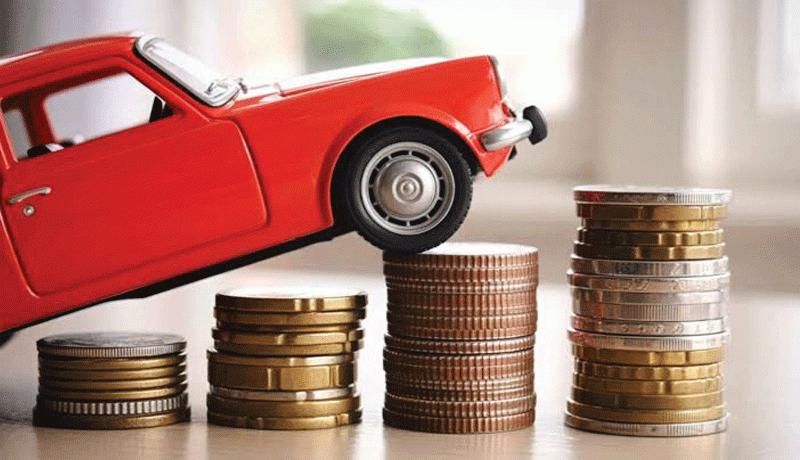
He explains that in Zimbabwe, a car is not just a way to get from one point to another, but is essentially a savings account with wheels that you can quickly liquidate when things fall apart.
While the global automotive market views vehicles as rapidly depreciating liabilities, a unique convergence of macroeconomic forces, logistics bottlenecks and regional trade shifts has turned cars in Zimbabwe into one of the most reliable, liquid and sought-after stores of value.
At the heart of this phenomenon is a changing supply chain where the long-favoured import route through Dar es Salaam, Tanzania, is becoming prohibitively expensive.
This shift is transforming car ownership into an elite achievement and cementing the automobile’s status as Zimbabwe's ultimate financial insurance policy.
- Record breaker Mpofu revisits difficult upbringing
- Tendo Electronics eyes Africa after TelOne deal
- Record breaker Mpofu revisits difficult upbringing
- Greatkhalister in Comrades Marathon debut
Keep Reading
Globally, the psychology of car buying is well-documented, with most people purchasing vehicles for a predictable mix of utility, status, identity, safety and comfort.
While these drivers certainly exist in Zimbabwe, the local economic landscape has superimposed a far more urgent, pragmatically brilliant reason onto the purchase of a vehicle, extreme liquidity and wealth preservation.
Economic analyst Memory Shumba explains that while a piece of land might take six months to find a buyer and several more to clear the deeds, a clean, well-maintained Honda Fit or Toyota Vitz can be converted into hard USD cash within twenty-four hours.
In a volatile economic environment, that level of speed and liquidity is worth far more than any interest rate a bank could ever offer.
For nearly two decades, the route to car ownership for the average Zimbabwean ran directly through the Port of Dar es Salaam in Tanzania.
This East African gateway was the undisputed champion for budget-conscious buyers sourcing used Japanese vehicles from online exporters.
Unlike the port of Durban in South Africa, which historically favoured expensive vehicle transport via car carriers, Dar es Salaam offered a rugged and highly cost-effective alternative.
Importers would employ transit drivers to drive the vehicles over 2,000 kilometers down the Great North Road through Tanzania, into Zambia via the Tunduma and Nakonde border and finally into Zimbabwe through the Chirundu Border Post.
However, the dynamics of this corridor have shifted dramatically as a combination of regional policy changes, port fee hikes and aggressive local taxation has squeezed the budget importer.
This supply chain begins at the Japanese exporter, moves through the Port of Dar es Salaam where rising port and clearing fees are applied, travels through the Tunduma and Nakonde border, crosses the Chirundu Border Post where fuel and transit driver costs accumulate and finally enters Harare after being subjected to a heavy stack of duties and taxes.
Tanzania has steadily overhauled its port logistics and clearing frameworks, resulting in escalated storage fees, port handling charges and clearing agent tariffs.
The cost of overland fuel and the daily rates for transit drivers have spiked, making the physical journey from Tanzania to Zimbabwe significantly more expensive than it was in recent years.
At the final stretch of the journey, the Zimbabwe Revenue Authority maintains a steep tariff structure to regulate vehicle imports.
While the government has slashed customs duties on fully electric vehicles to 25% to encourage green energy, standard internal combustion engine vehicles face a flat 40% customs duty.
To make matters more challenging, the general Value Added Tax in Zimbabwe sits at 15.5% and is calculated on top of the vehicle’s value plus customs duty, while vehicles older than five years face an additional 35% surtax.
When you tally the original Japanese auction price, ocean freight, Tanzanian clearing fees, transit fuel, driver allowances and the heavy domestic duty stack, a car that cost US$2,000 at auction in Nagoya easily balloons to over US$6,500 by the time it receives its Zimbabwean registration plates.
Because of this squeeze on transit routes, buying a fresh import is no longer a casual purchase, but has instead become a monumental, hard-fought milestone.
To own a registered vehicle in Zimbabwe is to signal that you have successfully navigated a gauntlet of international logistics and heavy taxation.
Because obtaining a car has become so difficult and expensive, the cars already inside Zimbabwe's borders hold their value remarkably well and do not suffer the instant, steep depreciation characteristic of vehicles in Western markets.
Instead, certain vehicles are treated almost like stablecoins in an informal currency network, leading to what local dealers call the hatchback cash standard.
The Honda Fit, especially the older GE6 and GE8 models, typically commands an average local purchase price of US$3,500 to US$7,500 and can be liquidated in under twenty-four hours to eager buyers like commuters, taxi operators and small businesses.
Similarly, the Toyota Vitz sells for US$3,200 to US$6,000 within the same day to first-time buyers, students and sales agents.
The slightly larger Toyota Wish goes for US$5,000 to US$6,500 and takes roughly twenty-four to forty-eight hours to sell to school run drivers and cross-border traders, while premium utility vehicles like the double-cab Toyota Hilux trade for US$18,000 to US$35,000 and find buyers among farmers, mining consultants and corporates within one to two weeks.
Because these hatchbacks and wagons are highly fuel-efficient, have widely accessible spare parts and are easily utilised for commercial purposes, there is a permanent pool of buyers waiting to snap them up.
If an owner needs money for school fees, a medical emergency, or to fund a new business venture, they do not need to discount their car deeply to find a buyer.
The market is liquid enough that a seller can demand a fair market price in USD and get paid in cash on the spot.
Local schoolteacher Sandra Chiedza notes that she bought her Toyota Vitz for US$3,800 two years ago, drove it every day, serviced it regularly and was recently offered US$3,600 for it.
She emphasises that driving a car for two years while losing only UUS$200 in value is a far better financial option than keeping money in a bank account that charges monthly maintenance fees.
To truly understand why the liquidity of a vehicle is its ultimate selling point, one must look at the psychological relationship Zimbabweans have with formal banking.
Decades of currency fluctuations, sudden monetary policy shifts and limits on cash withdrawals have fostered a cultural preference for physical, tangible assets.
Keeping wealth in a bank account runs the risk of withdrawal limits, conversion to local currencies, or transaction fees, while keeping physical cash under a mattress risks theft, fire or the temptation of casual spending.
A car is a productive asset that saves money on commuting, allows you to run a side business and transports your family, all while retaining the ability to revert instantly into hard US dollars when a crisis hits.
Along Harare’s busy roads, dozens of informal car sales lots are packed with polished hatchbacks, family wagons and rugged double-cab trucks, where dealers have front-row seats to this economic phenomenon.
Farai Chimusoro, who has managed a car lot in Eastlea for over a decade, says that people come in every single day looking to do a quick sale or what the trade calls a downgrade.
He shares that a parent will often bring in a beautiful SUV to trade for a smaller, cheaper hatchback plus the cash difference in order to raise immediate funds for university tuition, allowing them to walk away with the necessary cash while still keeping a set of wheels.
Looking at his current inventory, Chimusoro points out that while they used to receive ten cars a week arriving from Dar es Salaam, they now only get two or three because of high transit costs and heavy duties.
This slowing supply of new imports means the cars already in Zimbabwe are holding their value incredibly well, making a registered local car equivalent to holding gold.
The traditional narrative of car ownership has been rewritten in Zimbabwe.
As the traditional supply pipeline through Tanzania becomes more expensive and restrictive, owning a vehicle has evolved into a badge of true financial resilience that represents a hard-won victory over steep duties and international logistics.
Beyond the prestige and the convenience of avoiding public transport, the ultimate reason Zimbabweans save every penny to buy a car is simple peace of mind, proving that in a country where adaptability is a prerequisite for survival, a car is both a reliable machine to get you to work today and a stack of cash that can save your family tomorrow.