If a traffic officer catches you holding a smartphone while cruising down the highway, the consequences are swift and severe, heavy fines, penalty points and an uncompromising lecture on road safety.
The legal rationale is entirely unassailable, grounded in decades of cognitive research showing that diverting visual focus from the road for even two seconds doubles crash risk.
Yet, step inside almost any showroom-fresh vehicle today and you will encounter a staggering double standard.
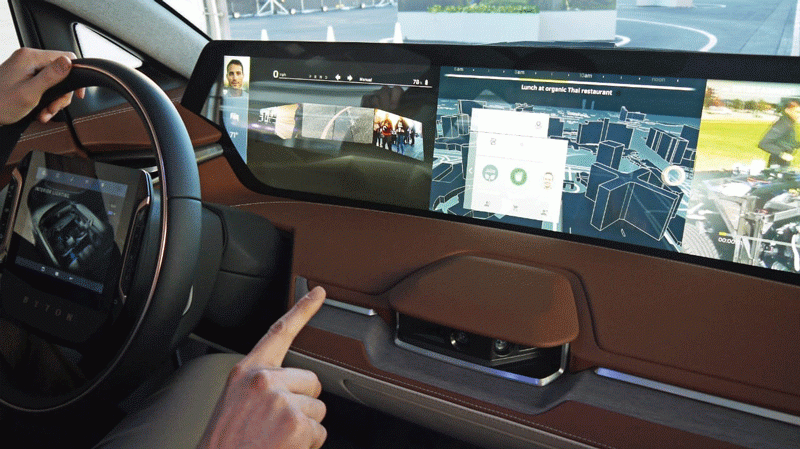
Modern dashboards have been stripped of traditional physical switchgear and replaced by massive, glowing glass panels.
To alter cabin temperature, adjust fan speed, toggle seat heaters, or change a radio station, drivers must perform the exact same action traffic laws penalize, staring directly at a digital screen and tapping through virtual menus while traveling at highway speeds.
The automotive industry has effectively created screens on wheels, sacrificing fundamental human ergonomics for sleek marketing.
This transition from physical controls to all-encompassing touchscreens did not happen because drivers demanded it, it happened because it transformed vehicle manufacturing economics.
Historically, designing a dashboard required extensive engineering, requiring automakers to source physical rotary dials, tactile rocker switches, molded plastics and intricate wiring harnesses for every individual feature.
- Digital pathways: How technology can improve access to education in Zimbabwe
- Bring back the buttons: How automakers sacrificed road safety for cheap manufacturing
Keep Reading
Each physical button represented a mechanical point of failure, an inventory line item and a distinct cost in assembly line labor.
By consolidating secondary vehicle controls into a single central touchscreen, car manufacturers unlocked astronomical cost savings.
A single off-the-shelf liquid crystal display running proprietary software costs vastly less to manufacture and install than dozens of bespoke physical buttons and dedicated electrical circuits. Software updates allow carmakers to modify controls long after production without requiring hardware redesigns.
To sell this compromise to buyers, marketing departments wrapped the transition in tech-centric grandeur, framing sleek, button-less dashboards as the pinnacle of futuristic luxury while press releases praised clean lines and empty dash surfaces as minimalist sophistication.
In reality, however, this digital sweep sacrificed decades of human-factors safety engineering for cheap manufacturing and flashy showroom appeal.
The fundamental flaw of the touchscreen cockpit lies in basic human biology, as driving is an overwhelmingly visual task that demands continuous spatial awareness.
When operating traditional vehicle controls, humans rely on a cognitive mechanism known as proprioception, the brain’s awareness of body position in space, combined with physical muscle memory and tactile feedback.
In a conventionally designed car, a driver reaches out without taking their eyes off the road while their fingers effortlessly identify the knurled edge of a climate dial or the distinct shape of a rocker switch.
The physical texture provides immediate, unambiguous confirmation, allowing a driver to know without looking that turning a dial three clicks to the left lowers the temperature by three degrees. This interaction takes less than a second, requires zero visual confirmation and leaves the driver’s gaze focused on the road ahead.
Touchscreens destroy this tactile paradigm because smooth glass offers zero physical feedback.
A driver cannot feel where a digital icon begins or ends, nor can they gauge whether a touch registered without looking directly at the screen.
Furthermore, touch-sensitive displays lack mechanical resistance, meaning a bumpy road or firm suspension can cause a driver’s finger to misfire, tapping an unintended menu instead of adjusting the air conditioner.
Automotive user experience designers routinely bury essential features under multi-layered software menus.
Adjusting fan speed or changing air direction once required a single blind gesture, whereas on a modern touchscreen, that same action requires looking down at the display, tapping a home button, opening an HVAC sub-menu, locating a virtual slider and visually confirming the adjustment.
During this multi-second ordeal, the driver is flying completely blind to surrounding traffic hazards.
The real-world danger of touchscreen distraction is empirically proven.
A landmark benchmark test conducted by the Swedish automotive publication Vi Bilagare evaluated touchscreen interfaces against traditional physical controls by measuring the time and distance required for drivers to perform four basic everyday tasks while driving at 110 kilometers per hour.
In a 2005-model Volvo V70 equipped with traditional physical knobs and buttons, the driver completed all four tasks in just 10 seconds flat, covering 306 meters.
By contrast, in modern vehicles reliant on touchscreens, the time required to complete the exact same tasks ballooned, with drivers operating touchscreen-heavy electric vehicles spending up to 44.6 seconds navigating digital menus, translating to a staggering 1,372 meters traveled while repeatedly looking away from the road.
Furthermore, research published by the National Highway Traffic Safety Administration and cognitive safety studies from the University of Utah demonstrate that touchscreen interfaces introduce heavy cognitive load, causing drivers to exhibit up to 30 percent slower reaction times to sudden hazards.
At 100 kilometers per hour, a car travels nearly 28 meters every second, meaning a three-second glance downward translates to driving the length of a football field blind.
Beyond safety risks, screen-centric cockpits fail basic real-world practicality.
Traditional mechanical switches operate reliably in all environmental conditions, whether in freezing winter cold or scorching summer heat, but touchscreens present severe operational vulnerabilities.
Direct sunlight frequently causes glare across large glossy displays, rendering climate readouts and navigation maps invisible, while fingerprint smudges build up rapidly into unsightly smears.
In cold weather, drivers wearing gloves find themselves unable to operate capacitive screens, forcing them to expose their hands to freezing temperatures just to turn on the heater.
System latency and software glitches present another frustrating hurdle, as digital screens rely on operating systems rather than completing circuits instantaneously.
If the central computer lags, freezes, or reboots, drivers lose access to vital vehicle controls, including windscreen demisters.
To make matters worse, several carmakers have introduced touch-sensitive capacitive sliders that lack backlighting, rendering them completely invisible during nighttime driving and forcing drivers to blindly grope in the dark.
After a decade of unchecked screen proliferation, the automotive industry faces an inevitable reckoning as safety authorities and consumers push back against touchscreen distraction.
Leading the charge is the European New Car Assessment Programme, which is stripping safety points from car manufacturers that fail to provide physical controls for critical functions under updated assessment protocols.
To achieve a top five-star safety rating, vehicles must feature dedicated physical buttons, switches, or stalks for essential tasks, including turn signals, hazard lights, windscreen wipers, horn operation and emergency SOS functions.
This regulatory shift is already forcing major automakers into humbled design U-turns.
Executive leadership at Volkswagen publicly admitted that replacing physical steering wheel buttons and HVAC dials with unlit touch sliders was a mistake that alienated customers, leading to a commitment to reinstate tactile buttons across their upcoming vehicle lineup.
Other major manufacturers, including Hyundai, Mazda and Nissan, have similarly pledged to preserve physical switchgear for core driving functions, explicitly rejecting full-screen integration.
Technology in automobiles should enhance the driving experience, not compromise operational safety.
Touchscreens offer genuine value for static features such as high-resolution navigation maps, detailed vehicle telemetry and stationary media selection, however, transforming primary cabin controls into touchscreen interactions represents a profound failure of human-centered engineering.
The law rightly recognizes that staring at a handheld screen while piloting a two-tonne metal vehicle at highway speeds is a dangerous act that puts lives at risk and it is high time automobile manufacturers were held to the exact same standard of safety and common sense.
Physical buttons and switches are not outdated relics, they are essential safety equipment, and the verdict from drivers and regulators is clear, bring back the buttons.