On August 20, 2026, African Sun Limited issued a routine-sounding “Portfolio Update” to shareholders. It was anything but.
The notice revealed a hospitality group prepared to make a bold trade-off: release capital tied up in three established city hotels to secure full control of the partnership operating one of Zimbabwe’s most prestigious tourism assets — and commit US$11 million to refurbishing it.
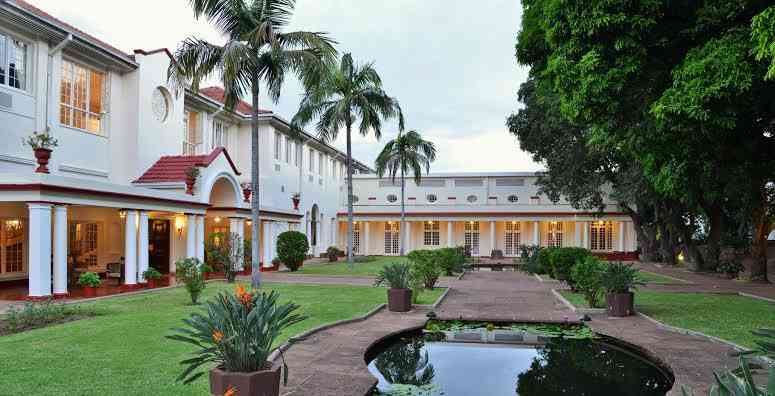
Subject to final regulatory approvals, African Sun has signed a cessation agreement with Meikles Hospitality to acquire its remaining 50% interest in the Victoria Falls Hotel Partnership, a joint venture the two companies have operated since 1998. The partnership operates the storied Victoria Falls Hotel — the “Grand Old Lady of the Falls” — built in 1904 and owned by Emerged Railways Properties, a venture between the National Railways of Zimbabwe and Zambia Railways.
The transaction would give African Sun 100% control of the Victoria Falls Hotel Partnership for the first time in nearly three decades.
To fund the acquisition and an accompanying US$11 million refurbishment programme, the board has resolved to dispose of the Group’s Holiday Inn portfolio in Harare, Bulawayo and Mutare — three hotels that have, for more than three decades, been synonymous with the African Sun brand.
The disposals are not yet done deals. They remain conditional on consent from IHG, which franchises the Holiday Inn brand locally; the National Railways of Zimbabwe Contributory Pension Fund, landlord of the Harare and Bulawayo properties; and Zimbabwe’s Competition and Tariff Commission.
African Sun is targeting full management and operational control of the Victoria Falls Hotel by September 2026, with handover of the Holiday Inns pencilled in for January 1, 2027.
African Sun’s move should not be read as an abandonment of hospitality. The evidence points instead to a deliberate concentration of capital around fewer, higher-value assets.
- Nakamba back from injury
- African Sun floats on ‘gain on bargain purchase’
- African Sun floats on ‘gain on bargain purchase’
- African Sun completes purchase of Dawn Properties
Keep Reading
That direction was already visible in the company’s 2024 Integrated Annual Report, which outlined a strategy of optimising the portfolio around a smaller, more profitable selection of hotels while redirecting capital towards refurbishment, technology and sustainability.
The numbers tell the story.
In 2024, African Sun still managed nine hotels with 1,375 rooms — six owned and three leased — generating revenue of US$53.98 million, up 15% year-on-year, and EBITDA of US$9.88 million, up 21%.
Since then, the Group has trimmed aggressively.
Great Zimbabwe Hotel was disposed of effective April1, 2025. The Monomotapa Hotel, formerly Crowne Plaza, was sold to the Public Service Pension Fund for a reported US$18 million. Caribbea Bay Resort on Lake Kariba followed, effective March 1, 2026, for around US$5.65 million.
Sun Leisure Tours was discontinued in 2024, while the long-mothballed Beitbridge Express Hotel — idle since 2016 after successive losses — was ultimately offloaded through other channels following a brief management agreement in 2024 that was subsequently terminated.
The result is a considerably leaner core of seven properties: Elephant Hills Resort, Hwange Safari Lodge, Holiday Inn Mutare, Troutbeck Resort, The Victoria Falls Hotel, Holiday Inn Harare and Holiday Inn Bulawayo.
Together, they account for roughly 1 048 rooms before the proposed Holiday Inn exit.
If that disposal is completed, African Sun’s inventory would fall to around 594 rooms across four properties: Victoria Falls Hotel, Elephant Hills Resort, Hwange Safari Lodge and Troutbeck Resort.
That would represent an extraordinary transformation for a company once synonymous with hotel scale in Zimbabwe. But what African Sun is surrendering in room count, it appears determined to retain in strategic positioning: a smaller collection containing some of the country’s most important tourism assets.
This is not African Sun’s first strategic recalibration.
The company traces its roots to Meikles Southern Sun Hotels, established in 1979 and renamed Zimbabwe Sun — ZimSun — in 1980. It listed on the Zimbabwe Stock Exchange in 1990 and, by the 2000s, had built a genuine pan-African footprint, operating hotels in South Africa, Nigeria and Ghana.
The flagship of that expansion was The Grace Hotel in Rosebank, Johannesburg, acquired in 2004. Under ZimSun’s management, The Grace was rated the best hotel in Johannesburg by Condé Nast Traveller — evidence that a Zimbabwean operator could compete credibly on foreign soil.
Perhaps the expansion’s most memorable moment came in July 2009, when Holiday Inn Accra Airport hosted US President Barack Obama and his family during his first official trip to sub-Saharan Africa as president — a rare turn in the global spotlight for a Zimbabwean-managed hotel and an achievement African Sun still counts among the highlights of its history.
But when regional trading conditions deteriorated, African Sun did not cling indefinitely to scale. It exited The Grace and The Lakes in 2011, disposed of its Ghanaian and Nigerian operations by 2015, and refocused on Zimbabwe.
For decades, Zimbabwe’s corporate hotel industry has been dominated by three names: African Sun, Rainbow Tourism Group (RTG) and Cresta Hospitality.
A 2022 academic study counted 11 establishments under African Sun, compared with six for RTG and five for Cresta. That hierarchy is now visibly shifting.
African Sun’s domestic portfolio has fallen from 11 hotels in 2020 to seven today. If the proposed Holiday Inn disposal proceeds, its core portfolio would effectively contract to four properties: Victoria Falls Hotel, Elephant Hills Resort, Hwange Safari Lodge and Troutbeck Resort.
RTG, meanwhile, has been moving in the opposite direction.
The Group acquired Montclair Resort and Conference Hotel in Nyanga for US$5 million, with the property integrated into its portfolio effective March 1, 2025. It subsequently expanded Montclair from 85 rooms at acquisition to 110 rooms and invested US$2 million in refurbishment.
That upgrade, completed in July 2026, forms part of a broader RTG strategy combining investment in existing assets with selective portfolio expansion.
African Sun is therefore shrinking its footprint while concentrating capital. RTG is expanding while simultaneously upgrading what it already owns.
Those contrasting strategies create an intriguing question.
Three internationally branded, IHG-affiliated hotels — in Harare, Bulawayo and Mutare — are potentially changing hands at precisely the moment African Sun’s closest domestic rival has raised fresh capital and demonstrated an appetite for acquisitions.
Could this be the opening RTG has been positioning for?
Strategically, the Holiday Inn portfolio would offer something RTG’s recent acquisitions have not: an established, internationally franchised city-hotel network with existing corporate, business-travel and conferencing demand across three important urban markets.
It would also address geographic gaps. Bulawayo gives an acquirer exposure to Zimbabwe’s second-largest city and an important industrial and commercial centre, while Mutare provides a foothold in the eastern-border trade corridor. Harare adds another established corporate property in the country’s largest business market.
But strategic fit is not the same thing as a transaction.
The IHG franchise-consent requirement, approval from the NRZ Contributory Pension Fund as landlord of the Harare and Bulawayo properties, and Competition and Tariff Commission review all introduce additional variables. The assets could just as easily go to another acquirer: a pension-fund-backed vehicle of the kind that has already absorbed former African Sun properties, a private investor, or a new operator prepared to take on the IHG franchise.
RTG may also decide that capital discipline matters more than another acquisition after an investment-heavy 2025–2026 period.
Whether RTG moves, another established operator steps forward or a dark-horse buyer emerges is a question only the coming months — and the outstanding approvals — will answer.
African Sun’s notice does not say that a buyer has been identified. That distinction matters.
But strategically, the possibility is difficult to ignore.
Step back from the corporate manoeuvring and a broader picture emerges: Zimbabwe’s tourism sector looks considerably healthier than the churn within any single hotel group might suggest.
The 2024 numbers were already strong. Zimbabwe recorded 1.61 million international tourist arrivals, tourism receipts of nearly US$1.18 billion and tourism investment of about US$190.5 million, up 7%.
That momentum accelerated into 2026.
In the first quarter, international arrivals rose 11% to 384,561, tourism receipts climbed 14% to US$251 million, and new tourism investment surged 438% to US$67.8 million.
International recognition has followed. Zimbabwe was named Destination of the Year for Natural Wonders at ITB Berlin 2026, while Tourism minister Barbara Rwodzi was named Africa’s Tourism Minister of the Year at the same event.
Against that backdrop, African Sun’s recalibration, Meikles’ portfolio realignment and RTG’s expansion look less like evidence of an industry in trouble than signs of a market being actively repriced.
Capital is moving. Ownership structures are changing. Operators are choosing where they believe their money can earn the strongest returns. Some are trading scale for higher-value tourism assets; others are expanding into the gaps they leave behind.
The hotel portfolios will continue to be reshuffled, and brands will continue to change hands. The “big three” of a decade ago will not necessarily be the big three of the decade ahead.
But beneath all that movement sits the more important story: investors are still putting money into Zimbabwean tourism.
African Sun may be getting smaller.
Its ambition — and Zimbabwe tourism’s — appears to be getting bigger.
*Simbarashe Muswehaurari is a Zimbabwean communications and strategy professional with experience spanning the technology, telecommunications, tourism and hospitality sectors. He writes in his personal capacity