AFRICA stands at a defining moment in its energy history.
The continent possesses some of the world's most abundant renewable-energy resources, vast mineral deposits, enormous agricultural potential and a rapidly growing population whose economic aspirations are increasing every year.
Yet this potential exists alongside one of the world's most persistent electricity deficits. Millions of people remain without access to electricity, while many businesses and industries that are already connected to the grid continue to experience unreliable or inadequate power. This contradiction raises a fundamental question that Africa must confront with urgency: are we investing sufficiently, and with enough technical and financial discipline, to build the energy system required to support the continent's development ambitions?
As an electrical engineer, I look at this challenge from the perspective of the entire power system rather than from the perspective of a single generation technology. Electricity does not begin and end at a power station. It moves through a complex network of generators, transformers, substations, transmission lines, distribution networks, protection systems, control centres and ultimately the equipment used by consumers. The success of an energy transition therefore cannot be measured simply by the number of solar panels installed or the number of megawatts announced. It must be measured by whether electricity is available when it is needed, whether the grid can remain stable, whether industries can operate competitively and whether households and communities can rely on the system to support a better quality of life.
This is why I believe Africa's energy transition must now move from the language of ambition into the discipline of implementation. Mission 300 has provided an important framework for accelerating electricity access across Africa, and the progress already being made demonstrates that large-scale change is possible when governments, development institutions and the private sector work together. However, the magnitude of Africa's energy deficit means that the continent cannot afford to become satisfied with incremental progress. The objective is too important, the population is too large and the economic consequences of inadequate electricity are too significant. We must constantly ask whether the pace of investment, construction and electrification is sufficient to meet the target and, more importantly, whether it is sufficient to support Africa's development beyond 2030.
One of the most serious issues confronting this ambition is the financing gap. Africa continues to receive only a small proportion of global clean-energy investment despite possessing extraordinary renewable-energy resources and an enormous unmet demand for electricity.
This imbalance should concern both African leaders and international development partners. The problem is not that Africa lacks sunlight, rivers, wind or other energy resources. The problem is that the infrastructure required to transform these resources into reliable electricity requires substantial and sustained capital. A solar resource in the desert does not power an industrial facility by itself. Between the energy resource and the consumer there must be generation equipment, transmission infrastructure, substations, transformers, distribution networks, protection systems, control technology and qualified personnel. Every part of that chain requires investment.
From an engineering perspective, this distinction is extremely important. When I evaluate a power project, I cannot simply ask how many megawatts it will generate. I must also ask how those megawatts will be integrated into the grid, where the electricity will be consumed, whether the transmission system has sufficient capacity, how the voltage profile will be maintained, what the fault levels will be, what reserve margin will be available and how the system will respond if a major generating unit or transmission line fails. These technical considerations determine whether the electricity produced by a project becomes dependable power for the economy or simply becomes another isolated asset struggling to deliver its full value.
- Open letter to President Mnangagwa
- Feature: ‘It’s worse right now than under Mugabe’: Sikhala pays the price of opposition in solitary cell
- Masvingo turns down fire tender deal
- Human-wildlife conflict drive African wild dogs to extinction
Keep Reading
Africa therefore needs to stop treating the energy transition purely as a generation challenge. It is a complete power-system development challenge. New generation capacity must be accompanied by investment in transmission and distribution. Renewable-energy deployment must be supported by energy storage, improved forecasting, modern protection systems and flexible grid management. Rural electrification must be linked to productive economic activity so that newly connected communities can use electricity for agriculture, manufacturing, refrigeration, education and digital services. At the same time, utilities must be strengthened so that the infrastructure being constructed today can be operated, maintained and expanded tomorrow.
This becomes even more important when we consider the changing nature of electricity demand across Africa. The continent is not simply seeking to provide basic electricity services to its existing population. It is also attempting to industrialise, expand manufacturing, process minerals locally, modernise agriculture and participate more aggressively in the digital economy. Data centres require substantial and reliable electricity. Advanced manufacturing requires stable power.
Mineral beneficiation requires energy-intensive processing. Electric mobility will increase electricity demand. Modern irrigation systems require electricity. Artificial intelligence and cloud computing depend on increasingly sophisticated digital infrastructure, and digital infrastructure ultimately depends upon a reliable electricity supply.
Consequently, Africa's economic ambitions are also energy ambitions. We cannot seriously discuss industrialisation without discussing generation capacity. We cannot discuss mineral beneficiation without discussing electricity costs and reliability. We cannot discuss digital transformation without discussing grid resilience.
We cannot discuss modern agriculture without discussing irrigation and cold-chain infrastructure. Energy sits underneath all of these development objectives, and the strength of the energy system will influence how successfully Africa can pursue them.
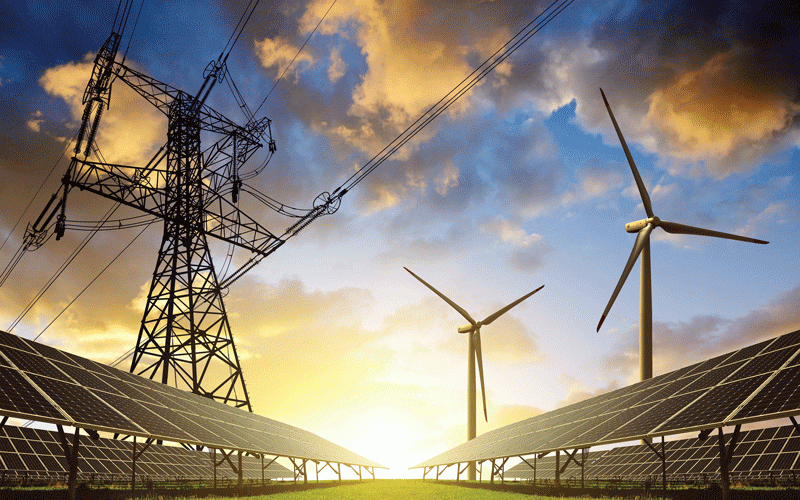
The continent's enormous renewable-energy potential provides an important advantage. Solar power in particular can play a transformative role in expanding electricity generation and improving access in areas where conventional grid expansion may be difficult or expensive. Wind, hydroelectricity, geothermal energy and sustainable biomass can also contribute significantly depending on the resources available in individual countries. However, the engineering challenge is to integrate these resources into a coherent electricity system. Renewable generation is not always available at the exact moment electricity is demanded, and therefore the future grid will require increasingly sophisticated approaches to balancing supply and demand.
This is where energy storage and grid modernisation become essential. Battery energy-storage systems can help manage short-term fluctuations and provide valuable flexibility. Improved forecasting can help system operators anticipate changes in renewable output. Modern substations and digital protection systems can improve reliability and response times.
Demand-side management can help shift certain electricity consumption patterns away from periods of system stress. Regional interconnections can allow countries to exchange electricity when one system has surplus generation and another is experiencing a deficit. These are not separate initiatives. They are components of one increasingly interconnected power system.
Regional cooperation will therefore be critical to Africa's energy future. Electricity does not recognise political boundaries in the same way that infrastructure planning often does. A major transmission corridor can connect several markets, and regional power pools can improve the utilisation of generation assets across national borders.
This is particularly important for renewable energy because different geographical areas can experience different generation conditions at different times. Stronger regional electricity markets can therefore help countries make more efficient use of available resources while improving overall system resilience.
However, regional integration must be supported by serious technical planning. Interconnected systems require coordinated protection schemes, compatible operating standards, adequate reserve capacity and sophisticated system-control mechanisms. Engineers must understand how power flows across interconnected networks and how disturbances in one part of the system can affect another.
As African grids become more interconnected and renewable penetration increases, power-system engineering will become even more important.
There is also a human-capital dimension that cannot be ignored. Africa cannot successfully transform its energy system without developing the engineers, technicians, scientists, project managers and entrepreneurs who will design, construct, operate and maintain the infrastructure. Our universities must therefore adapt their programmes to the requirements of the future electricity system. We need engineers specialising in power systems, high-voltage engineering, renewable-energy integration, battery storage, power electronics, protection and control, grid automation and energy economics. We also need technically competent artisans and technicians capable of safely installing, testing and maintaining increasingly sophisticated equipment.
The energy transition should therefore become an opportunity to build African technical capacity rather than simply an opportunity to import technology. International companies and international expertise will continue to have an important role, but African engineering companies must increasingly participate across the energy value chain. We need local companies capable of designing electrical systems, constructing substations, installing renewable-energy systems, providing engineering services, maintaining infrastructure and eventually manufacturing selected components where there is a commercially viable opportunity to do so.
This is important not only from the perspective of local participation but also from the perspective of long-term energy security. A country that depends entirely on external expertise to maintain critical infrastructure remains vulnerable even if it has sufficient generation capacity. Building technical capacity means building resilience. It means ensuring that when a transformer fails, when a protection system requires attention or when a transmission corridor needs upgrading, there are local professionals capable of responding quickly and competently.
Financing remains the other major pillar of this transformation. It is not sufficient to tell Africa to attract more private investment. We must examine the conditions under which that investment is expected to operate. Energy infrastructure is capital-intensive and frequently requires long periods before investors recover their initial investment.
Investors therefore require predictable regulatory environments, credible offtakers, bankable contracts and mechanisms capable of reducing political, currency and other risks. Where these conditions are absent, the cost of capital rises and technically viable projects can become financially unattractive.
Development finance institutions consequently have an important role to play in mobilising private capital. Their impact should not be measured only by the amount of money they lend directly. Their greater value may come from using guarantees, blended finance, concessional funding and risk-sharing structures to attract much larger volumes of commercial capital. If development finance can reduce the risks surrounding an energy project sufficiently to unlock several times more private investment, then the developmental impact becomes significantly greater.
The cost of capital is particularly important in Africa because it directly influences the cost of electricity. A project that might be economically competitive in a low-interest-rate environment can become significantly more expensive when financed at high rates. This ultimately affects consumers and industries.
Expensive electricity reduces industrial competitiveness, increases operating costs and can discourage investment. Therefore, improving the financing environment is not simply a financial-sector objective. It is an energy-security and industrial-development objective.
Africa must also improve the speed at which energy projects move from conception to construction. We have seen too many projects remain for years in various stages of feasibility studies, approvals, negotiations and financing discussions.
Some of these delays are understandable because major infrastructure projects require careful environmental, technical, financial and legal assessment. However, there is a point at which excessive delay becomes an economic cost in itself. Every year that a viable power project remains unbuilt represents electricity that could have been available to households, businesses and industries.
This is why project preparation deserves much greater attention. Governments and development institutions should invest in preparing technically and commercially robust projects before presenting them to investors.
Proper feasibility studies, reliable resource assessments, grid-connection studies, environmental assessments, land arrangements, financial models and bankable contractual structures can dramatically improve the probability of successful project execution. The objective should be to create a pipeline of projects that investors can understand, evaluate and finance with confidence.
At the same time, Africa must not make the mistake of believing that building new infrastructure automatically solves the energy problem. Existing infrastructure must also be protected and maintained. A new power station connected to an ageing transmission network cannot deliver its full economic value if the network is unable to evacuate the electricity. A new transformer does not solve the problem if distribution infrastructure remains overloaded. Maintenance is therefore not an administrative activity that comes after development. It is an integral component of development itself.
As engineers, we understand that reliability is designed and maintained. Equipment must be inspected, tested and serviced. Protection systems must be verified. Transformers must be monitored. Transmission corridors must be maintained. Distribution networks must be upgraded as demand increases. Preventive maintenance is usually less expensive than emergency repair after a catastrophic failure. The same principle should govern national energy infrastructure.
I also believe Africa needs to change how it measures the success of electrification. Counting new connections is important, but it does not tell the entire story. We should also examine the reliability of supply, the duration and frequency of outages, the quality of voltage delivered to consumers, the cost of electricity, system losses and the productive economic activity created by new connections. A community that has technically been connected to the grid but experiences frequent interruptions has not received the full developmental benefit of electricity.
The ultimate objective should be productive and reliable electricity access.
A rural electrification programme should enable agricultural processing, irrigation, refrigeration and small-scale manufacturing. An industrial connection should enable companies to operate competitively. A hospital connection should support modern healthcare equipment. A school connection should support digital learning. Electricity should become an economic enabler rather than merely another household service.
This is where Mission 300 has the potential to become much more than an access programme. If implemented effectively, it can become part of a much broader African economic transformation. Connecting hundreds of millions of people to electricity can create a foundation for entrepreneurship, education, healthcare, manufacturing and agricultural development. But that outcome will depend on whether electricity is reliable, affordable and connected to productive economic opportunities.
We must also recognise that Africa's energy transition cannot simply copy the pathway followed by developed economies. Our starting point is different. Many developed economies are replacing established electricity systems with cleaner technologies, while large parts of Africa are simultaneously trying to build basic electricity infrastructure, expand industrial capacity and transition towards cleaner generation. Africa therefore has to solve several problems at the same time.
That requires a pragmatic approach.
We should embrace renewable energy aggressively where it makes technical and economic sense. We should develop storage where it provides value to the grid. We should improve hydroelectric systems where water resources permit. We should modernise existing generation assets. We should strengthen transmission networks. We should invest in energy efficiency. We should explore emerging technologies carefully. And we should ensure that the transition does not undermine the reliability and affordability of electricity required for development.
There should be no ideological war between energy technologies. The electricity system does not care about political slogans. It responds to engineering realities.
The engineer's responsibility is to ask whether the system will remain stable, whether electricity will be available when demand occurs and whether the infrastructure can be maintained over its design life. Those questions should guide energy policy.
This is why I remain deeply concerned when Africa's enormous energy challenge is discussed primarily in terms of targets without equal attention to the engineering and financial machinery required to achieve them. Targets are useful because they create direction and accountability. But a target does not build a transmission line. A declaration does not commission a substation. An investment announcement does not automatically produce electricity. The physical transformation of Africa will occur only when projects are engineered, financed, constructed, tested and brought into operation.
That is the transition we must accelerate.
We need to move from announcements to financial close, from financial close to procurement, from procurement to construction and from construction to commissioning. We need governments that can make timely decisions, development institutions that can prepare and de-risk projects, investors willing to commit capital and engineering companies capable of executing projects to international standards.
Most importantly, we need African participation in this process.
Africa's energy future should not be built exclusively by outsiders while Africans remain passive consumers. We must become developers, engineers, contractors, manufacturers, operators, researchers and investors within our own energy economy. The transition represents one of the greatest opportunities to develop industrial capacity on the continent.
The young African engineer graduating today should not have to leave Africa to work on major energy projects. There should be opportunities here to design substations, build solar farms, develop battery systems, modernise grids, construct transmission lines and solve the continent's most difficult electrical challenges.
That is the Africa I want to see.
I want to see African engineers designing infrastructure for African conditions. I want to see African companies growing into major energy contractors. I want to see universities producing specialists who understand the future grid. I want to see investment flowing into projects that create both electricity and employment. I want to see rural communities transformed by productive energy access. And I want to see African economies move from exporting raw materials towards processing, manufacturing and innovation.
But none of this can happen without electricity.
This is why I believe the energy transition must be placed at the centre of Africa's development agenda rather than treated as a specialised environmental discussion. Energy determines the speed at which economies can industrialise. It determines the competitiveness of businesses. It influences healthcare and education. It affects food security. It shapes digital transformation. It influences investment decisions. It is one of the fundamental foundations upon which modern economies are built.
As the Doctor of Electricity, I have always believed that the real measure of an engineer is not how many calculations he can perform or how sophisticated a technical report may appear. The real measure is whether his knowledge can be converted into infrastructure that works and improves people's lives. Behind every transformer is a community. Behind every transmission line is an economic opportunity. Behind every megawatt is a factory, a farm, a hospital, a school or a household that needs reliable power.
That is why Africa's energy challenge is personal to me as an engineer.
I do not see electricity merely as electrons moving through conductors. I see electricity as the foundation upon which opportunity travels.
If we get the energy transition right, we can unlock industries that have never existed before. We can create millions of opportunities for young people. We can strengthen healthcare systems. We can modernise agriculture. We can expand manufacturing. We can improve education. We can accelerate digital transformation. We can increase the value of Africa's mineral resources by processing them locally. We can build stronger economies.
But if we fail to invest at the necessary scale, Africa risks continuing to experience the same cycle of energy shortages, expensive electricity, weak industrialisation and dependence on external solutions.
That is why the statistic that Africa attracts only a small fraction of global clean-energy investment should not simply be quoted and forgotten. It should be treated as a call to action. The continent requires investment proportional to the scale of its population, its energy deficit and its economic potential.
Mission 300 provides an important platform through which that urgency can be organised. But Mission 300 should not be viewed as the final destination. It should be the beginning of a much larger transformation in which electricity access becomes the foundation for long-term economic development.
We must therefore think beyond 2030.
The children connected to electricity today will become tomorrow's engineers, entrepreneurs, scientists, farmers, doctors and industrialists. The infrastructure we construct today will shape the economies they inherit. The decisions we make about generation, transmission, distribution and energy policy will influence Africa's competitiveness for decades.
Energy planning must therefore become a generational exercise.
We should be planning transmission corridors decades ahead. We should anticipate industrial load growth before it occurs. We should identify future generation requirements. We should plan for increasing electric mobility and digital infrastructure. We should train specialist engineers before their skills are urgently required. We should develop regional power markets capable of supporting a much larger and more integrated African electricity system.
This is the level of thinking Africa now requires.
We have spent enough time discussing the problem.
We know the problem.
We know that millions lack electricity.
We know that investment is inadequate.
We know that infrastructure gaps remain significant.
We know that the continent possesses enormous renewable resources.
We know that industrialisation will increase electricity demand.
The next question is whether we are prepared to build at the speed and scale required.
I believe we must.
Africa cannot afford another decade in which energy projects remain trapped between policy announcements and physical implementation. We need urgency, but we also need discipline. We need investment, but we need investment supported by sound engineering. We need international partnerships, but we also need African ownership and capacity. We need renewable energy, but we also need a stable and resilient power system.
Above all, we need to understand that the energy transition is not simply about changing the source of electricity. It is about changing the capacity of Africa to generate, transmit, distribute and use electricity productively.
That is the real transformation.
And that is why I remain optimistic.
Africa has the resources. Africa has the people. Africa has the market. Africa has the demand. Africa has the engineers. Africa has the entrepreneurial spirit. What has been missing is sufficient alignment between these strengths and the capital, policy and infrastructure required to convert them into results.
The opportunity before us is enormous.
The responsibility is even greater.
Mission 300 can become a historic milestone if Africa and its partners treat it not merely as a numerical electricity-access target, but as an opportunity to build the foundations of a modern African economy. Achieving that ambition will require governments to reform, investors to commit, development institutions to de-risk, engineers to innovate, universities to train and African companies to execute.
The world should also recognise that investing in Africa's energy transition is not simply an act of development assistance. It is an investment in one of the world's largest emerging economic markets. Africa's future demand for electricity will create opportunities across generation, transmission, storage, manufacturing, digital infrastructure, engineering services and technology.
The continent should therefore not be presented to investors merely as a problem to be solved.
Africa should be presented as an opportunity to be built.
We should invite capital to participate in building the power systems that will support the next generation of African industry. We should invite technology companies to partner with African engineers. We should invite financial institutions to develop innovative instruments suited to African conditions. And we should challenge African governments and businesses to create the regulatory and commercial environments that make these investments possible.
The energy transition will not be achieved by one institution, one government or one technology.
It will be achieved through a system of cooperation.
As an engineer, I believe that principle is fundamental. A power system functions because thousands of components operate together. Africa's energy transformation must work in exactly the same way. Governments, investors, development partners, utilities, universities, engineers, private companies and communities must become interconnected components of one larger development system.
If we can achieve that level of coordination, the continent's energy future can be transformed.
We can move from energy scarcity towards energy abundance.
We can move from electricity access towards productive electricity.
We can move from importing technology towards developing African technical capacity.
We can move from raw-material exports towards energy-powered industrialisation.
And we can move from talking about Africa's potential towards demonstrating it through infrastructure that works.
The time for that transformation is now.
Africa has waited long enough for reliable electricity to become a foundation of its development. The next phase must be defined by urgency, engineering excellence, investment and execution.
Mission 300 must not become another target that Africa remembers for its ambition. It must become a turning point that Africa remembers for the infrastructure it built and the lives it transformed.
The continent does not need another generation of promises about electricity.
It needs power stations, transmission lines, substations, distribution networks, storage systems, skilled engineers, committed investors and projects that move from paper into reality.
That is how we will power Africa.
That is how we will industrialise Africa.
And that is how we will engineer Africa's future.