Special Correspondent
The creative sector is undergoing a mandatory recalibration, shifting from the ephemeral nature of viral content toward the durable value of intellectual property.
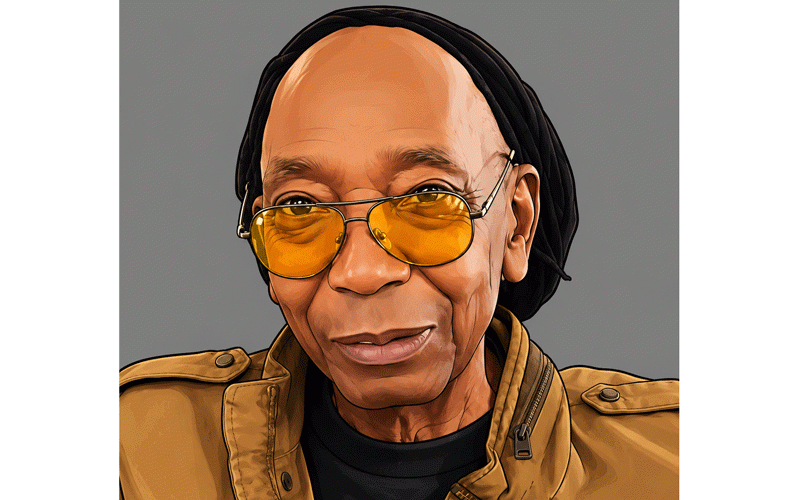
At the forefront of this movement is Palesa Nomthandazo Phumelele Modiga. Performing under the moniker Zoë Modiga, this multi-award-winning South African vocalist and independent creative architect is currently deploying her "Did I Do My Thing?" tour as the primary live-infrastructure node for her 2026 opus, The Vault.
By operationalising a twenty-year creative archive—material spanning from 2007 to 2025—Modiga is executing a systematic liquidation of dormant assets to solidify her position as a cornerstone of the contemporary African sonic grid.
- Technical architecture and instrumental proficiency
Modiga’s status is anchored by rigorous classical training at the National School of Arts, where she mastered the piano, clarinet, and vocals—technical competencies she now employs as an industrial-grade production framework.
By self-funding and managing the production through her independent label, Yelloëwax, she has effectively removed the middle-layer of institutional debt that historically stifles the long-term growth of independent African artists.
Her music, a sophisticated synthesis of jazz composition, African storytelling, and Motown soul, functions as an evocative, high-fidelity exploration of identity that transcends the limitations of conventional genre categorization.
- Global comparative analysis
To understand Modiga’s placement in the international market, one must evaluate her model alongside artists who similarly engineer their creative autonomy and cultural narrative:
Esperanza Spalding (American, Jazz/Neo-Soul): Like Modiga, Spalding is a multi-instrumentalist whose technical rigor in jazz composition has allowed her to maintain total creative sovereignty while achieving global institutional recognition.
Lianne La Havas (British, Soul/Folk): A peer in the utilization of acoustic textures and vocal precision, La Havas mirrors Modiga’s ability to turn deeply personal narratives into a universally resonant, sophisticated sonic language.
Fatoumata Diawara (Malian, World/Afro-Pop): Diawara shares Modiga's commitment to indigenous storytelling as an economic and cultural asset, utilizing her background as a storyteller and guitarist to bridge traditional African motifs with global luxury-market sensibilities.
- The operational diagnostic: curation as infrastructure
Modiga’s operational philosophy replaces the traditional "artist" archetype with the "creative architect." "Authenticity is the thing that exists when you are allowing of yourself to be exactly who it is that you are," Modiga observed, defining the strategic baseline of her operational model.
"It is the audacity that communicates... and you have to be a little bit delusional in your audacity to express freely." Through her production tag, "Most," she has bifurcated her output, creating a scalable model for her creative influence that exists independently of her vocal performance.
The tour's venue selection—The Homecoming Centre (Cape Town), The Chairman (Durban), and The Lesedi at Joburg Theatre (Johannesburg)—is a calculated decision to prioritize acoustic integrity over high-volume capacity, signaling a premium shift in her brand positioning.
- The editorial verdict
The trajectory is clear: the era of the speculative, label-dependent performer is reaching its terminal phase. Modiga’s model—characterised by absolute autonomy, technical mastery, and the rigorous preservation of her archival narrative — provides a definitive roadmap for professional sustainability.
The market has received its diagnosis: the shift toward total creative and institutional sovereignty is no longer a luxury; it is the fundamental requirement for participating in the global sonic elite.
Grant Notho Khumalo is a media architect and strategist bridging African creative assets with global sovereign investment. A market infrastructure specialist for The Zimbabwe Independent and NewsDay, he drives regional value through clinical global analysis.
Follow on X: @TotemGrant