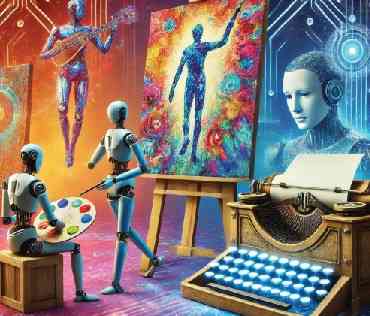
Artificial intelligence has entered the arts not as a silent assistant, but as a powerful generative force capable of producing images, music, text, and performances that increasingly resemble human expression.
What once demanded years of practice, emotional labour, and cultural immersion can now be simulated in seconds by algorithms trained on vast archives of human creativity.
While this technological shift is frequently framed as progress, it raises profound ethical and legal questions about authorship, ownership, and the future of artistic labour.
The central concern is no longer whether AI can create art, but whether existing systems are equipped to protect the rights and dignity of human creators.
At the core of the ethical crisis surrounding AI in the arts is the issue of copyright infringement through data extraction.
Most generative AI systems are trained on copyrighted works music, visual art, literature, and performances without the explicit consent of creators.
This practice undermines foundational principles of intellectual property law, which exist to protect originality, labour, and economic rights.
A solutions-based response requires the development of consent-based training models, where artists can choose whether their work is included in datasets. Such systems should be supported by opt-in and opt-out mechanisms, transparent documentation of training sources, and legally binding licensing agreements.
- Time running out for SA-based Zimbos
- In Full: Nineteenth post-cabinet press briefing: July 05, 2022
- Sally Mugabe renal unit disappears
- Epworth eyes town status
Keep Reading
These measures would align AI development with existing copyright frameworks rather than bypassing them.
Another viable solution lies in the creation of collective licensing and royalty systems for AI training, similar to those used in the music industry.
Under this model, creators whose works contribute to AI datasets would receive compensation through collecting societies or digital rights organisations.
Advances in blockchain and digital watermarking can further support this process by enabling traceability of creative works used in training datasets.
Rather than treating AI as an exception to copyright law, policymakers must update legal frameworks to recognise AI training as a form of use that requires permission and remuneration.
Beyond legality, the question of voice remains deeply ethical. Human voice in the arts carries identity, memory, accent, and lived experience.
AI-generated voices and styles, while technically convincing, lack embodiment and accountability.
When these synthetic outputs circulate without disclosure, they risk deceiving audiences and diluting the cultural value of human expression.
A practical and enforceable solution is mandatory labelling of AI-generated content, particularly in music, visual arts, literature, and advertising.
Such labelling would protect audiences, preserve trust, and ensure that human creators are not invisibly replaced by automated systems.
The aesthetics of creativity are also being reshaped by algorithmic logic.
AI systems optimise for patterns and popularity, often reinforcing dominant styles while marginalising experimental, indigenous, or disruptive forms of expression.
To counter this, cultural institutions, funding bodies, and education systems must actively support human-led creativity and culturally rooted art forms.
Public arts funding can prioritise projects that foreground human authorship or critically interrogate technology.
Rather than rejecting AI outright, artists should be supported to engage with it reflexively as a subject of critique, resistance, and ethical exploration.
Economic displacement presents another urgent challenge. As AI-generated content becomes cheaper and faster to produce, human artists face shrinking opportunities and income insecurity.
A solutions-oriented approach requires recognising creative work as labour deserving of protection. Governments and cultural regulators can introduce minimum pay standards, platform accountability laws, and protections against unfair competition from automated content.
In regions where creative economies are already fragile, such as much of the Global South, these measures are essential to prevent further marginalisation of artists.
Education also plays a critical role in shaping ethical futures for AI and the arts.
Rather than positioning AI as a shortcut to creativity, curricula should emphasise ethical literacy, copyright awareness, and cultural responsibility.
Young creators must be equipped to understand where data comes from, whose labour underpins AI systems, and how to assert their rights.
By embedding ethics and intellectual property education into arts and media studies, societies can cultivate informed creators who use technology intentionally rather than exploitatively.
Ultimately, the challenge posed by AI in the arts is not purely technological it is legal, cultural, and moral.
AI does not eliminate the need for copyright; it intensifies it.
The path forward lies in updated copyright laws, transparent AI governance, artist-centred licensing models, and ethical cultural policy.
When properly regulated, AI can coexist with human creativity as a tool rather than a substitute.
When the machine sings, the question is not whether it sounds beautiful.
The deeper question is whether the systems behind it respect the voices that taught it how to sing.
Defending human creativity is not an act of resistance to progress it is a demand for justice, accountability, and cultural integrity in an age of intelligent machines.
n Raymond Millagre Langa is a multidisciplinary creative and researcher whose work integrates arts, education, and social advocacy to address youth-centred development challenges. He is the founder of Indebo Edutainment Trust, where he advances edutainment as a research-informed tool for education, community engagement, and social change.